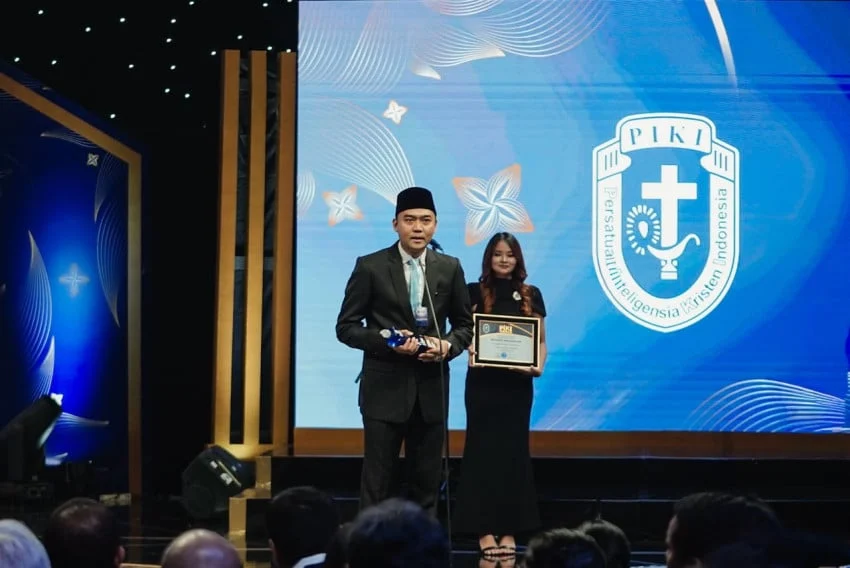
JAKARTA — In a significant recognition of ongoing efforts to foster religious tolerance and protect fundamental rights in Indonesia, Special Staff to the Minister of Religious Affairs Gugun Gumilar was officially awarded the prestigious Freedom of Worship Activist category at the PIKI Awards 2026. The high-profile ceremony, organized by the Indonesian Christian Intelligent Association (Persatuan Inteligensia Kristen Indonesia or PIKI), took place on Sunday, October 25, 2026, drawing prominent figures from government, religious institutions, academia, and civil society organizations.
The accolade serves as a formal acknowledgment of Gumilar’s unwavering dedication, policy advocacy, and grassroots engagement aimed at safeguarding the freedom of worship and nurturing social cohesion within Indonesia’s pluralistic society. As a key advisor within the Ministry of Religious Affairs, Gumilar has consistently positioned religious moderation as a core pillar of state policy, actively intervening in local disputes and ensuring that minority communities can practice their faiths without intimidation or administrative hurdles.
Reflecting on the honor during his acceptance speech, Gumilar emphasized that the recognition transcends personal achievement. Instead, he framed the award as a collective tribute to the countless stakeholders, civil servants, religious leaders, and community activists who labor tirelessly behind the scenes to maintain interfaith harmony across the archipelago.
"I extend my deepest gratitude to PIKI for this appreciation. However, for me, this award is not about personal achievement. It is a form of tribute to all parties who have continuously worked, struggled, and taken a part in maintaining harmony and ensuring that every citizen can exercise their right to worship according to their beliefs," Gumilar stated during the event.
He further reiterated that religious freedom and the freedom to worship are non-negotiable constitutional rights guaranteed under the 1945 Constitution of the Republic of Indonesia. According to Gumilar, protecting these rights cannot be relegated solely to the central government or law enforcement agencies. Rather, it demands an active, participatory approach involving all elements of society, including grassroots faith leaders, mass organizations, academic institutions, and cross-faith communities.
The Background and Significance of the PIKI Awards 2026
The PIKI Awards have steadily grown in stature as one of Indonesia’s premier civilian honors recognizing contributions to democracy, pluralism, and religious tolerance. Organized annually by the Indonesian Christian Intelligent Association, the awards seek to spotlight individuals and institutions that demonstrate exceptional courage, intellectual rigor, and policy effectiveness in defending minority rights and mitigating religious friction.
In recent years, Indonesia—despite its foundational national motto of Bhinneka Tunggal Ika (Unity in Diversity)—has continued to grapple with localized challenges regarding places of worship, administrative hurdles for minority religious groups, and occasional flare-ups of intolerance driven by identity politics. Against this backdrop, the 2026 edition of the PIKI Awards placed a heavy emphasis on evaluating candidates based on tangible field actions rather than purely rhetorical commitments.
The selection committee highlighted Gumilar’s proactive approach to resolving protracted disputes involving places of worship as a primary catalyst for his victory. By bridging the gap between local communities, regional administrations, and religious minorities, Gumilar’s tenure as Special Staff has been marked by a shift from reactive crisis management to proactive diplomacy and dialogue.
Chronology of Engagement: From Policy to Practice
Gumilar’s recognition at the PIKI Awards 2026 is deeply rooted in a series of high-profile interventions and policy implementations that have characterized his tenure at the Ministry of Religious Affairs. Observers note that his recognition is the culmination of consistent field-level engagement rather than a single isolated event.
A notable milestone in this trajectory occurred when Gumilar undertook a direct inspection visit to the Indonesian Christian Church (Gereja Kristen Jawa or GKJ) Nusukan in Solo, Central Java. The visit was designed not merely as a symbolic gesture, but as a concrete affirmation of the state’s presence in guaranteeing the constitutional rights of the congregation. During the inspection, Gumilar engaged directly with local church leaders, congregation members, and regional authorities to review administrative compliance, foster community dialogue, and preemptively defuse potential tensions regarding the utilization of the worship facility.
This proactive fieldwork established a blueprint for how the Ministry of Religious Affairs under the current administration intends to handle localized worship disputes: early intervention, transparent communication, and strict adherence to constitutional guarantees rather than yielding to exclusionary pressures from intolerant groups.
Data and Context: The State of Religious Freedom in Indonesia
To fully contextualize the importance of the PIKI Awards 2026 and Gumilar’s recognition, it is essential to examine the broader empirical landscape of religious freedom and tolerance in Indonesia. Various civil society watchdogs, including the Wahid Institute, Setara Institute, and the National Commission on Human Rights (Komnas HAM), have consistently monitored violations related to freedom of religion and worship across the country.
While Indonesia remains broadly peaceful and moderate, data from recent years indicates that restrictions on building places of worship and administrative discrimination remain the most frequent challenges faced by religious minorities. Bureaucratic hurdles often stem from the stringent implementation of Joint Ministerial Regulations (PBM) regarding the establishment of houses of worship, which historically have been susceptible to exploitation by local interest groups seeking to block minority facilities.
Within this data-driven reality, officials like Gumilar who bridge the bureaucratic machinery of the state with grassroots religious communities play a vital role. By cutting through administrative red tape and asserting the supreme authority of the constitution over restrictive local ordinances, the Ministry of Religious Affairs has sought to lower the incidence of protracted worship disputes.
Institutional and Inter-Faith Reactions
The announcement of Gumilar’s award drew widespread praise from diverse religious organizations, academic circles, and human rights advocates across Indonesia. Representatives from various faith-based networks lauded the PIKI selection committee for honoring an official who demonstrates tangible accessibility and responsiveness to grassroots grievances.
Interfaith dialogue advocates point out that Gumilar’s operational style—characterized by direct site visits, active listening, and collaborative problem-solving—rebuilds public trust in state institutions. When minority communities see high-ranking government officials physically standing alongside them to guarantee their right to worship, it serves as a powerful deterrent against acts of intimidation by intolerant factions.
Furthermore, academic institutions specializing in sociology and religion have noted that the award reflects a growing institutional preference for inclusive governance. Scholars emphasize that managing a diverse population of over 275 million people across thousands of islands requires continuous negotiation between national legal frameworks and local socio-cultural dynamics. In this context, proactive bureaucrats act as indispensable shock absorbers who prevent localized friction from escalating into systemic national conflict.
Broader Impact and Policy Implications
The recognition of Gugun Gumilar at the PIKI Awards 2026 carries several profound implications for the future of religious governance and civil-state relations in Indonesia.
First, it sets an institutional benchmark for public servants within the Ministry of Religious Affairs and other related bodies. By elevating an official known for field-level engagement and minority protection, the award signals that career advancement and public recognition are increasingly tied to measurable contributions toward social cohesion and human rights protection.
Second, it reinforces the state’s narrative of inclusive nationalism. In an era where populist politics and religious polarization remain potent global phenomena, Indonesia’s ability to showcase functional, proactive mechanisms for protecting minority rights reinforces its standing as a moderate, democratic leader in the Southeast Asian region.
Finally, the event underscores the enduring importance of collaboration between the state and civil society organizations like PIKI. Government policy alone cannot eliminate prejudice or foster genuine tolerance; it requires the active participation of religious intellectuals, educators, community leaders, and activists who can shape public discourse at the grassroots level.
As Indonesia continues to navigate the complexities of its vast religious and cultural diversity, the acknowledgment of leaders who champion the freedom of worship serves as both an encouragement for continued reform and a reminder of the vigilance required to maintain the nation’s foundational motto: Bhinneka Tunggal Ika.