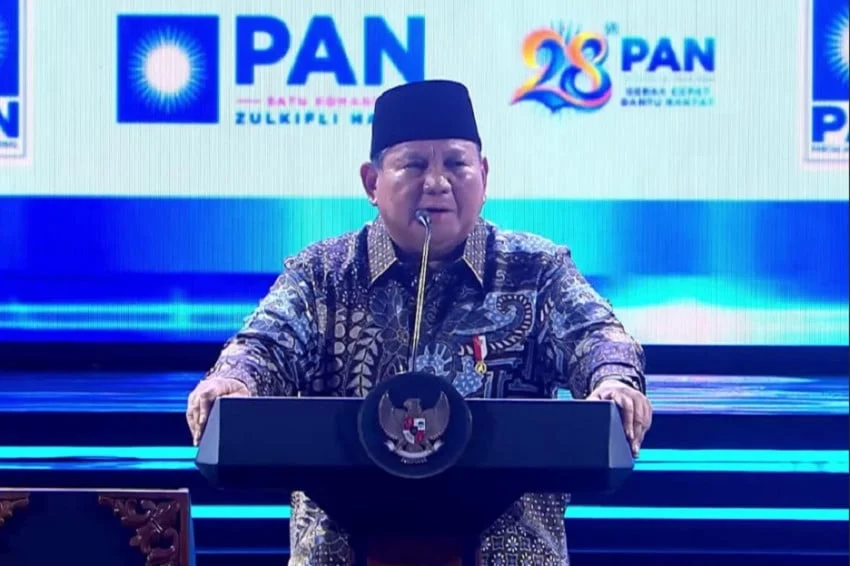
President Prabowo Subianto has candidly expressed his personal aversion to relying on pre-drafted scripts during public addresses, noting that professional advisors frequently urge him to adhere strictly to prepared texts. The remarks were made during his keynote address at the grand celebration marking the 28th anniversary of the National Mandate Party (PAN), held at the Jakarta International Convention Center (JICC) in Senayan, Jakarta.
Addressing a packed auditorium of party loyalists, lawmakers, and political figures, the Indonesian head of state shared a lighthearted yet revealing glimpse into the tension between his natural speaking style and the counsel of his communications team. The revelation underscores a distinctive characteristic of Prabowo’s political persona: a preference for spontaneous, conversational rhetoric over tightly managed institutional messaging.
The setting for this disclosure was an event of high political significance. The anniversary celebration served not only as a milestone for one of Indonesia’s prominent political parties within the ruling coalition but also as a platform for alignment among key stakeholders of the national government. Yet, rather than delivering a heavily vetted, policy-dense speech typical of state functions, Prabowo chose to pivot toward a more personal and unrehearsed dialogue with the audience.
The Tension Between Spontaneity and Protocol
During his speech, Prabowo acknowledged that his tendency to deviate from prepared talking points often creates anxiety among his aides, political consultants, and communication strategists. He revealed that experts consistently advise him to stick to the script to mitigate political risks and maintain message discipline.
"Saudara sekalian, berkali-kali di manapun saya sampaikan beberapa hal, mungkin yang sudah dengar pidato-pidato saya mungkin bosan. Tapi tidak apalah. Toh saudara sudah undang saya ke sini. Benar? Salah panitia undang saya," Prabowo remarked, reflecting on his recurring themes and playfully shifting accountability to the event organizers for inviting an unpredictable speaker.
Translating to his broader communicative philosophy, the President elaborated on the core friction point with his advisors. "I am always told by advisors, political experts, and communication experts, ‘Mr. Prabowo, do not speak without a text. You must use a text.’ But what can I do? I prefer to speak naturally and as I am."
This stylistic preference has long defined Prabowo’s public engagements. Throughout his decades-long career in public service—spanning his military tenure, opposition leadership, and eventual ascension to the presidency—observers have noted his transition from formal military briefings to passionate, populist oratorical displays. While text-dependent speeches are standard protocol for heads of state to ensure precise diplomatic phrasing and policy accuracy, Prabowo’s inclination toward off-the-cuff remarks has frequently energized crowds while occasionally keeping his communications team on edge.
Background Context of the Event and PAN Anniversary
The 28th-anniversary celebration of the National Mandate Party (PAN) was a major fixture on the Indonesian political calendar. Founded in the wake of the 1998 Reformasi movement by prominent figure Amien Rais and a coalition of intellectuals and activists, PAN has evolved into a stable anchor within successive government coalitions.
The presence of President Prabowo at the milestone event highlighted the solid strategic partnership between the executive branch and PAN leadership, notably party chairman Zulkifli Hasan. For PAN, hosting the sitting president at their anniversary underscores their integral role in the current administration and provides a platform to reinforce party solidarity ahead of future legislative cycles.
In the lead-up to the event, party organizers had anticipated a high-profile address outlining national achievements and future policy directions. Prabowo did touch upon key themes of national unity, economic resilience, and governance; however, his detour into the mechanics of his speechwriting process captured the most attention, humanizing the presidency and resonating with an audience accustomed to highly sanitized political discourse.
The Role of Speechwriting in Modern Indonesian Politics
In contemporary governance, presidential speeches are rarely left to chance. They are the culmination of hours of inter-agency coordination, policy review, and strategic framing. Ministries ranging from the State Secretariat to the Ministry of Foreign Affairs contribute data points, legal caveats, and programmatic updates to ensure that every public utterance by the head of state aligns with official state policy.
For a leader like Prabowo Subianto, balancing the rigorous demands of institutional communication with a personal desire for authenticity presents a continuous operational challenge. Communications scholars and political analysts note that while scripted speeches minimize the risk of diplomatic missteps or market-moving policy blunders, unscripted dialogues often foster a deeper emotional connection with the electorate.
When a president speaks off the cuff, audiences frequently perceive the message as more genuine and less filtered by political public relations. However, this approach carries inherent vulnerabilities. Unscripted remarks can occasionally be misinterpreted by financial markets, foreign governments, or domestic political opposition, forcing cabinet ministers and presidential spokespersons into retroactive clarification roles.
Fact-Based Analysis of Implications
Prabowo’s public admission at the PAN anniversary carries several distinct implications for his administration’s communication strategy and political positioning:
- Reinforcement of Populist Appeal: By openly admitting his dislike for teleprompters and prepared texts, Prabowo reinforces his image as a straightforward, unpretentious leader who values direct engagement over bureaucratic formality. This style resonates strongly with grassroots supporters who favor perceived authenticity over polished political theater.
- Challenges for Communications Staff: The President’s preference creates a high-stress environment for his media and policy advisors. Ensuring that national policy positions remain consistent while accommodating an unscripted executive style requires agile crisis communication and rapid response protocols from the Presidential Communications Office.
- Media Dynamics: Indonesian media outlets frequently capitalize on unscripted presidential remarks, extracting memorable soundbites that dominate news cycles. While this maintains high visibility for the administration, it shifts journalistic focus away from dense policy debates toward the stylistic nuances of the President’s delivery.
- Coalition Relations: Delivering such candid remarks in front of a key coalition partner like PAN signals a high degree of comfort and political security. It demonstrates that the President feels secure enough among political allies to drop formal diplomatic guard rails and share internal operational frustrations lightheartedly.
Chronology of Related Events
To understand the trajectory of Prabowo’s public speaking style, it is helpful to examine key milestones in his communications approach since taking office:
- October 2024: Following his inauguration, Prabowo’s early cabinet addresses emphasize discipline, nationalism, and anti-corruption measures, blending formal policy reading with impassioned impromptu exhortations to his ministers.
- Late 2024 to 2025: Throughout various regional visits and economic summits, observers note a recurring pattern where the President sets aside prepared remarks to directly address local grievances or share personal anecdotes with citizens.
- September 2026: During the 28th anniversary of PAN at JICC Senayan, Prabowo explicitly articulates his frustration with advisors who mandate speech texts, marking one of his most direct public acknowledgments of the internal debate surrounding his oratorical style.
Official Responses and Broader Reactions
While immediate opposition figures have occasionally scrutinized the ambiguity of unscripted executive statements, allies within the ruling coalition view Prabowo’s conversational approach as a sign of strong leadership confidence. Representatives from PAN lauded the President’s visit and his engaging address, emphasizing that the party remains fully aligned with his broader vision for national development.
Communication experts suggest that the administration may adopt a hybrid model moving forward: utilizing strict scripts for high-stakes international summits and formal state legislation, while permitting a more relaxed, conversational format during domestic party gatherings and grassroots engagements. This approach allows the President to maintain necessary diplomatic precision while preserving the personal touch that connects him with his voter base.
As the Prabowo administration continues to navigate domestic economic priorities and international partnerships, the tension between prepared policy texts and spontaneous rhetoric will likely remain a defining characteristic of his presidency—a testament to a leader who continuously seeks to bridge the gap between institutional protocol and personal authenticity.