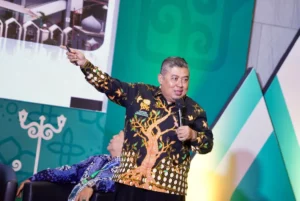
The intersection of ecological preservation and humanitarian resilience took center stage as Professor Haedar Nashir, General Chairperson of the Central Leadership (PP) Muhammadiyah, addressed environmental management and disaster mitigation strategies in Indonesia. Speaking at the opening ceremony of the National Working Meeting (Rakernas) held by the Disaster Resilience Institute—Muhammadiyah Disaster Management Center (LRB-MDMC) of PP Muhammadiyah, Haedar underscored that human engagement in disaster management, ecological conservation, and natural resource governance is fundamentally rooted in the theological obligation of humanity acting as khalifatullah fil ardh (stewards of God on Earth).
The high-profile gathering, hosted at the Center for Development and Empowerment of Vocational Teachers and Education Personnel (BBPPMPV) for Arts and Culture in the Special Region of Yogyakarta, brought together disaster responders, organizational leaders, and environmental advocates. Haedar’s address set a visionary tone for the organization’s future operations, merging Islamic jurisprudence with contemporary ecological science to address the escalating frequency of environmental crises in the archipelago.
The Theological and Practical Imperative of Environmental Stewardship
In his keynote address, Haedar elaborated on the premise that human beings bear an inherent responsibility to maintain ecological equilibrium and manage natural wealth wisely. Within the framework of Islam Berkemajuan (Progressive Islam), natural resources must be managed optimally, guided strictly by Islamic principles to secure societal welfare and collective prosperity.
"Natural resources must be managed to build a prosperous life and must not become a source of harm for humanity. This means building without destroying," Haedar stated to an audience of volunteers and officials. He argued that the domestic ecological challenges plaguing Indonesia—ranging from deforestation and watershed degradation to extreme weather events—are fundamentally tied to flawed human perceptions and exploitative treatments of nature.
To counteract these trends, Haedar advocated for the immediate formulation of an ecological management paradigm that rejects short-term capitalist exploitation in favor of sustainable, science-backed methodologies. "What should the paradigm be? Our task is to compile knowledge and systems, and that is where Muhammadiyah is called. Not capitalism that destroys and exploits," he asserted. By fostering resilient ecosystems, LRB-MDMC is tasked with safeguarding natural resources while upholding universal humanitarian values.
Contextualizing MDMC’s Role within Indonesia’s Disaster Landscape
To fully understand the weight of Haedar’s directives, it is essential to examine the broader geographical and socio-economic context of Indonesia. Straddling the Pacific Ring of Fire and situated between the Indian and Pacific Oceans, Indonesia remains one of the most disaster-prone nations on Earth. The country frequently contends with earthquakes, volcanic eruptions, tsunamis, landslides, and widespread hydro-meteorological hazards such as floods and prolonged droughts, which have been exacerbated by global climate change and unchecked land conversion.
Over the past two decades, organizations like the Muhammadiyah Disaster Management Center have evolved from ad-hoc volunteer networks into institutionalized, highly coordinated first responders. Established formally to streamline the organization’s humanitarian response, MDMC has gained national and international recognition for its rapid deployment capabilities, adherence to humanitarian standards, and emphasis on community-based disaster risk reduction (CBDRR).
The Rakernas serves as a critical annual milestone for MDMC to evaluate past operations, upgrade operational frameworks, and synchronize regional units with national disaster management strategies, particularly in coordination with the National Board for Disaster Management (BNPB).
Core Pillars of Resiliency: Sincerity, Adaptation, and Quality Leadership
During the plenary sessions following the opening remarks, Haedar outlined three foundational pillars necessary to sustain and elevate MDMC’s humanitarian mission in an increasingly complex global environment.
1. The Primacy of Sincerity (Keikhlasan)
Addressing the psychology of disaster response, Haedar highlighted that the primary driver behind MDMC’s decades-long efficacy is the unwavering sincerity embedded within the character of its volunteers. While professional logistics and modern equipment are indispensable, the moral fortitude of volunteers often bridges critical gaps during emergency phases.
"That is why, when others distance themselves from disasters, MDMC volunteer friends actually approach the disaster, trying to carry out humanitarian roles to prevent a wider crisis," Haedar observed. "That is where money becomes valueless if sincerity is strong."
2. Organizational Adaptability and System Automation
The second pillar focuses on institutional evolution. To remain relevant amidst shifting technological and geopolitical landscapes, MDMC must continuously update its operational methodologies. Haedar stressed that modernization must manifest as an automated organizational network capable of mobilizing instantly upon the onset of a crisis.
"When a disaster occurs in the homeland, before long MDMC moves. The system automatically moves, the network is strong. That is why MDMC has earned many awards," he noted, emphasizing that bureaucratic agility is paramount for minimizing loss of life and property.
3. Leadership Regeneration and Grassroots Education
The third pillar addresses human capital development and proactive mitigation. Haedar emphasized that the long-term sustainability of humanitarian movements relies heavily on continuous leadership regeneration to produce a younger, highly resilient cadre of professionals.
Furthermore, Haedar drew attention to the unique resilience found within non-urban and rural communities across Indonesia. Generations of living in hazard-prone environments have forged localized survival mechanisms among remote populations; however, these communities often lack formal scientific frameworks for disaster mitigation.
"Sometimes when a disaster occurs, they do not even know it is a disaster. Therefore, our task is to convey knowledge so that community disaster mitigation is not carried out arbitrarily," Haedar explained. This underscores the necessity of embedding disaster education into the cultural fabric of rural Indonesia, transforming reactive crisis response into proactive community preparedness.
Implications for National Resilience and Future Outlook
The strategic directives issued by PP Muhammadiyah at the LRB-MDMC Rakernas carry significant implications for civil society engagement in Indonesia. By framing environmental degradation as a spiritual and ethical failure while positioning disaster resilience as a systemic, scientific necessity, Muhammadiyah continues to bridge the gap between religious duty and secular governance.
As the organization moves forward, the integration of ecological ethics into disaster management offers a viable blueprint for sustainable development in a developing nation balancing economic growth with vulnerability to climate change. Through enhanced educational outreach, institutional automation, and a steadfast commitment to volunteerism, LRB-MDMC reinforces its position as a pillar of national resilience—protecting both the vulnerable populations of the archipelago and the fragile ecosystems they call home.