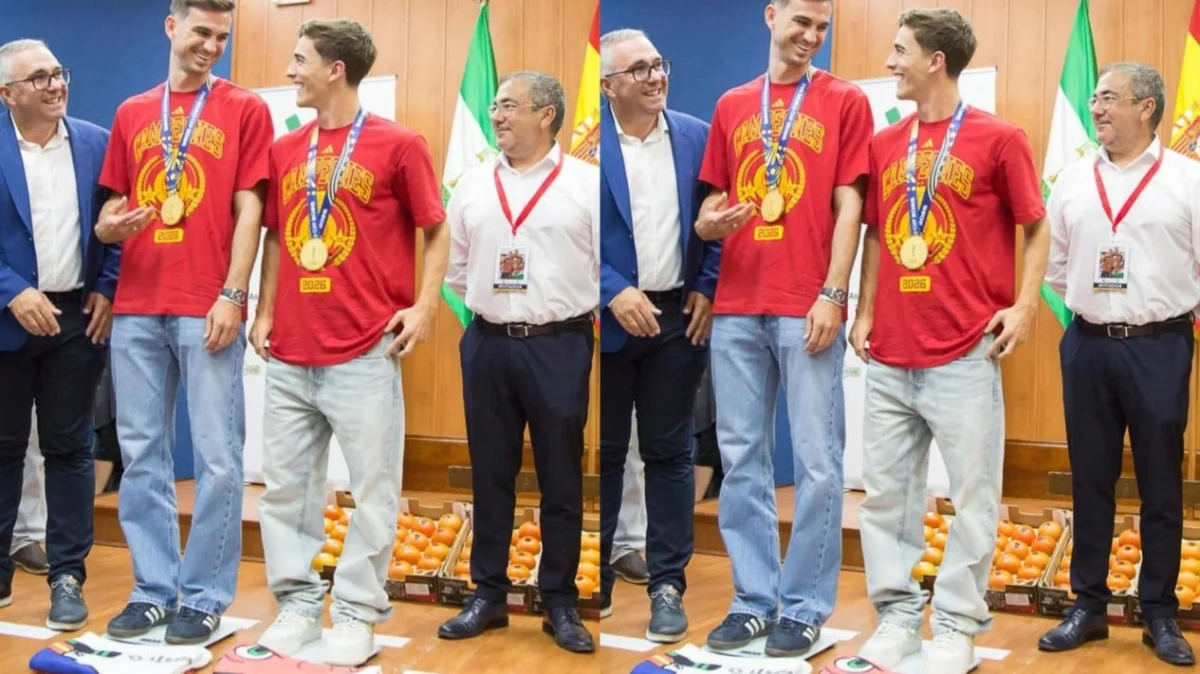
The jubilant celebrations in Spain following their dramatic FIFA World Cup 2026 victory over Argentina continue to reverberate across the nation, with particular attention drawn to the heartwarming and unconventional reception afforded to their triumphant national team players. While financial rewards are a customary aspect of acknowledging championship success, the residents of Los Palacios y Villafranca, the hometown of midfielders Fabián Ruiz and Gavi, opted for a deeply symbolic and agriculturally rooted tribute: a donation of tomatoes equivalent to the players’ body weight. This distinctive honor underscores the region’s identity and its proud tradition of celebrating sporting achievements.
The unique ceremony took place on Tuesday, marking a poignant return for Ruiz and Gavi to their roots following Spain’s historic triumph. The duo, instrumental in La Roja’s journey to lifting the coveted World Cup trophy after a 16-year drought, were escorted to the local town hall where they were weighed. This measurement then dictated the precise quantity of the region’s renowned tomatoes to be gifted to them as a token of immense pride and appreciation for their dedication and success on the global stage.
This peculiar yet deeply meaningful tradition is not a novel occurrence for Los Palacios y Villafranca. It was previously bestowed upon another celebrated son of the town, Jesús Navas, who was a vital member of the Spanish squad that conquered the world in 2010. Navas, a veteran winger with extensive experience for both Sevilla and Manchester City, has been a cornerstone of Spanish footballing success, also contributing to their UEFA European Championship victories in 2012 and, more recently, in 2024.
A Deep-Rooted Tradition of Agricultural Appreciation
Fabián Ruiz, currently plying his trade for Paris Saint-Germain, tipped the scales at 84 kilograms. Gavi, the dynamic Barcelona midfielder, registered a weight of 68 kilograms. These figures, meticulously recorded and publicly acknowledged, translate into substantial quantities of fresh, locally grown tomatoes. This practice serves as a powerful testament to the strong agricultural heritage of Los Palacios y Villafranca, a municipality situated in the southern Spanish region of Andalusia. The area is not only a significant producer of high-quality tomatoes but has also increasingly become recognized as a fertile ground for nurturing exceptional footballing talent.
The significance of this tradition extends beyond mere local pride. It weaves together the identity of the community – its agricultural prowess and its burgeoning reputation as a cradle of footballing stars. By presenting these young men with produce from their homeland, the community is reinforcing a connection to their roots and acknowledging that their success on the international football scene is intertwined with the very soil from which they hail.
Chronology of Spanish Footballing Success and Local Recognition
The recent World Cup victory in 2026 marks a significant milestone in Spanish football history. The journey to this pinnacle of achievement has been a long and arduous one, punctuated by periods of brilliance and moments of near misses.
- 2010 FIFA World Cup: Spain, under Vicente del Bosque, secured their first-ever World Cup title in South Africa, defeating the Netherlands 1-0 in the final. This victory marked the beginning of a golden era for Spanish football. Jesús Navas was part of this historic squad, and his return to Los Palacios y Villafranca was met with this unique tomato tribute.
- UEFA Euro 2012: Spain continued their dominance by winning their second consecutive European Championship, thrashing Italy 4-0 in the final. Fabián Ruiz was also a part of this victorious generation, further solidifying his status as a key player for the national team.
- UEFA Euro 2024: Just two years prior to the 2026 World Cup triumph, Spain once again showcased their continental prowess by winning the UEFA European Championship. This victory served as a crucial building block and a confidence booster for the squad heading into the World Cup.
- 2026 FIFA World Cup: The culmination of years of development and the harnessing of exceptional talent saw Spain emerge victorious in the 2026 World Cup, held in North America. The final match, a tense affair against Argentina, concluded with a 1-0 scoreline in favor of La Roja, ending a 16-year wait for the most prestigious trophy in international football. Gavi, a rising star, secured his first major international trophy with the senior national team.
The continuity of the tomato tribute, now extended to Ruiz and Gavi, highlights the enduring nature of this local custom. It serves as a tangible link between past glories and present achievements, celebrating each generation of footballers who have brought honor to Los Palacios y Villafranca.
The Significance of the Tomato as a Symbol
The choice of tomatoes is not arbitrary. Los Palacios y Villafranca is a region deeply intertwined with agriculture, and tomatoes are a staple crop. This choice imbues the award with a profound sense of place and identity. It is a recognition of the players’ origins and a celebration of the community’s livelihood and agricultural heritage. The act of gifting a portion of their own produce is a gesture of profound solidarity and pride, signifying that the community shares in their success and feels a direct connection to their achievements.
This agricultural tribute stands in stark contrast to the more conventional monetary rewards often associated with sporting victories. While financial compensation is undoubtedly important for professional athletes, the tomato tradition offers a form of appreciation that is deeply personal and culturally significant. It speaks to a community that values its roots and finds unique ways to express its pride in its sons who have reached the global zenith.
Wider Implications and Analysis
The unique celebration of Fabián Ruiz and Gavi offers a fascinating insight into the diverse ways sporting success can be recognized and celebrated. In an era where global sports often emphasize commercialization and standardized accolades, this local tradition from Los Palacios y Villafranca stands out as a powerful reminder of the importance of community, heritage, and deeply personal forms of appreciation.
The success of the Spanish national team, culminating in the 2026 World Cup victory, has significant implications beyond the immediate joy of the fans. It bolsters the sport’s popularity within Spain, potentially inspiring a new generation of footballers. The economic impact of such a victory can also be substantial, with increased tourism, merchandise sales, and media interest. Furthermore, the continued success of players like Ruiz and Gavi, who have emerged from smaller communities, can inspire aspiring athletes from similar backgrounds, demonstrating that talent and dedication can indeed lead to global recognition.
The longevity of this tradition, stretching back to Jesús Navas’s triumph in 2010 and now continuing with Ruiz and Gavi, suggests a strong cultural foundation. It signifies a community that actively embraces and celebrates its local heroes in a way that is authentic to its identity. This practice can foster a stronger sense of belonging and pride among residents, reinforcing the idea that the success of their athletes is a collective achievement.
The fact that both Ruiz and Gavi, despite their international careers and association with major European clubs, have embraced this local tradition with enthusiasm speaks volumes about their connection to their hometown. It highlights a groundedness and an appreciation for the community that supported them from their earliest days. This reciprocal relationship between the athletes and their home base is a powerful narrative that resonates beyond the football pitch.
As Spain revels in its World Cup glory, the story of Fabián Ruiz and Gavi, honored with a weight of tomatoes, serves as a charming and enduring testament to the multifaceted nature of celebration. It is a story that underscores the enduring power of community, the richness of cultural traditions, and the profound pride that can be found in the simplest, yet most meaningful, of gestures. The fertile fields of Los Palacios y Villafranca have not only produced bountiful harvests but have also cultivated champions, who are now symbolically returned to the land that nurtured their dreams.