The world of sports is brimming with diversity, offering a spectacle of athleticism and strategy that captivates audiences globally. Among these, Southeast Asia boasts a unique and exhilarating sport that seamlessly blends the aerial grace of volleyball with the powerful footwork of soccer: Sepak Takraw. This captivating game, played without the use of hands, has carved a significant niche for itself, enjoying enduring popularity across nations like Indonesia, Thailand, Malaysia, and the Philippines. Its distinctive name itself tells a story of its origins, a linguistic fusion that hints at its rich cultural heritage.
The name "Sepak Takraw" is a compelling amalgamation of two distinct languages, reflecting the sport’s cross-cultural roots. "Sepak," derived from the Malay language, directly translates to "to kick." Complementing this is "Takraw," a word from the Thai language, which refers to a "woven rattan ball." Therefore, Sepak Takraw literally means "to kick the rattan ball." This nomenclature was officially solidified following a notable match between Malaysia and Thailand in Kuala Lumpur in 1960, marking a significant milestone in the sport’s formal recognition.
Before its unified designation, the sport held various regional names. In Malaysia, it was known as "Sepak Raga Jaring." The addition of the term "jaring" (net) is attributed to Hamid Mydin, widely regarded as a pivotal figure in the evolution of Sepak Takraw. In Penang, around 1945, Mydin incorporated the net into the game, distinguishing it from the traditional "Sepak Raga," which was played without one. This adaptation was crucial in shaping the modern iteration of the sport.
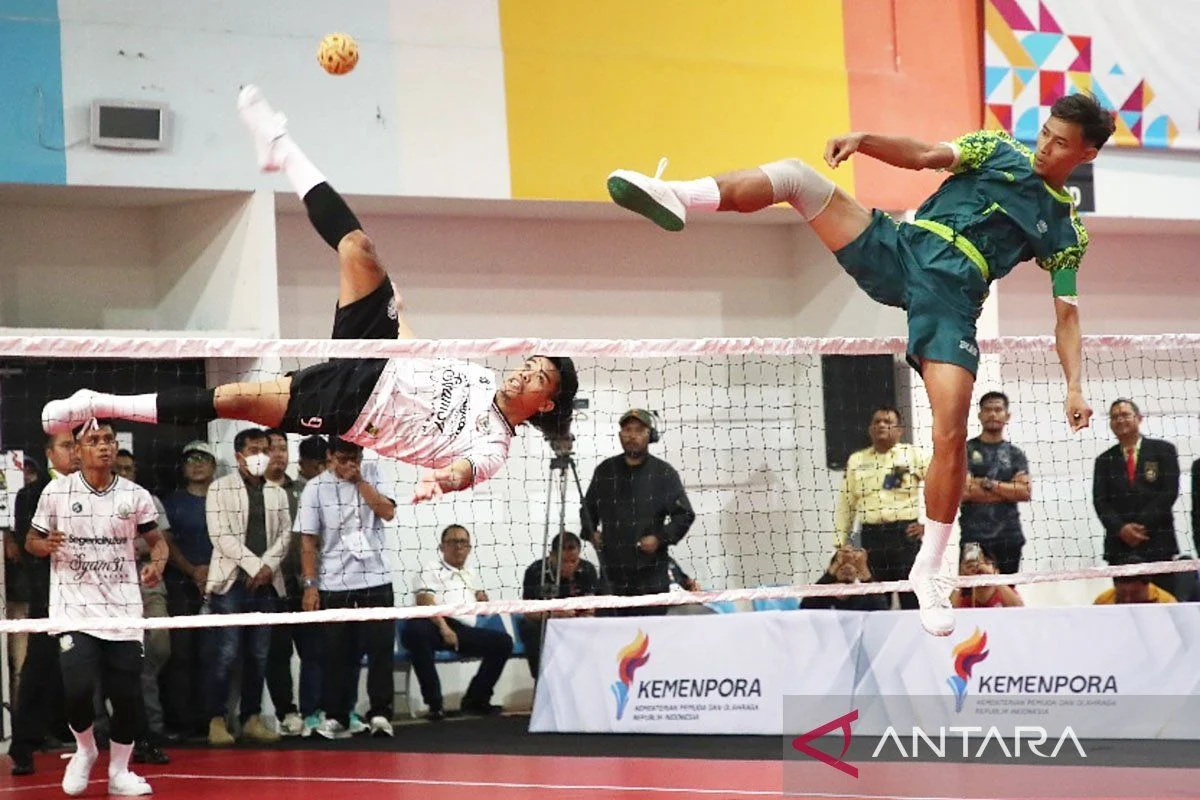
Often dubbed "kick volleyball" due to its striking resemblance in play to volleyball but executed with feet and other body parts, Sepak Takraw is fundamentally a team sport. Typically, teams consist of two to four players, competing on a court that closely resembles that of badminton. The essence of the game lies in its restricted use of limbs. Players are permitted to use their feet, knees, shoulders, chest, and head to propel the ball over the net, a rule that demands exceptional agility, coordination, and aerial prowess. This limitation transforms the game into a dazzling display of acrobatic feats, where players execute spectacular kicks, bicycle kicks, and headers to outmaneuver their opponents.
On the international stage, the governance of Sepak Takraw falls under the purview of the International Sepaktakraw Federation (ISTAF). Established in 1988, ISTAF plays a crucial role in standardizing rules, organizing global competitions, and promoting the sport worldwide. Its establishment marked a significant step towards unifying the sport’s administration and fostering its growth on a global scale.
The sport’s widespread appeal is evident in its myriad local names across different countries. In Indonesia, Brunei, Malaysia, and Singapore, it is known as Sepak Raga. The Philippines has its own version called Sipa, while Myanmar refers to it as Chinlone. Thailand, as mentioned, uses the term Takraw. These diverse appellations underscore the sport’s deep-seated presence and adaptation within various cultural contexts throughout Asia.
The Ancient Roots and Evolution of Sepak Takraw
The historical trajectory of Sepak Takraw suggests its origins trace back to Malaysia approximately 500 years ago. It gained considerable traction within royal courts during the 15th century, a testament to its perceived elegance and skill. By the 16th century, the sport had traversed borders, reaching Indonesia where it became known as Sepak Raga. Its popularity began to surge across Southeast Asia in the 1940s, coinciding with the nascent stages of formal rule development.
A landmark event in the sport’s formalization occurred in 1945 with the first official competition held in Penang, then under the banner of "Sepak Raga Jaring." This event was instrumental in standardizing the game’s mechanics and rules. The formation of the Malaysian Sepak Raga Federation in Penang in 1960 further cemented its organizational structure. A significant moment arrived in 1965 when Sepak Takraw was included in the Southeast Asian Peninsula Games. It was during this prestigious regional event that the sport was officially christened "Sepak Takraw," a name that would soon resonate across international sporting arenas.
Intriguingly, some historical accounts suggest that Sepak Takraw may have been introduced to Southeast Asia by Chinese travelers, positing a shared ancestry with football. This theory links Sepak Takraw to Cuju, an ancient Chinese ball game recognized by FIFA as potentially the earliest form of modern football. Cuju, primarily an ancient military exercise, involved soldiers kicking a leather ball, with the objective of keeping it airborne for as long as possible. This historical connection highlights the universal appeal of ball-kicking games and their evolution across millennia and continents.
The Strategic Dance: Understanding Sepak Takraw Rules and Gameplay
The intricacies of Sepak Takraw are defined by a set of fundamental rules that govern player positioning, gameplay, and scoring. The sport is played on a court similar in dimensions to a badminton court, divided by a net. Each team typically comprises three players: a ‘Tekong’ (server), a ‘Feeder,’ and a ‘Killer.’
Player Positions and Roles:
- Tekong: The Tekong is the primary server, responsible for initiating each rally. Their position is crucial as a strong and accurate serve can immediately put the opposing team on the defensive.
- Feeder: The Feeder’s role is to set up offensive plays. They skillfully control the ball, preparing it for the Killer’s powerful strike. Their precision and vision are vital for creating scoring opportunities.
- Killer: As the name suggests, the Killer is the primary attacker. They utilize their acrobatic skills to execute powerful spikes and volleys over the net, aiming to score points by making the ball unreturnable by the opposition.
Gameplay Mechanics:
The game commences with a coin toss to determine which team serves first. The Tekong then initiates the rally by tossing the ball from their hand and kicking it over the net into the opponent’s court. Once the serve is returned, the rally ensues. Players are forbidden from using their hands or arms. Instead, they must employ their feet, knees, chest, shoulders, or head to keep the ball in play and direct it towards the opponent’s side. The objective is to force the opponent to make an error or to land the ball within their court boundaries.
The interplay between the Feeder and the Killer is a cornerstone of effective strategy. The Feeder’s ability to deliver accurate passes allows the Killer to unleash devastating attacks. The defensive players must be equally adept at anticipating these attacks, using their bodies to block or deflect the ball, and initiating counter-offensives. The speed and agility required to react to a flying Takraw ball, often at incredible heights and speeds, are astounding.
Scoring System:
A point is awarded to a team each time the ball is successfully grounded in the opponent’s court, or if the opponent commits a fault. A fault can include hitting the ball out of bounds, touching the net with any part of the body, or making an illegal contact (e.g., using hands). A set is won by the first team to reach 21 points. However, a team must win by a margin of at least two points. A match is typically decided by the best of three sets. This scoring system ensures that games remain competitive and often reach thrilling conclusions.
The dynamic nature of Sepak Takraw, characterized by its fast-paced rallies and spectacular aerial maneuvers, makes it a visually engaging sport. The limited contact points and the necessity for players to use their entire bodies to control and direct the ball demand an extraordinary level of physical conditioning, flexibility, and hand-eye (or rather, foot-eye) coordination.
Broader Implications and International Recognition
The recent developments concerning the resolution of dual leadership in Indonesian Sepak Takraw have been met with considerable optimism. The International Sepaktakraw Federation (ISTAF) has expressed its pleasure regarding the successful resolution of these internal organizational challenges. This signifies a crucial step towards unified governance and a more cohesive approach to developing the sport within Indonesia, a nation with a deep-seated passion for Sepak Takraw. Such resolutions are vital for ensuring the sport’s continued growth and its ability to compete effectively on the international stage.
The Menpora (Minister of Youth and Sports) has also indicated that the resolution of this dualism is a positive development, and the focus now shifts to ensuring smooth operations and further development of the sport. This governmental backing and recognition are instrumental in securing resources, fostering grassroots programs, and ultimately enhancing the performance of national athletes. The successful resolution of leadership disputes in sports federations is often a prerequisite for unlocking their full potential and attracting sustained investment.
The dualism within Indonesian Sepak Takraw, which the Indonesian National Sports Committee (KONI) and the Indonesian Olympic Committee (KOI) have worked to resolve, highlights the complexities of sports governance. The fact that these prominent sporting bodies have successfully mediated the situation underscores their commitment to fostering a healthy and functional sporting ecosystem. Their efforts are not only crucial for Sepak Takraw but also serve as a model for resolving similar challenges in other sports, as the Menpora has alluded to the need for similar resolutions in three other sports.
The enduring appeal of Sepak Takraw lies in its unique blend of athleticism, cultural heritage, and strategic depth. As the sport continues to evolve and gain wider recognition, its ability to captivate audiences with its acrobatic displays and fast-paced action remains undeniable. The ongoing efforts to streamline its governance and promote its development promise a bright future for this extraordinary Southeast Asian sport. The world is increasingly taking notice of this thrilling discipline, recognizing it not just as a regional pastime but as a legitimate and exciting global sport in its own right.