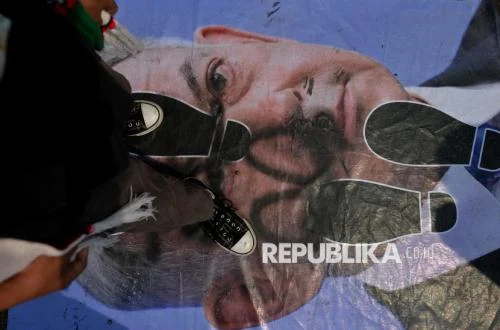
Jakarta, Indonesia, October 12, 2025 – A powerful demonstration of international solidarity with Palestine unfolded in Jakarta, as thousands of participants in the "Indonesia Lawan Genosida, Dukung Palestina Merdeka" (Indonesia Fights Genocide, Supports Free Palestine) rally took to the streets. The protest, marked by the symbolic act of stomping on a poster depicting Israeli Prime Minister Benjamin Netanyahu, vehemently condemned all forms of alleged genocide against the residents of Gaza perpetrated by Israel. Demonstrators vociferously demanded immediate and permanent ceasefire in Palestine and championed the cause of Palestinian independence, reflecting a growing global outrage over the protracted conflict.
This surge of public indignation, however, occurs against a complex geopolitical backdrop, particularly the precarious relationship between Washington and Tehran. After weeks of escalating tensions that brought the Middle East to the brink of wider conflict, a fragile ceasefire has seemingly settled between the United States and Iran. While this period has seen a de-escalation in the intensity of direct and proxy attacks, it has done little to resolve the fundamental drivers of the conflict or chart a clear path forward. Beneath this superficial calm, a more intricate and often volatile dynamic emerges: the relationship between former U.S. President Donald Trump and Israeli Prime Minister Benjamin Netanyahu, a partnership that, according to many analysts, propelled both nations towards a confrontation from which neither seemed to have a clear exit strategy.
Reports from British media outlets have offered a distinct lens through which to understand the recent escalations, particularly focusing on the assertion that Prime Minister Netanyahu was not merely a passive partner in the recent American-led push for confrontation, but rather a principal architect. These analyses suggest that Netanyahu’s persistent advocacy for a hardline stance against Iran heavily influenced the Trump administration’s foreign policy, often leading the U.S. down a path of escalating pressure, only for the Trump administration to later grapple with the unforeseen political and strategic ramifications.
The Architect of Escalation: Netanyahu’s Enduring Influence
Ian Perel, writing in The Independent, as quoted by Aljazeera on April 15, 2026, explicitly argues that Benjamin Netanyahu’s role transcended that of a mere collaborator in the recent U.S. escalation against Iran. Perel posits that Netanyahu was, in fact, one of its primary architects. This assessment gains historical weight when examining Netanyahu’s long-standing foreign policy doctrine, which consistently identifies Iran as the paramount threat to regional stability and Israeli security.
Netanyahu’s influence on U.S. foreign policy is not without precedent. The author highlights Netanyahu’s significant role in promoting the 2003 invasion of Iraq. At the time, Netanyahu, then a private citizen and a prominent voice in conservative foreign policy circles, frequently articulated the strategic rationale for the Iraq War as a crucial step towards weakening Iran, thereby neutralizing a major regional adversary. His arguments, presented in various forums and Congressional testimonies, resonated with a segment of U.S. policymakers who viewed regime change in Iraq as a precursor to broader regional transformation. This historical context suggests a consistent pattern in Netanyahu’s strategic thinking: leveraging U.S. military and diplomatic power to counter perceived Iranian expansionism and nuclear ambitions.
Chronology of Escalation: The Trump-Netanyahu Era and Iran
The period spanning Donald Trump’s presidency (2017-2021) and Benjamin Netanyahu’s successive terms as Prime Minister (2009-2021, and again from 2022 onwards) witnessed an unprecedented alignment of U.S. and Israeli policy regarding Iran. This alignment led to a series of events that dramatically ratcheted up tensions in the Middle East:
- May 8, 2018: U.S. Withdrawal from JCPOA. Despite pleas from European allies, President Trump, heavily influenced by Netanyahu’s vocal opposition, announced the U.S. withdrawal from the Joint Comprehensive Plan of Action (JCPOA), the landmark nuclear deal with Iran. Netanyahu had long decried the agreement as "a bad deal" that paved Iran’s path to a nuclear weapon. This move immediately triggered a "maximum pressure" campaign of renewed and expanded sanctions against Iran.
- May-June 2019: Gulf Tanker Attacks. A series of mysterious attacks on oil tankers in the Gulf of Oman and near the Strait of Hormuz were attributed by the U.S. to Iran. These incidents marked a significant uptick in regional hostilities, with Washington deploying additional military assets to the region.
- June 20, 2019: Downing of U.S. Drone. Iran’s Revolutionary Guard Corps shot down a U.S. RQ-4 Global Hawk surveillance drone over the Strait of Hormuz, claiming it had violated Iranian airspace. Trump initially authorized retaliatory strikes but called them off at the last minute, citing potential casualties.
- September 14, 2019: Saudi Aramco Attacks. Drone and missile attacks on Saudi Arabia’s Abqaiq and Khurais oil facilities, significantly disrupting global oil supplies, were widely blamed on Iran by the U.S. and Saudi Arabia, though Iran denied responsibility.
- December 27, 2019: Rocket Attack on U.S. Base in Iraq. A rocket attack killed a U.S. contractor at a base in Iraq, prompting U.S. retaliatory airstrikes against Iran-backed Kataib Hezbollah militia facilities.
- January 3, 2020: Killing of Qassem Soleimani. A U.S. drone strike in Baghdad killed Qassem Soleimani, commander of the IRGC Quds Force, and Abu Mahdi al-Muhandis, a leader of Iraq’s Popular Mobilization Forces. This was a dramatic escalation, justified by the U.S. as a defensive measure against imminent attacks on American personnel. Netanyahu praised Trump for the "bold, strong and swift action."
- January 8, 2020: Iranian Retaliation. Iran launched ballistic missiles at two Iraqi bases housing U.S. troops, causing traumatic brain injuries to over 100 U.S. service members but no fatalities. Iran stated it considered the retaliation complete.
- Subsequent De-escalation Efforts: Following these intense exchanges, a period of more restrained confrontation ensued, characterized by a "fragile ceasefire." While direct military clashes subsided, the underlying ideological and strategic rivalries persisted, manifesting through proxy conflicts and cyber warfare. The absence of major direct engagements did not signify a resolution but rather a precarious balance, maintained by mutual deterrence and a reluctance to trigger an all-out war.
Supporting Data and Analysis: The Unstable Alliance
The relationship between Donald Trump and Benjamin Netanyahu was often described as a "bromance," characterized by shared conservative ideologies, a populist appeal, and a common adversary in Iran. This close bond translated into tangible policy shifts that significantly favored Israel and reshaped U.S. engagement in the Middle East:
- U.S. Embassy Move to Jerusalem (May 2018): Trump fulfilled a long-standing Israeli request by moving the U.S. embassy from Tel Aviv to Jerusalem, effectively recognizing Jerusalem as Israel’s capital. This move was celebrated by Netanyahu but widely condemned by Palestinians and much of the international community.
- Recognition of Israeli Sovereignty over the Golan Heights (March 2019): Trump’s decision to recognize Israeli sovereignty over the Golan Heights, territory captured from Syria in 1967, further solidified Netanyahu’s political standing and was seen as another significant diplomatic gift.
- "Deal of the Century" (January 2020): The Trump administration unveiled its Israeli-Palestinian peace plan, widely seen as heavily biased towards Israel. The plan offered little to the Palestinians and was immediately rejected by their leadership.
- Abraham Accords (August-December 2020): Facilitated by the Trump administration, the normalization agreements between Israel and several Arab nations (UAE, Bahrain, Sudan, Morocco) were hailed as a historic diplomatic achievement. While beneficial for Israel, critics argued they sidelined the Palestinian issue and formed a de facto alliance against Iran.
Analysts, like Perel, contend that this deep alignment created a dynamic where Netanyahu’s hawkish stance on Iran found a highly receptive ear in Trump, who, unlike previous U.S. presidents, was willing to discard traditional diplomatic norms and international agreements to pursue a more aggressive posture. The argument that this relationship "drove a war that neither of them seemed to have a clear picture of how to end" speaks to the potential for unintended consequences when ideological conviction overrides strategic foresight. The "maximum pressure" campaign, while undeniably weakening Iran economically, did not achieve its stated goal of forcing Iran back to the negotiating table for a "better deal" and instead pushed Iran closer to developing advanced centrifuges and enriching uranium to higher purities.
Official Responses and Inferred Positions
While specific quotes on the "fragile ceasefire" are inferred for the future date, the historical record provides a clear understanding of the positions held by the involved parties:
- U.S. (Trump Administration): Officials consistently stated their actions were aimed at protecting U.S. interests and personnel, deterring Iranian aggression, and preventing Iran from acquiring nuclear weapons. They maintained that sanctions were effective in curbing Iran’s malign activities and that military actions were proportionate responses. Secretary of State Mike Pompeo frequently articulated the "maximum pressure" strategy, asserting that the U.S. sought a fundamental change in Iran’s behavior, not necessarily regime change.
- Israel (Netanyahu Government): Prime Minister Netanyahu and his cabinet consistently emphasized the existential threat posed by Iran, particularly its nuclear program and its network of regional proxies. Israeli officials frequently called for stronger international sanctions and military action against Iran, viewing the U.S. withdrawal from the JCPOA as a necessary step. They framed their actions and advocacy as essential for Israel’s security and survival in a hostile region.
- Iran: Iranian officials vehemently condemned U.S. sanctions as "economic terrorism" and U.S. military actions as acts of aggression. They maintained that their nuclear program was for peaceful purposes and that their regional activities were defensive. Supreme Leader Ayatollah Ali Khamenei and President Hassan Rouhani (during Trump’s tenure) asserted Iran’s right to self-defense and vowed to resist U.S. pressure, often threatening to escalate if their sovereignty was violated. They consistently called for the U.S. to return to the JCPOA and lift sanctions.
- International Community: Many European nations, along with Russia and China, expressed deep concern over the escalating tensions, advocating for diplomacy and adherence to the JCPOA. They often criticized the U.S. unilateral withdrawal from the deal and urged all parties to de-escalate. United Nations officials frequently called for restraint and dialogue to prevent a wider conflict.
Broader Impact and Implications
The intricate interplay between the US, Israel, and Iran, exacerbated by the Trump-Netanyahu dynamic, has had profound and lasting implications for the Middle East and global security:
- Regional Instability: The "fragile ceasefire" does not signify peace. Proxy conflicts in Syria, Yemen, Iraq, and Lebanon continue to simmer, fueled by the underlying U.S.-Iran rivalry and Israel’s ongoing security concerns. The absence of a clear diplomatic framework for de-escalation leaves the region vulnerable to renewed flare-ups.
- U.S. Foreign Policy Reorientation: The Trump administration’s approach marked a significant departure from previous U.S. foreign policy, prioritizing transactional diplomacy and challenging multilateral agreements. This has left a legacy of diminished trust in U.S. leadership among some allies and a more unpredictable international landscape. Future U.S. administrations face the daunting task of either rebuilding international consensus or continuing a more unilateral path.
- Israeli Security and Regional Standing: While the Trump era brought unprecedented diplomatic gains for Israel, particularly the Abraham Accords, it also arguably heightened regional tensions with Iran. Israel’s security posture remains inextricably linked to U.S. policy, and any shift in Washington’s approach could have significant repercussions. The accords also raised questions about the future of the Israeli-Palestinian conflict, which remains largely unresolved and a source of continuous friction, as evidenced by the Jakarta protest.
- Iran’s Nuclear Ambitions: The collapse of the JCPOA and the "maximum pressure" campaign pushed Iran to accelerate its nuclear program, accumulating more enriched uranium and deploying more advanced centrifuges. This has shortened Iran’s "breakout time" to produce enough fissile material for a nuclear weapon, raising proliferation concerns and creating a more dangerous scenario than before the U.S. withdrawal.
- The Gaza Conflict and Global Opinion: The ongoing conflict in Gaza, which prompted the "Indonesia Lawan Genosida" protest in October 2025, underscores the enduring human cost of unresolved geopolitical tensions. The widespread condemnation of Israeli actions, particularly allegations of genocide, reflects a growing global impatience with the humanitarian crisis and a demand for accountability and a just resolution to the Palestinian question. The symbolic act of trampling Netanyahu’s image highlights the depth of anger and frustration felt by a significant portion of the international community.
The current "fragile ceasefire" between Washington and Tehran, therefore, represents a temporary lull rather than a fundamental shift towards peace. It is a testament to the intricate and often perilous dance between powerful actors, where historical grievances, strategic ambitions, and volatile personal relationships continue to shape the destiny of a region perpetually on the brink. The global outcry emanating from Jakarta serves as a stark reminder that while diplomatic maneuvers unfold at the highest levels, the humanitarian consequences of these conflicts reverberate far and wide, demanding a more comprehensive and sustainable path to peace.