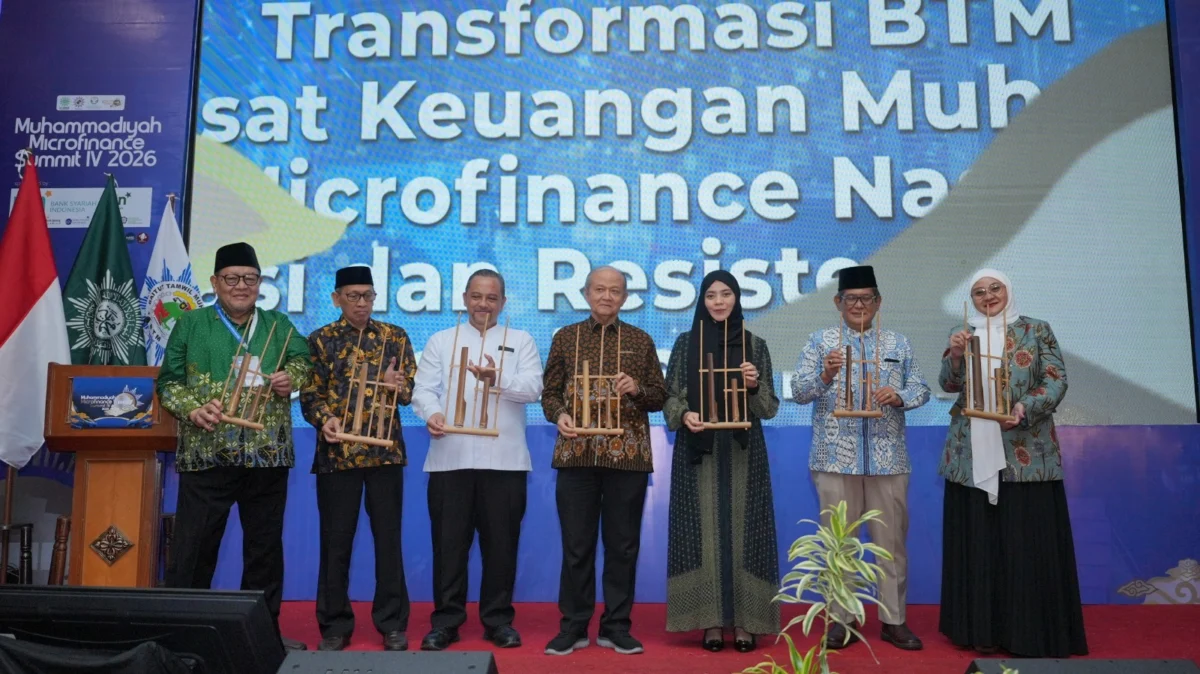
The landscape of Islamic microfinance in Indonesia witnessed a significant strategic convergence as Baitut Tamwil Muhammadiyah (BTM) officially commenced the Muhammadiyah Microfinance Summit IV in Bandung, West Java. Running from November 27 to November 28, 2026, the high-profile summit serves as a crucial national forum designed to evaluate, recalibrate, and accelerate the economic empowerment initiatives championed by Muhammadiyah, one of the country’s largest Islamic socio-religious organizations.
Bringing together financial experts, cooperative leaders, regional executives, and policy advocates, the two-day event focuses heavily on fortifying the institutional resilience of microfinance networks. The primary objective centers on transforming grassroots economic units into robust pillars capable of driving structural financial independence for both the organization’s members—known as the persyarikatan—and the broader Indonesian public.
Strategic Vision and Historical Evolution of the Gerakan Microfinance Muhammadiyah
The inception of the Muhammadiyah Microfinance Summit series is deeply rooted in the organization’s long-term strategic resolutions. Delivering the opening address, Chairman of the Central BTM Board (Induk BTM), Ahmad Su’ud, emphasized that the ongoing summit represents a collective, synchronized endeavor to architect the future of Muhammadiyah’s economic ecosystem. He underscored that microfinance functions as a vital strategic instrument in securing genuine economic independence for the ummah and the organization at large.
The foundational roadmap for this modern economic drive was formally established following the 47th Muhammadiyah Muktamar (National Congress) held in Makassar in 2015. During that pivotal congress, Induk BTM officially launched the Gerakan Microfinance Muhammadiyah (GMM), or the Muhammadiyah Microfinance Movement. This ambitious national program was conceptualized to institutionalize and scale up Islamic cooperative finance, bridging the gap between formal banking systems and unbanked or underbanked grassroots entrepreneurs.
The operational blueprint of the GMM mandated a clear structural target: the establishment of at least one dedicated BTM entity under every Regional Leadership of Muhammadiyah (Pimpinan Daerah Muhammadiyah, or PDM) across the archipelago. To ensure its nationwide execution, the movement secured formal backing as an official flagship program of the Micro, Small, and Medium Enterprises (MSME) Development Bureau of the Muhammadiyah Central Board (PP Muhammadiyah). Over the subsequent years, this mandate transformed from a visionary policy into an operational reality, weaving a dense financial safety net across numerous provinces, regencies, and municipalities.
Redefining Religious Philanthropy and Economic Jihad
While Muhammadiyah is historically renowned for its monumental contributions to Indonesian society through the establishment of thousands of educational institutions, hospitals, clinics, and social welfare centers, leaders at the Bandung summit reiterated that economic empowerment has always been an inseparable pillar of the movement’s founding philosophy.
Ahmad Su’ud noted that since its inception in 1912 by Ahmad Dahlan, Muhammadiyah’s mission of modernizing Islamic thought and practice in Indonesia encompassed not only spiritual enlightenment and social welfare, but also the structural liberation of the indigenous population from economic marginalization. The organization’s pioneering leaders recognized early on that religious devotion and social upliftment are inextricably linked to material self-sufficiency.
In the contemporary context, translating this multifaceted mission into practical reality requires moving beyond traditional charity models toward sustainable enterprise development. Su’ud elaborated that the modern dakwah (propagation) of Muhammadiyah must extend far beyond cultivating spiritual consciousness. It must actively manifest within the economic sphere by dismantling systemic barriers to capital access, fortifying vulnerable small-scale businesses, and generating sustainable employment opportunities in local communities.
Significantly, the leadership used the international platform of the summit to challenge conventional corporate metrics applied to financial institutions. Su’ud explicitly cautioned against evaluating the success of BTM branches through standard capitalist benchmarks, such as pure profit accumulation, asset size, or high dividend yields. Instead, he argued that the true Key Performance Indicator (KPI) for any Baitut Tamwil Muhammadiyah must be measured by social impact: specifically, the number of low-income families and micro-entrepreneurs successfully lifted out of poverty and guided toward sustainable financial independence through targeted capital injection and business mentorship.
Structural Integration and Institutional Governance
As the microfinance network expanded rapidly over the past decade, questions regarding regulatory compliance, institutional hierarchy, and long-term governance came to the forefront of organizational strategy. Addressing these critical administrative dimensions during the summit, Syafrudin Anhar, Deputy Chairman of the PP Muhammadiyah MSME Development Bureau, outlined three foundational pillars essential for the future sustainability of BTM: legal clarity, institutional positioning, and long-term developmental trajectory within the wider organizational ecosystem.
Anhar highlighted a major structural milestone achieved following the 48th Muhammadiyah Muktamar in Surakarta. In a bid to streamline oversight, enhance accountability, and protect the integrity of organizational assets, the Central Board officially designated BTM as an institutional entity operating under the direct guidance and coordination of the PP Muhammadiyah MSME Development Bureau.
Under this updated regulatory framework, any BTM operating at the regional level—whether supervised by a Regional Leadership (PDM) or a Provincial Leadership (Pimpinan Wilayah Muhammadiyah, or PWM)—is legally and operationally classified as an official Amal Usaha Muhammadiyah (Muhammadiyah Charitable Effort) specializing in microfinance. Consequently, these entities must strictly adhere to the administrative oversight, governance standards, and policy coordination mandated by the MSME Development Bureau. This structural consolidation aims to mitigate financial risks, prevent operational fragmentation, and ensure that all microfinance activities remain strictly aligned with Islamic financial principles and the overarching ideological goals of the organization.
Replicating Regional Success Stories Across the Archipelago
A central operational focus of the Muhammadiyah Microfinance Summit IV involves knowledge transfer and the horizontal scaling of proven business models. During his address, Syafrudin Anhar drew special attention to the remarkable performance of BTM networks in Central Java, pointing to the region as a national benchmark for successful Islamic micro-intermediation.
Central Java has long served as an incubator for advanced Muhammadiyah economic initiatives, featuring dense networks of BTMs that have successfully integrated digital financial services, agricultural supply chain financing, and community-based savings schemes. These branches have demonstrated a high capacity for capital retention, low non-performing financing (NPF) ratios, and extensive community outreach, directly engaging thousands of small traders, farmers, and artisans.
To accelerate nationwide progress, the MSME Development Bureau is actively urging regional leaders from other provinces—such as West Java, East Java, Sumatra, Sulawesi, and beyond—to systematically study and replicate the best practices established in Central Java. By adopting standardized operational procedures, robust risk-management protocols, and community-centric financing models, regional branches can bypass developmental bottlenecks and rapidly deploy effective economic empowerment tools in their respective localities.
Broader Implications for Indonesian Islamic Finance and the National Economy
The convening of the Muhammadiyah Microfinance Summit IV occurs against the backdrop of shifting macroeconomic dynamics in Indonesia, where the government continues to prioritize financial inclusion and the formalization of the MSME sector as drivers of national resilience. With micro, small, and medium enterprises accounting for over 60 percent of Indonesia’s Gross Domestic Product (GDP) and absorbing the vast majority of the national workforce, the strategic interventions undertaken by civil society organizations like Muhammadiyah carry profound macroeconomic significance.
By providing ethical, sharia-compliant liquidity to micro-entrepreneurs who typically lack access to commercial banking facilities, institutions like BTM function as shock absorbers during periods of economic volatility. They fill a critical structural gap left by conventional commercial banks, which often impose stringent collateral requirements and high administrative hurdles that exclude marginal economic actors.
Furthermore, the emphasis on institutional governance and regulatory compliance showcased at the Bandung summit reflects a mature understanding of the challenges facing Islamic cooperatives in the modern era. By aligning grassroots financial entities under a centralized bureaucratic framework—the MSME Development Bureau—Muhammadiyah is proactively addressing historical vulnerabilities associated with cooperative mismanagement, thereby safeguarding public trust and ensuring the long-term viability of its financial network.
As the Muhammadiyah Microfinance Summit IV concludes its deliberations in Bandung, the actionable blueprints formulated by industry leaders and organizational executives are expected to cascade down to hundreds of regional chapters. By reinforcing legal foundations, scaling proven regional models, and anchoring financial operations in a philosophy of social upliftment, the movement aims to cement its status as a formidable architect of inclusive economic growth in Indonesia for decades to come.