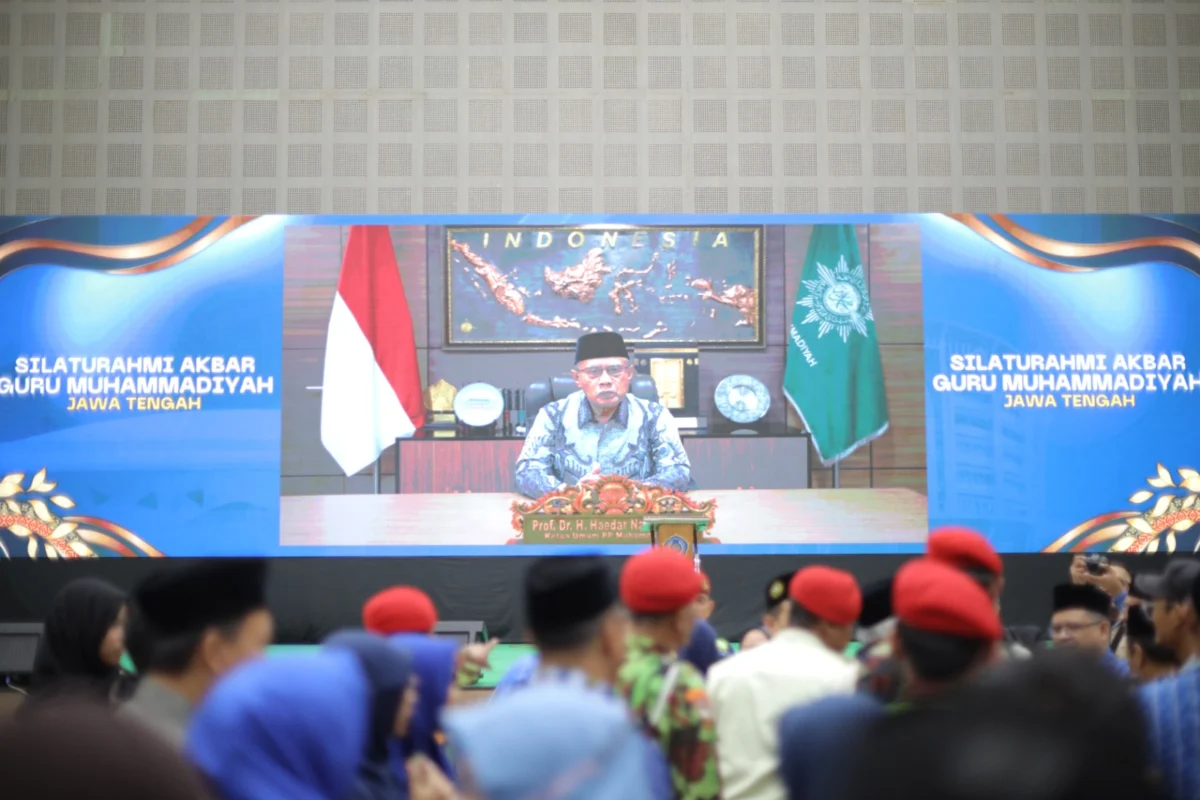
The Edutorium at Universitas Muhammadiyah Surakarta (UMS) recently served as the epicenter of a major national gathering as hundreds of educators converged for the grand Silaturahmi Forum Guru Muhammadiyah. Held on Saturday, November 7, the high-profile event merged the celebrations of the 114th Milad of Muhammadiyah with early observances leading toward National Teachers Day. The assembly drew prominent figures, administrators, and teaching staff from across the expansive Muhammadiyah educational network, creating a vibrant space for professional dialogue, shared reflection, and ideological alignment. At the heart of the proceedings was a comprehensive keynote address delivered by the General Chairperson of the Central Board (PP) of Muhammadiyah, Haedar Nashir, who used the platform to issue a compelling call to action for educators navigating an increasingly complex socio-technological landscape.
The gathering transcended a traditional ceremonial reunion, functioning instead as a strategic symposium designed to reinforce the collective identity, moral compass, and professional resilience of Muhammadiyah educators. As modern educational frameworks shift rapidly under the influence of globalization, digital disruption, and evolving student demographics, the forum provided a timely intervention. Haedar’s address focused heavily on recalibrating the mission of the modern teacher, ensuring that academic rigor remains intrinsically bound to ethical grounding, ideological clarity, and societal transformation.
The Evolving Landscape of Modern Education and the Teacher as the Ultimate Catalyst
The role of the educator in the twenty-first century has undergone a profound transformation. No longer viewed merely as conduits for textbook information, teachers are now recognized as architects of human capital, emotional anchors for developing minds, and frontline defenders against moral erosion. Within the vast ecosystem of Muhammadiyah—which operates thousands of educational institutions ranging from early childhood centers to prestigious universities nationwide—the responsibility of maintaining high standards while preserving Islamic values is immense.
During his address, Haedar referenced the deeply ingrained traditional Indonesian adagium describing a teacher as someone who must be digugu lan ditiru—a figure whose words are trusted and whose actions are worthy of imitation. He emphasized that this classical wisdom holds even greater relevance today, where students are constantly bombarded by external influences through digital media. The transfer of knowledge, while fundamental, is insufficient without the simultaneous cultivation of character and the projection of genuine moral exemplars (uswah).
To operationalize this philosophy amidst contemporary challenges, Haedar outlined three foundational pillars that must guide every Muhammadiyah educator. These principles are designed to fortify teachers against professional burnout, elevate institutional competitiveness, and secure the ideological continuity of the organization.
Pillar One: Unwavering Commitment and Comprehensive Integrity
The first pillar articulated by the Muhammadiyah leader centers on the absolute necessity of maintaining unyielding commitment and integrity. Haedar stressed that a teacher’s professional accountability extends far beyond the physical boundaries of the classroom or the completion of administrative lesson plans. True educational stewardship requires a holistic approach where the instructor functions as a "teacher of life."
In an era where educational metrics are frequently reduced to standardized test scores and quantitative performance indicators, this reminder serves as a corrective balance. Teachers are tasked with modeling resilience, ethical decision-making, and social empathy in their daily interactions. By anchoring instructional duties in moral integrity, educators ensure that students do not just acquire marketable skills, but also develop the conscience necessary to apply those skills for the betterment of society. This commitment must remain steadfast regardless of geographic disparities, institutional resource limitations, or socioeconomic hurdles faced by educators stationed in remote regions of the archipelago.
Pillar Two: Continuous Competency Enhancement and Institutional Competitiveness
Recognizing that the quality of any educational system is inextricably linked to the capabilities of its teaching workforce, Haedar’s second pillar focused on ongoing professional development. The modern educational sector is characterized by intense domestic and international competition, driven by rapid technological advancements and shifting parental expectations. In this high-stakes environment, educational institutions cannot rely solely on historical reputation; they must continually elevate their standards of instruction.
Haedar identified the classroom teacher as the primary catalyst for institutional excellence. When individual educators proactively enhance their pedagogical skills, master emerging instructional technologies, and deepen their subject matter expertise, the entire institution benefits. Elevating teacher capacity directly translates into higher-quality graduates, enhanced institutional prestige, and a stronger competitive edge in the broader education market. Consequently, professional development is framed not merely as an optional career perk, but as an institutional imperative and a collective responsibility within the Muhammadiyah network.
Pillar Three: Preserving Idealism and the Spirit of Selfless Dedication
Addressing the socioeconomic realities of the teaching profession, Haedar’s third pillar tackled the delicate balance between material compensation and vocational idealism. Acknowledging the historical designation of teachers as pahlawan tanpa tanda jasa (heroes without service medals), he urged educators not to view this title as a cliché, but as a living ethos of sincere dedication.
While acknowledging and validating the legitimate economic grievances and operational hardships faced by educators—particularly those working in remote, underfunded, and geographically isolated regions with limited infrastructural support—Haedar issued a firm caution against measuring the worth of teaching solely through transactional comparisons with other corporate or bureaucratic professions. He emphasized that the intrinsic value of shaping a generation cannot be quantified by salary scales alone. Maintaining an enduring spirit of struggle and idealism is what separates transformative educators from ordinary wage earners, ensuring that the mission of enlightening the nation remains vibrant despite systemic challenges.
Ideological Anchoring within the Muhammadiyah Movement
Beyond general pedagogical principles, Haedar placed significant emphasis on the specific ideological framework that distinguishes Muhammadiyah educational institutions from public or other private schools. He reminded the assembled educators that their professional duties must remain harmoniously aligned with the religious outlook (paham agama), ideological foundations, and strategic movement systems (sistem pergerakan) of the Muhammadiyah organization.
This ideological integration ensures that the vast network of Muhammadiyah schools does not drift into secular pragmatism or lose its foundational mission of promoting Islamic values rooted in Tajrenew (reform) and progressive thought. By maintaining this alignment, educators act as conscious agents of social change who view their daily classroom activities as a form of worship and social jihad aimed at fostering a enlightened, modern, and righteous society.
Broader Implications and Future Outlook for Muhammadiyah Education
The timing of the Silaturahmi Forum Guru Muhammadiyah carries profound implications for the organization’s broader strategic roadmap. As Muhammadiyah approaches its 114th year of continuous service to the Indonesian republic, the challenges confronting its educational infrastructure are more complex than ever. Issues ranging from equitable digital access in remote branches to adapting curricula to meet the demands of the fourth industrial revolution require robust, visionary leadership.
Observers note that by emphasizing teacher quality, ideological consistency, and moral resilience, Muhammadiyah is positioning its educational institutions to remain competitive and socially relevant. The directive given by Haedar Nashir serves as both a strategic guideline for school administrators and an empowering message for front-line instructors. As these educators return to their respective regions across Indonesia, the challenge will lie in translating these high-level principles into daily classroom practices, institutional policies, and community engagements. Ultimately, the success of this initiative will be measured not just in academic rankings or institutional accreditations, but in the character, competence, and moral clarity of the millions of students passing through Muhammadiyah classrooms each year.