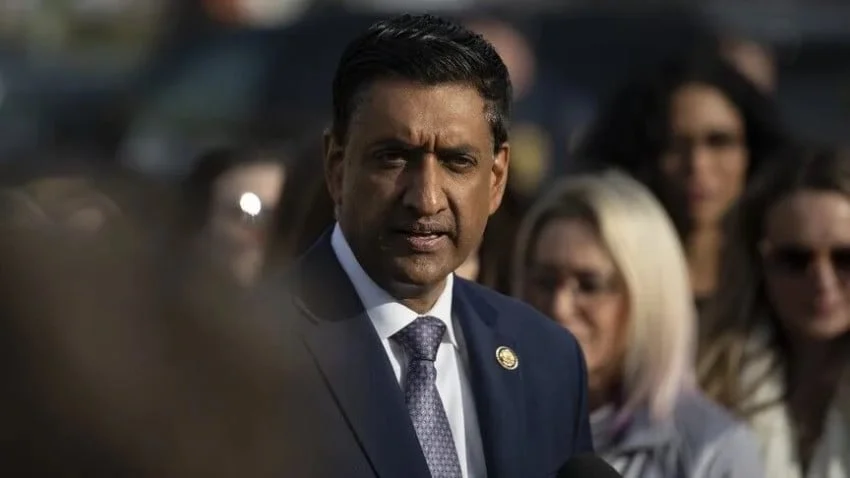
WASHINGTON — In what represents a sharp escalation of intra-party friction over foreign policy, United States Representative Ro Khanna of California has articulated a profoundly critical stance regarding American military and diplomatic support for Israel. Speaking candidly during the lead-up to the highly anticipated midterm elections, the prominent Democratic lawmaker argued that his party must adopt an unyielding posture toward the Israeli government should Democrats manage to secure majorities in the legislative branch. Khanna’s remarks signal a deepening ideological divide within the Democratic Party, where progressive lawmakers are increasingly challenging traditional bipartisan consensus on Middle Eastern geopolitics.
The statements, delivered to IHIP News, encompass a series of sweeping policy proposals that directly challenge decades of established US foreign policy conventions. According to Khanna, a future Democratic majority must immediately pivot away from unconditional support for Israel, utilizing the leverage of American financial and military assistance to force a fundamental reassessment of military operations in Gaza and the broader region. The comments underscore a growing urgency among progressive elements in American politics who view the ongoing humanitarian crisis in Gaza as a defining moral and political test for the party leadership.
Progressive Demands and Policy Shifts
Elaborating on the specifics of his proposed platform, Khanna outlined a four-point mandate that would fundamentally alter Washington’s diplomatic architecture in the Middle East. First, the California congressman insisted that the United States must explicitly characterize the humanitarian toll in Gaza using legally and morally charged terminology. "We have to call it a genocide," Khanna stated, reflecting the rhetoric of human rights advocates and international legal scholars who have leveled similar accusations against the current Israeli military campaign.
Second, Khanna called for an immediate and unconditional cessation of American military assistance. "We have to say: no more aid. We have to say: no more sales of military equipment that are used to kill civilians," he emphasized. This assertion targets the core mechanism of the US-Israel strategic alliance, which has historically involved billions of dollars in annual military financing designed to maintain Israel’s qualitative military edge in the region.
Third, Khanna proposed a dramatic overhaul of American diplomatic recognition, arguing that a Democratic-controlled Congress should spearhead an immediate push for Palestinian statehood. He asserted that within the legislative session’s opening week, the United States should officially recognize the State of Palestine and establish diplomatic missions, including embassies in Ramallah and occupied East Jerusalem. This proposal sharply diverges from the traditional US stance that Palestinian statehood can only be achieved through direct bilateral negotiations between Israelis and Palestinians.
Finally, Khanna targeted Washington’s traditional diplomatic shield for Israel at the international level. "And we will stop protecting Israel at the United Nations," he declared, taking aim at the longstanding US practice of utilizing its veto power in the UN Security Council to block resolutions critical of Israeli policies.
Context of the Midterm Elections and Domestic Priorities
Khanna’s hardline declarations arrive against the complex backdrop of the United States midterm elections, where control of both the House of Representatives and the Senate hangs in the balance. While foreign policy is rarely the singular driving force behind American domestic elections, the humanitarian crisis in the Middle East has emerged as a significant wedge issue, particularly among younger voters, Arab-American communities, and progressive activists who form a crucial part of the Democratic electoral coalition.
However, the political landscape within the Democratic Party remains starkly divided over these issues. While progressives like Khanna elevate foreign policy and humanitarian concerns to the forefront of their political messaging, other party figures emphasize domestic economic pressures. This internal tension was highlighted by Abul El-Sayed, a Democratic Senate candidate, who noted that a vast segment of the electorate—particularly the youth demographic—prioritizes pressing domestic concerns above foreign entanglements. According to El-Sayed, voters are acutely focused on the affordability of healthcare, the mounting housing crisis, and the disruptive impact of rapid advancements in artificial intelligence (AI) on the domestic labor market. El-Sayed’s observations point to the delicate balancing act Democratic candidates must perform as they attempt to reconcile the passionate demands of progressive foreign policy activists with the bread-and-butter economic anxieties of the broader electorate.
Historical Background of US-Israel Relations and Bipartisan Consensus
To fully comprehend the significance of Ro Khanna’s statements, it is essential to examine the historical trajectory of the United States-Israel alliance. For more than half a century, American foreign policy has been characterized by a robust, bipartisan consensus supporting the State of Israel. Following the 1967 Six-Day War, this relationship deepened into a strategic partnership defined by extensive intelligence sharing, joint military exercises, and robust diplomatic backing.
Historically, both Democratic and Republican administrations have viewed Israel as a vital democratic anchor in a volatile region. Financial assistance, formalized largely through decades-long memorandum of understanding agreements, has consistently provided Israel with roughly $3.8 billion annually in military aid, supplementing these funds with additional emergency packages during periods of acute conflict.
For generations, questioning this relationship was considered a rare political liability in Washington. Pro-Israel lobbying organizations, most notably the American Israel Public Affairs Committee (AIPAC), wielded substantial influence over congressional elections and policy formulation. Within this traditional framework, proposals to condition aid, recognize Palestinian statehood unilaterally, or withhold diplomatic protection at the United Nations were largely confined to the fringes of American political discourse.
The Evolution of the Progressive Shift
The erosion of this unbreakable consensus began in earnest over the past decade, catalyzed by shifting demographics within the Democratic Party and a generational change in public attitudes toward the Israeli-Palestinian conflict. Younger Americans, including younger Democrats, have increasingly viewed the conflict through the lens of human rights, civil liberties, and international law, drawing parallels between domestic social justice movements and the plight of the Palestinian population.
This ideological shift gained institutional footing in Congress with the election of a new wave of progressive lawmakers, commonly referred to informally as "The Squad," who began openly challenging traditional party orthodoxies regarding Israel. Over successive legislative sessions, these members introduced resolutions calling for ceasefires, demanding oversight on the end-use of US-supplied weapons, and questioning the unconditional nature of military financing.
The outbreak of the Israel-Hamas war following the October 7, 2007 attacks dramatically accelerated this trend. As the scale of devastation and the rising civilian death toll in Gaza dominated global media coverage, pressure mounted on progressive and moderate Democrats alike. What was once a debate largely confined to activist circles has now permeated the upper echelons of the congressional Democratic caucus, with figures like Ro Khanna feeling emboldened to articulate positions that would have been politically untenable just a decade prior.
Chronology of Escalating Tensions (2023–2024)
The trajectory leading to Khanna’s recent declarations can be mapped through a series of critical milestones marking the deterioration of unconditional legislative support for Israeli military strategies:
- October 2023: Following the Hamas-led attacks and the subsequent launch of large-scale military operations in Gaza by the Israel Defense Forces (IDF), the initial congressional response was overwhelmingly supportive of Israel’s right to self-defense, resulting in swift, bipartisan votes for emergency funding.
- Late 2023 to Early 2024: As the humanitarian crisis intensified and civilian casualties mounted, progressive Democrats began organizing legislative pushbacks. Lawmakers introduced amendments to supplemental funding bills aimed at imposing human rights conditions on military assistance to foreign nations, including Israel.
- Spring 2024: President Joe Biden’s administration faced intense internal dissent from federal agencies, congressional staffers, and lawmakers regarding the administration’s certification of arms transfers. The withholding of a specific shipment of heavy-payload bombs by the White House in May 2024 marked a notable, albeit cautious, signal that Washington was prepared to apply pressure on the Israeli government regarding its military tactics in Rafah.
- Summer 2024: Israeli Prime Minister Benjamin Netanyahu addressed a joint session of Congress, an event boycotted by numerous progressive Democrats, including several high-profile members of the House and Senate, highlighting the widening chasm between the Israeli leadership and the progressive wing of the US Democratic Party.
- Fall 2024: As midterm election campaigns ramped up, foreign policy statements from candidates increasingly reflected domestic polarization. While moderate and establishment Democrats sought to maintain a delicate balance between supporting traditional alliances and acknowledging humanitarian concerns, progressive leaders like Khanna chose to stake out uncompromising positions demanding radical policy transformations.
Implications for US Foreign Policy and Domestic Politics
The articulation of such radical policy shifts by a senior Democratic lawmaker carries profound implications for the future of American statecraft, regardless of the immediate outcome of the midterm elections.
From a geopolitical standpoint, if a future Democratic majority were to adopt the platform outlined by Khanna, it would represent a tectonic shift in global diplomacy. Ending military assistance and halting the supply of offensive equipment would force the Israeli military to significantly alter its operational capabilities and strategic calculations. Furthermore, a unilateral American push for Palestinian statehood combined with the withdrawal of diplomatic shielding at the United Nations would isolate Israel internationally, fundamentally altering the diplomatic architecture of the Middle East and potentially accelerating a realignment of regional alliances.
Domestically, Khanna’s remarks illuminate a widening philosophical rift within the Democratic Party. The party’s establishment, historically aligned with centrist internationalism, continues to view traditional alliances as essential pillars of global stability. Conversely, the ascendant progressive wing increasingly frames foreign policy through a prism of human rights accountability and social justice, viewing traditional alliances as negotiable in the face of perceived humanitarian violations.
This internal ideological tug-of-war presents significant challenges for party leadership as they seek to construct a unified platform capable of retaining diverse voter coalitions. While candidates like Abul El-Sayed emphasize that domestic economic issues—such as housing affordability, healthcare access, and the economic dislocation caused by artificial intelligence—remain the primary concerns for working-class and young voters, the moral urgency attached to international conflicts ensures that foreign policy will remain a contentious and polarizing battleground.
As the political landscape continues to evolve, the debate sparked by figures like Ro Khanna guarantees that the long-standing bipartisan consensus on Israel has entered a permanent era of scrutiny. Whether these progressive proposals transition from fringe rhetorical positions to mainstream legislative realities will depend heavily on the future balance of power in Washington and the ongoing evolution of public opinion within the American electorate.