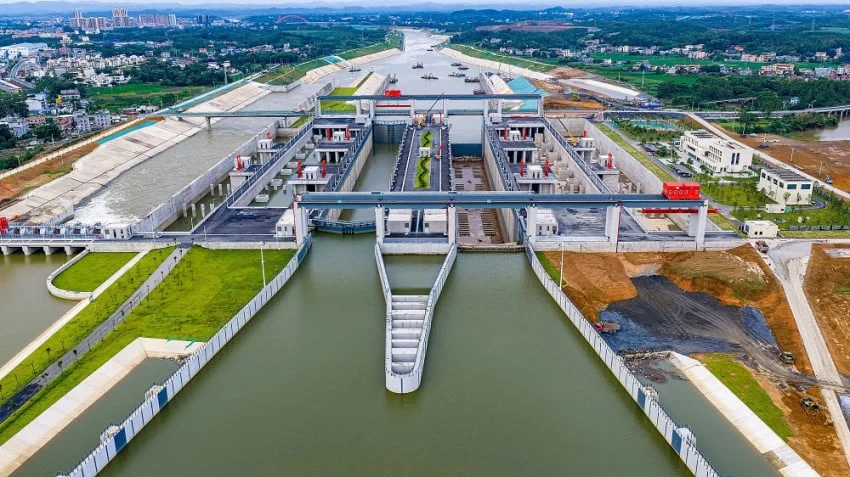
Beijing has officially inaugurated the Pinglu Canal, marking a monumental milestone in modern engineering and international trade logistics. As China’s first modern river-to-sea canal constructed under the People’s Republic, this massive infrastructure project physically reshapes the geography of the country’s southern frontier. Located entirely within the Guangxi Zhuang Autonomous Region—which shares a land border with Vietnam and opens directly onto the South China Sea—the canal serves as a vital maritime artery designed to drastically slash transit distances between China’s vast, landlocked southwestern interior and the booming economies of Southeast Asia.
The launch of the Pinglu Canal underscores Beijing’s ongoing commitment to optimizing supply chains, reducing operational expenditures for domestic industries, and deepening economic integration with the Association of Southeast Asian Nations (ASEAN). As global supply chains face continuous reconfigurations, this multi-billion-dollar project emerges as a cornerstone of China’s broader geopolitical and geoeconomic strategies, reinforcing trade connectivity across continents.
Project Overview and Geographic Route
The centerpiece of this ambitious undertaking is a 134-kilometer (83-mile) newly engineered waterway that establishes a direct navigational connection between the Xijiang River—a primary tributary of the Pearl River system—and the Beibu Gulf, situated at the northwestern corner of the Gulf of Tonkin. Historically, commercial vessels traveling from China’s southwestern provinces, such as Yunnan and Guizhou, to maritime trade routes had to navigate circuitous inland waterways or rely heavily on congested overland transportation networks to reach coastal ports.
The Pinglu Canal effectively circumvents these geographical bottlenecks. By bridging the Xijiang River directly to the Beibu Gulf, the artificial waterway provides a seamless, high-capacity maritime corridor. The project has been engineered to accommodate vessels with capacities of up to 5,000 tons, allowing large cargo barges to transition smoothly from inland industrial hubs directly into the open sea. This direct route transforms the economic viability of transporting bulk commodities, manufactured goods, and raw materials originating from China’s interior to international markets.
Strategic Alignment with the Belt and Road Initiative
The completion of the Pinglu Canal is not an isolated regional development; it is an integral component of the New International Land-Sea Trade Corridor. This corridor represents a key strategic initiative linking western and southwestern Chinese provinces directly to Southeast Asian markets and the wider global trade network. Furthermore, the corridor itself is nested within the grand vision of the Belt And Road Initiative (BRI), championed by Chinese President Xi Jinping.
Since its inception, the BRI has sought to reshape global trade dynamics by financing and constructing a massive web of highways, railways, ports, and energy pipelines connecting Asia with Europe and Africa. The Pinglu Canal operationalizes this vision at a regional level, knitting together the economic zones of Guangxi, Chongqing, Sichuan, Guizhou, and Yunnan. By streamlining the transit of goods to the Beibu Gulf ports, the canal integrates these inland regions more tightly into global maritime supply chains, cementing China’s economic footprint in Southeast Asia.
Economic Efficiency: Substantial Cost and Distance Reductions
The economic rationale behind the construction of the Pinglu Canal is anchored in hard logistical data. According to regional authorities in Guangxi, the waterway is projected to shorten the shipping distance between southwest China and Southeast Asian destinations by approximately 560 kilometers (350 miles). This dramatic reduction in mileage translates directly into substantial savings in fuel, labor, and time.
Local government assessments indicate that the project will drive down overall logistics costs by 18 to 30 percent. Zhang Zhiwen, deputy secretary-general of the Guangxi regional government, estimated that transportation cost reductions alone will yield savings exceeding 5 billion yuan (approximately $700 million USD) annually. These efficiency gains are expected to directly benefit industrial enterprises operating far from the coast, enhancing their global price competitiveness.
Massive Financial Investment and Engineering Scale
Realizing a project of this magnitude required unprecedented financial and engineering commitments. The total estimated cost for the construction of the Pinglu Canal stands at approximately 72.7 billion yuan, translating to roughly $10.8 billion USD. The massive capital expenditure reflects the complex engineering required to excavate millions of cubic meters of earth, construct advanced ship locks to manage elevation changes, and mitigate potential environmental disruptions along the 134-kilometer stretch.
Despite the high capital outlay, regional policymakers view the expenditure as a necessary investment in long-term economic vitality. Lu Xinning, vice-chairperson of the Guangxi autonomous region, emphasized that the canal delivers "tangible benefits" designed to alleviate operational pressures on businesses. By modernizing transport infrastructure, the regional administration aims to stimulate both domestic commerce within China and foreign trade with neighboring nations, positioning Guangxi as a premier international logistics gateway.
Chronology and Development Timeline
The realization of the Pinglu Canal is the culmination of decades of regional planning and intensive construction efforts. While the concept of connecting the Xijiang River to the Beibu Gulf had been discussed by planners for years due to its obvious strategic advantages, the project gained definitive momentum under recent national five-year plans aimed at regional development and infrastructure modernization.
Feasibility studies, environmental impact assessments, and preliminary engineering designs were fast-tracked in the late 2010s. Ground was officially broken on the massive construction project following comprehensive approvals from central and regional authorities. Over the subsequent years, tens of thousands of engineers, construction workers, and logistics experts labored across multiple sections of Guangxi to excavate the channel, build complex water-conservancy facilities, and integrate the canal with existing rail and highway networks. The official opening ceremony marks the transition from the construction phase to full operational status, initiating a new era for southern Chinese navigation.
Domestic and International Integration
The operationalization of the Pinglu Canal significantly expands the geographic scope of China’s domestic and international trade networks. Previously, major economic centers in China’s southwest—such as Chongqing, a sprawling industrial mega-city, and Chengdu, a major technological and manufacturing hub in Sichuan Province—relied predominantly on eastern outlets, such as the Yangtze River delta ports, or lengthy overland routes to access export markets.
With the new corridor functioning smoothly, southwestern manufacturers can channel their goods southward through Guizhou and Guangxi, utilizing the Pinglu Canal to reach the Beibu Gulf ports efficiently. From these coastal hubs, container ships can rapidly deploy cargo to Vietnam, Thailand, Malaysia, Indonesia, and other key ASEAN economies, as well as broader international shipping lanes. This diversification of export routes relieves pressure on China’s eastern seaboard ports while fostering balanced regional development across the country’s interior.
Implications for Regional Geopolitics and Trade
The opening of the Pinglu Canal carries profound implications for geopolitical and trade dynamics in Southeast Asia. As ASEAN remains one of China’s largest and most crucial trading partners, enhancing physical connectivity directly facilitates higher volumes of bilateral trade. Faster transit times and lower logistical overheads will likely encourage deeper supply chain integration between Chinese industrial clusters and Southeast Asian manufacturing bases, particularly in sectors such as electronics, machinery, agriculture, and consumer goods.
From a geopolitical perspective, the project reinforces Beijing’s economic centrality in the region. By providing landlocked provinces with direct, unhindered access to the South China Sea, China strengthens its economic leverage and ensures that regional trade flows remain resilient against potential maritime disruptions elsewhere. Neighboring countries, particularly Vietnam, are closely monitoring the project’s ecological and economic spillover effects, balancing the opportunities for increased cross-border commerce with the environmental management of shared water systems.
Environmental and Socio-Economic Considerations
Mega-engineering projects of this scale inevitably invite scrutiny regarding their environmental and socio-economic footprints. Constructing a 134-kilometer canal through diverse terrain requires meticulous management of local ecosystems, water resources, and agricultural land. Regional authorities have maintained that ecological protection was a priority during the planning and execution phases, with measures implemented to safeguard local water quality, manage soil erosion, and protect aquatic biodiversity within the Xijiang River and Beibu Gulf drainage basins.
Socio-economically, the canal is expected to catalyze urbanization and industrial development along its corridor. Smaller towns and cities in Guangxi that previously lacked major logistical advantages are now positioned as key waypoints along an international trade artery. This shift is anticipated to attract foreign and domestic investment, create thousands of jobs in logistics and manufacturing, and narrow the economic disparity between China’s developed eastern coastal provinces and its developing western interior.
Conclusion: A New Chapter in Global Logistics
The inauguration of the Pinglu Canal represents a watershed moment in modern transportation infrastructure. By bridging the gap between interior river systems and maritime trade routes, China has forged a more efficient, cost-effective, and strategically vital pathway to Southeast Asia. Backed by billions of dollars in investment and deeply integrated into the Belt and Road Initiative, the canal stands to redefine trade flows for decades to come. As commercial fleets begin traversing its length, the Pinglu Canal will be judged not only by the billions of yuan it saves in logistics costs, but by its ability to foster sustainable, tightly integrated economic partnerships across the Asian continent.