
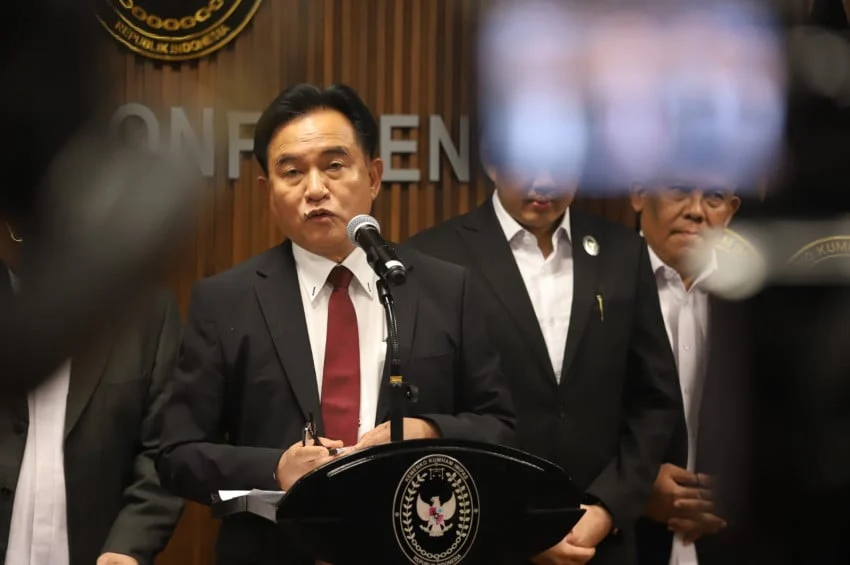
JAKARTA — Coordinating Minister for Legal, Human Rights, Immigration, and Corrections Yusril Ihza Mahendra has publicly stated that he has not yet received any formal reports regarding whether Vice President Gibran Rakabuming Raka was targeted in the massive illegal wiretapping operation that has recently shaken the highest levels of the Indonesian government. Speaking to members of the press during a late-night press briefing held in Jakarta, Yusril addressed lingering public questions concerning the full scope of the intelligence breach and the identities of those whose communications were unlawfully intercepted.
When specifically pressed by journalists on whether the Vice President’s communications had been compromised alongside other high-ranking state officials, Yusril offered a cautious response. "Wallahualam bissawab," Yusril remarked, invoking an Arabic phrase expressing that only God truly knows the absolute truth of the matter. He elaborated that, based on the briefings and investigative data delivered to him thus far, the confirmed primary targets of the illicit surveillance network included President Prabowo Subianto, a select group of cabinet ministers, and various prominent political figures. Consequently, he emphasized that he lacks the necessary evidentiary basis to either confirm or deny whether Vice President Gibran Rakabuming Raka was included on the perpetrators’ target list.
"What I have heard so far is that Mr. President, a number of ministers, and several politicians were targeted; therefore, I do not yet know whether the Vice President was also wiretapped or not," Yusril explained to reporters in Jakarta.
The official acknowledgment from the Coordinating Minister comes in the wake of a monumental announcement by the Indonesian National Police’s Criminal Investigation Agency (Bareskrim Polri). Bareskrim officially named three high-profile individuals as suspects in a complex criminal case involving illegal wiretapping, the malicious deletion of electronic data, and unauthorized system access, commonly known as illegal access.
The gravity of the investigation escalated dramatically when police confirmed that former National Police Chief and current Chief of Staff to the President, Listyo Sigit Prabowo, was among the principal suspects in the sweeping wiretapping scandal. Alongside Listyo Sigit Prabowo, law enforcement authorities also named two senior active-duty police generals as suspects: Inspector General Ahrie Sonta, who serves as the Head of the Legal Division of the National Police, and Inspector General Eko Hadi Santoso.
According to preliminary findings released by investigators, the criminal syndicate allegedly executed systematic surveillance operations targeting a wide array of critical communication lines. The intercepted targets reportedly spanned from the personal and official telephone numbers of President Prabowo Subianto to those of vital state officials, influential political figures, media executives, and key business leaders. The sheer breadth of the alleged operation has sent shockwaves through Indonesia’s political establishment, prompting immediate concerns regarding national security, cyber defense resilience, and the absolute confidentiality of state communications.
Background Context of the Investigation
The unfolding wiretapping controversy represents one of the most severe security breaches in modern Indonesian governance. In an era where digital communications form the backbone of both statecraft and personal connectivity, the exploitation of telecommunication networks by high-ranking state apparatus figures highlights profound vulnerabilities within institutional safeguards.
The investigation itself commenced following months of heightened intelligence monitoring and digital forensics audits conducted by specialized cybercrime units within Bareskrim Polri. Investigators began uncovering suspicious anomalies in communication traffic, unauthorized data access logs, and clandestine digital footprints that pointed toward a sophisticated, insider-driven surveillance network. The involvement of individuals occupying pivotal security and administrative positions—such as the Chief of Staff to the President and senior police generals—adds an unprecedented layer of complexity to the case, raising critical questions about institutional oversight, chain of command, and the abuse of state authority.
Chronology of Events Leading to the Suspect Designations
While Bareskrim Polri has kept specific operational details tightly sealed to protect the integrity of the ongoing judicial process, the timeline leading up to the public disclosure of the suspects traces a meticulous trajectory of law enforcement action:
- Initial Intelligence Discrepancies: Cyber defense and internal security teams detected irregular data extraction patterns and unauthorized remote access attempts targeting secure government communication channels.
- Preliminary Investigation and Digital Forensics: Bareskrim Polri launched a formal inquiry, gathering digital evidence, server logs, and witness testimonies that indicated a coordinated effort to intercept and store private conversations of top-tier officials.
- Expansion of the Scope: Investigators mapped out the network of compromised numbers, discovering that the clandestine surveillance extended beyond routine intelligence-gathering protocols and breached the private communications of the Head of State, cabinet ministers, and prominent civic leaders.
- Identification of Key Perpetrators: Forensic analysis linked specific administrative accounts, encryption keys, and digital signatures to the three primary suspects.
- Official Suspect Designation: Bareskrim Polri publicly announced the naming of Listyo Sigit Prabowo, Inspector General Ahrie Sonta, and Inspector General Eko Hadi Santoso as suspects in the illegal wiretapping, data deletion, and illegal access conspiracy.
Supporting Data and Scale of the Breach
While exact transcripts and the full repository of intercepted data remain classified under ongoing law enforcement restrictions, preliminary disclosures underscore the massive scale of the operation. Cybersecurity experts note that unauthorized access to the communications of a sitting head of state and primary cabinet ministers requires sophisticated technological tools, deep operational knowledge of telecommunications infrastructure, and significant insider access.
The inclusion of media figures and business leaders in the alleged target list further suggests that the operation was not merely a localized security protocol review, but a broad intelligence-gathering venture designed to map political influence, private negotiations, and policy formulation across multiple sectors of Indonesian society.
Official Responses and Institutional Reactions
The revelation that former National Police Chief Listyo Sigit Prabowo—a towering figure in Indonesia’s law enforcement hierarchy—has been implicated in an illegal wiretapping scandal has triggered profound institutional reverberations. Legal experts, civil society organizations, and members of the House of Representatives (DPR RI) have called for complete transparency and an unhindered, objective judicial process to restore public trust in national security institutions.
Government representatives have moved swiftly to reassure the public that state operations remain stable and that robust countermeasures are being implemented to purge compromised systems. Coordinating Minister Yusril Ihza Mahendra’s measured statements reflect a broader governmental strategy of addressing the crisis through established legal channels while avoiding premature speculation regarding unconfirmed targets, such as Vice President Gibran Rakabuming Raka.
Broader Impact and National Security Implications
The implications of this high-level wiretapping scandal extend far beyond the immediate criminal charges faced by the individual suspects. Several critical areas of national life are poised to feel the long-term impact of these developments:
- Reform of State Cybersecurity Infrastructure: The breach exposes critical vulnerabilities in how government officials communicate and manage classified information. It is anticipated that the administration will fast-track comprehensive upgrades to encrypted state communication networks and institute stricter oversight mechanisms for intelligence agencies.
- Restoring Trust in Law Enforcement: The fact that senior law enforcement officials are the primary suspects poses a unique challenge to the credibility of Indonesia’s legal system. Ensuring a transparent, fair, and publicly accountable trial will be paramount in demonstrating that no individual, regardless of rank or past position, stands above the law.
- Political Stability and Inter-Agency Dynamics: As investigations continue, the political landscape will undoubtedly experience shifts as parties and coalitions assess the fallout of the scandal. Maintaining institutional cohesion among the executive branch, the national police, and intelligence services remains critical to preventing administrative paralysis.
- Protection of Civil Liberties and Privacy Rights: The revelation that private citizens, including business leaders and journalists, may have been unlawfully monitored reinforces the urgent need for stricter legislative frameworks governing electronic information, data protection, and lawful interception protocols.
As Bareskrim Polri deepens its interrogation of the suspects and expands its forensic audit of the compromised networks, the public and political observers alike await further official updates. The unfolding case stands as a watershed moment for Indonesian governance, testing the resilience of its democratic institutions and the absolute supremacy of the rule of law.
