
The Indonesian government has launched comprehensive security measures, including sweeping operations to locate and secure clandestine surveillance devices, following a high-profile wiretapping scandal involving President Prabowo Subianto. The operation comes in the wake of formal investigations that have placed several high-ranking former and active law enforcement officials under intense legal scrutiny for alleged treason.
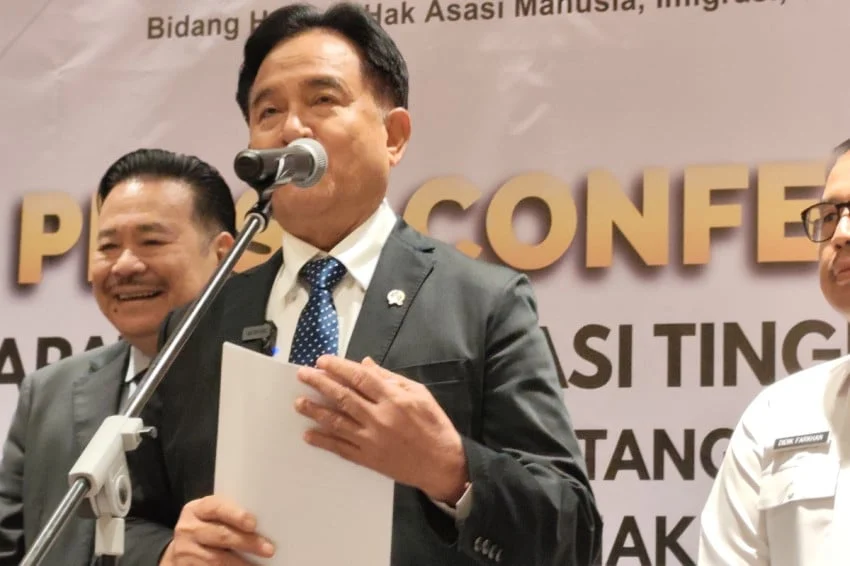
Minister for Coordinating Legal, Human Rights, Immigration, and Correctional Affairs, Yusril Ihza Mahendra, addressed the public during a densely attended press conference in Central Jakarta. During the briefing, Minister Yusril detailed the gravity of the situation, shedding light on the genesis of the investigation, the measures being taken to prevent future breaches, and the unprecedented nature of the threat targeting the nation’s highest office.
The unfolding political and national security crisis underscores the delicate intersection of institutional power, technological vulnerabilities, and the strict boundaries of state surveillance. As the investigation widens, state authorities are grappling with the ramifications of sensitive intelligence equipment falling into unauthorized hands, prompting a thorough reassessment of security protocols surrounding executive leadership.
Chronology and Genesis of the Investigation
The sequence of events leading to the current investigation began when confidential intelligence reports and formal complaints were lodged with law enforcement agencies, indicating that unauthorized electronic surveillance had been deployed against President Prabowo Subianto. Upon receiving the initial reports, specialized internal units within the Indonesian National Police launched a discreet preliminary inquiry to verify the authenticity of the claims.
As investigative teams combed through technical data and communication logs, they uncovered evidence pointing to the deliberate deployment of sophisticated wiretapping equipment. The trail of evidence rapidly expanded, moving beyond mere technical breaches to encompass coordinated actions that authorities allege were aimed at undermining state stability.
By early November 2026, the inquiry transitioned from a preliminary intelligence assessment to an official criminal investigation. The gravity of the findings prompted swift legal actions, culminating in the naming of several prominent figures as suspects. Among those implicated in the high-stakes probe are former Head of the Presidential Staff Office (KSP) and former National Police Chief, General Listyo Sigit Prabowo, alongside three high-ranking police officers: Inspector General Ahrie Sonta Nasution, Inspector General Eko Hadi Santoso, and Inspector General Slamet Uliandi.
According to preliminary legal documents released by investigators, the suspects are facing severe allegations centered around state security offenses, specifically including preliminary charges of treason (makar). The inclusion of high-profile security figures in the suspect registry has sent shockwaves through the nation’s political establishment, raising urgent questions about institutional loyalty, the chain of command, and the oversight of state intelligence assets.
Government Response and Technical Sweep Operations

In response to the unprecedented security breach, the administration of President Prabowo Subianto has adopted a multi-pronged approach combining aggressive criminal prosecution with wide-ranging preventive technical sweeps. Speaking to reporters in Jakarta, Minister Yusril emphasized that while the legal proceedings against the accused individuals will proceed transparently and rigorously, the government is simultaneously prioritizing the containment of any remaining security vulnerabilities.
"For future anticipation, it is certainly being thought about, but the criminal acts currently under investigation and inquiry will continue to be pursued," Yusril stated during the Monday press conference.
The Ministry, in coordination with defense and intelligence agencies, has mobilized specialized technical teams to conduct sweeping operations across key government installations. The primary objective of these sweeps is to detect, disable, and confiscate any unauthorized surveillance devices that may have been planted or left operational during the preceding months.
Furthermore, the government is reviewing the strict regulatory frameworks governing the procurement, distribution, and utilization of interception technology. Historically, specialized surveillance tools are restricted to authorized law enforcement and intelligence entities for counter-terrorism and major crime investigations. The current scandal has exposed critical loopholes and potential abuses of power, prompting calls for stringent legislative oversight to ensure that state-owned surveillance hardware is never again co-opted for unauthorized political objectives.
Broader Implications for National Security and Governance
The alleged wiretapping of a sitting head of state represents an extraordinary challenge to national security, carrying profound implications for Indonesia’s political landscape and democratic institutions. Cybersecurity and intelligence experts point out that the incident highlights the urgent need for modernized counter-surveillance infrastructure within executive compounds.
Beyond the immediate technical challenges, the involvement of senior law enforcement officials in a treason and wiretapping conspiracy deals a heavy blow to public trust in state institutions. The Indonesian National Police, already navigating ongoing internal reforms, faces an acute credibility test as it investigates some of its most senior former leaders. Public confidence hinges on the transparency, impartiality, and thoroughness of the judicial process as it moves toward eventual indictments and trials.
Political analysts note that the scandal could accelerate legislative efforts to reform intelligence oversight laws. Lawmakers from various factions have signaled readiness to revisit the legal frameworks governing state wiretapping capabilities, advocating for independent judicial authorization requirements for any interception operations involving high-ranking state officials. Such measures are seen as vital to preventing executive overreach and protecting the integrity of government communications.
As the investigation progresses, the Ministry of Law, Human Rights, Immigration, and Correctional Affairs has assured the public that all necessary legal instruments will be utilized to bring the perpetrators to justice. At the same time, immigration and border control agencies remain on high alert to monitor the movement of individuals connected to the expanding probe, ensuring that the judicial process remains unimpeded.
The unfolding case serves as a stark reminder of the complex security threats facing modern states, where traditional concepts of national defense must increasingly encompass sophisticated digital surveillance and the protection of critical institutional leadership against internal subversion.
