
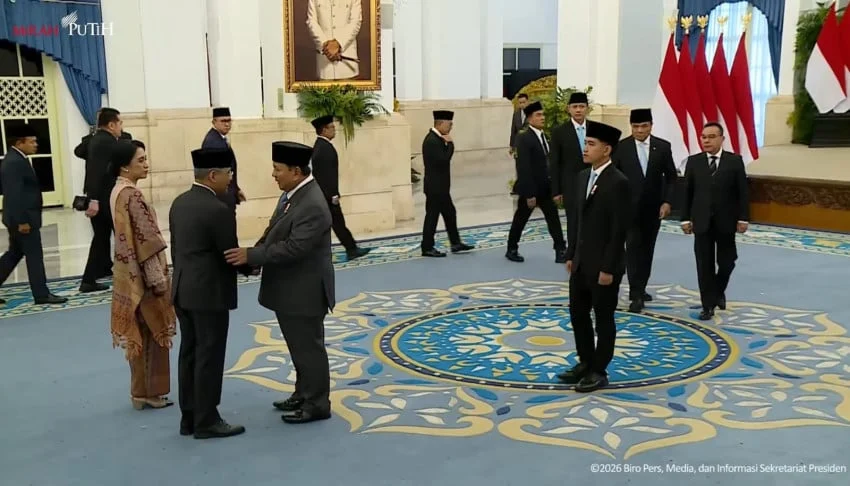
In a significant move that underscores the ongoing structural adjustments within the Indonesian government, President Prabowo Subianto has officially inaugurated Suahasil Nazara as the new Minister of Finance. The appointment, confirmed on Monday, September 14, 2026, marks the seventh cabinet reshuffle since the inception of the Merah Putih administration in October 2024. This latest transition replaces Purbaya Yudhi Sadewa, whose tenure as the nation’s chief fiscal architect came to an abrupt end during an ongoing session at the Regional Representative Council (DPD RI).
The departure of Purbaya Yudhi Sadewa, who had only occupied the position since September 8, 2025, has sent ripples through the domestic financial markets and international investor circles. While the administration has framed the move as a strategic necessity to ensure fiscal stability, the rapid turnover in such a critical ministerial post reflects the intense pressure the executive branch faces in navigating global economic headwinds and domestic fiscal targets. Suahasil Nazara, who previously served as the Deputy Minister of Finance, steps into the role with an intimate knowledge of the ministry’s internal machinery, having served as a key lieutenant during the formative stages of the Prabowo administration.
A Chronology of Constant Change: Tracking the Merah Putih Reshuffles
Since taking the oath of office in late 2024, President Prabowo Subianto has demonstrated a hands-on, often aggressive approach to cabinet management. The frequency of the reshuffles—averaging roughly one every three to four months—suggests a leadership style that prioritizes rapid performance optimization over long-term ministerial continuity.
The historical trajectory of these adjustments reveals a pattern of shifting priorities:
- February 19, 2025 (First Reshuffle): The initial realignment focused on the education and scientific sector. Brian Yuliarto succeeded Satryo Soemantri Brodjonegoro as the Minister of Higher Education, Science, and Technology, signaling a shift in the administration’s focus toward technological integration and research output.
- September 8, 2025 (Second Reshuffle): This period marked a major overhaul of the economic and social welfare teams. Purbaya Yudhi Sadewa replaced Sri Mulyani as Minister of Finance, a move that surprised many observers given Sri Mulyani’s long-standing international reputation. Simultaneously, Mukhtarudin took over the Ministry of Migrant Worker Protection, Ferry Joko Yuliantono assumed the role of Minister of Cooperatives, and Mochamad Irfan Yusuf was tasked with leading the newly prominent Ministry of Hajj and Umrah, supported by Dahnil Anzar Simanjuntak as Deputy Minister.
- September 17, 2025 (Third Reshuffle): Just nine days after the major September reshuffle, the President replaced the Coordinating Minister for Political and Security Affairs, installing Djamari Chaniago in place of Budi Gunawan. This period also saw the appointment of Erick Thohir as the Minister of Youth and Sports, replacing Dito Ariotedjo, alongside various shifts in the deputy ministerial ranks, including the appointments of Afriansyah Noor (Manpower), Rohmat Marzuki (Forestry), and Farida Farichah (Cooperatives).
The sequence of these events highlights a government that is clearly in a state of flux, continuously searching for the optimal personnel configuration to meet its "Asta Cita" vision—a set of policy goals aimed at achieving national self-sufficiency and economic growth.
Fiscal Policy Implications and Market Sentiment
The Ministry of Finance serves as the backbone of the national economy. Consequently, frequent changes in leadership within this ministry are often viewed with caution by the international financial community. Analysts suggest that the rapid turnover, specifically the change from Sri Mulyani to Purbaya Yudhi Sadewa and now to Suahasil Nazara, requires a delicate balancing act to maintain confidence among global credit rating agencies and foreign investors.
Suahasil Nazara is widely regarded as a technocrat with a deep understanding of fiscal policy. Having served as the Deputy Minister of Finance, his elevation provides a degree of continuity in the ministry’s day-to-day operations. However, the circumstances of his predecessor’s exit—occurring while Purbaya Yudhi Sadewa was in the middle of a DPD RI hearing—suggest that the administration expects high-level accountability and immediate results in tax revenue mobilization and budgetary efficiency.
Economists argue that while the reshuffle might be intended to improve government responsiveness, it risks creating "policy fatigue" within the bureaucracy. When ministers are replaced in rapid succession, the implementation of long-term economic programs can be delayed, as each new appointee may seek to redefine priorities or restructure departmental workflows.
Official Responses and Government Justification
The Presidential Secretariat has maintained that these changes are strictly performance-based. In official statements, government spokespersons have emphasized that the President retains the constitutional prerogative to evaluate his cabinet members based on their ability to execute the national strategic plan.
"The President requires a team that is not only capable but also perfectly aligned with the urgency of our national development goals," an aide to the President stated during a press briefing following the inauguration. "The appointment of Suahasil Nazara is intended to ensure that the Ministry of Finance remains robust, transparent, and responsive to the needs of the people, especially in light of the complex global economic challenges we face."
From the perspective of the legislature, reactions have been mixed. Members of the DPD RI and the House of Representatives (DPR) have expressed both support for the President’s right to reshuffle and concern over the potential lack of stability. Some lawmakers have called for a "cooling-off period" for the cabinet to allow new ministers to fully implement their strategies, arguing that frequent changes may hinder the government’s ability to meet the ambitious GDP growth targets set by the Prabowo administration.
Looking Ahead: The Future of the Merah Putih Cabinet
As the administration moves into the latter half of 2026, the focus for the new Minister of Finance will be twofold: maintaining fiscal discipline while financing the administration’s flagship social programs. With the national budget under constant pressure to fund both infrastructure projects and poverty alleviation initiatives, Suahasil Nazara will likely face immediate scrutiny regarding his strategy for broadening the tax base and managing the national debt.
The broader implications of these seven reshuffles suggest that the "Merah Putih" cabinet is a work in progress. President Prabowo’s willingness to disrupt his own cabinet indicates a refusal to accept the status quo. However, the ultimate success of this administration will not be measured by the number of reshuffles, but by the tangible impact of these changes on the average Indonesian citizen’s quality of life.
The international community will be closely watching the upcoming quarterly budget review. Investors are looking for signs that the leadership change at the Ministry of Finance will not lead to a deviation from Indonesia’s traditionally prudent fiscal policy. If Suahasil Nazara can provide clear guidance on inflation control and fiscal sustainability, he may well be the stabilizing force the administration needs to move past this period of organizational instability.
For now, the Indonesian political landscape remains dynamic. With the cabinet having been restructured seven times in under two years, observers are left wondering if this latest change will mark the end of the volatility or if further adjustments remain on the horizon. For the moment, the mandate is clear: the administration is in a race against time, and for Suahasil Nazara, the clock began ticking the moment he took his oath of office on that Monday in September. The challenges are significant, the expectations are high, and the scrutiny will be unrelenting.
