
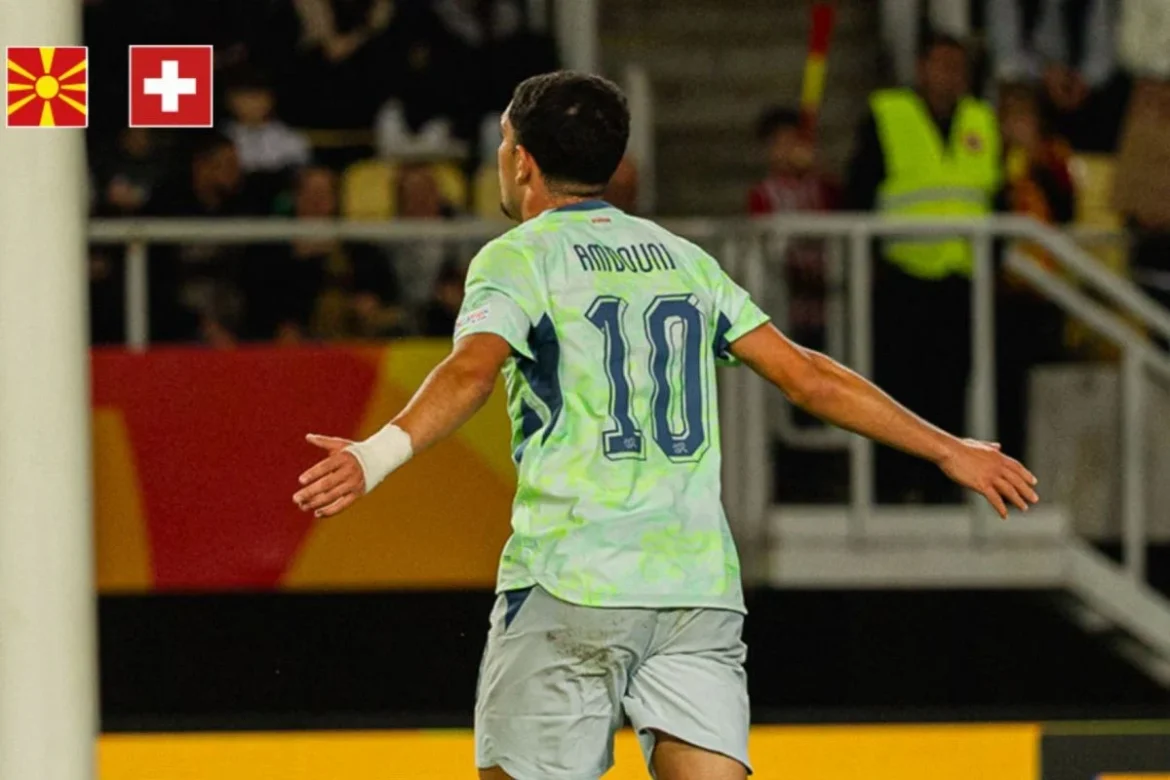
The landscape of the UEFA Nations League shifted significantly this past Saturday as Switzerland asserted their authority in Group A of League 2, securing a resounding 3-0 victory over North Macedonia at the Tose Proeski Arena in Skopje. In a concurrent fixture that highlighted the tactical deadlock often seen in European international football, Slovenia and Scotland played out a tense, scoreless draw at the Stozice Stadium in Ljubljana. These results, part of a sprawling slate of international fixtures across the continent, have set the tone for the group stages, offering early insights into which nations are poised for promotion and which face the daunting prospect of relegation.
Switzerland’s Tactical Masterclass in Skopje
Switzerland entered the match against North Macedonia with clear intent, looking to erase the memory of recent squad instability. Despite the high-profile absence of key playmaker Granit Xhaka—who remains sidelined due to personal matters related to COVID-19 documentation—the Swiss side displayed a cohesive and clinical performance.
The match began with Switzerland exerting high pressure, disrupting North Macedonia’s defensive structure from the opening whistle. The breakthrough arrived via Remo Freuler, whose technical precision provided the visitors with an early advantage. The momentum remained firmly with the Swiss throughout the first half, as they exploited gaps in the North Macedonian midfield. Zeki Amdouni, the standout performer of the night, proved to be the architect of North Macedonia’s downfall. His brace, coming from well-worked transitions, effectively silenced the home crowd and demoralized the hosts.
For North Macedonia, the result is a stark wake-up call. Competing in League 2, the level of opposition requires a defensive discipline that was clearly lacking in their organization on Saturday. The loss leaves them at the foot of Group A, placing immediate pressure on their coaching staff to recalibrate their defensive strategies before the next international window. Switzerland, conversely, sits atop the group with three points, boasting a superior goal difference that could prove vital as the competition progresses toward the final knockout stages.
The Stalemate in Ljubljana: Slovenia vs. Scotland
In stark contrast to the goal-heavy performance in Skopje, the clash between Slovenia and Scotland was a testament to defensive resilience and missed opportunities. On paper, Scotland entered the match as the side with a slight edge in technical pedigree, yet they found the Slovenian defensive block impenetrable.
The match at Stozice Stadium was characterized by a tactical tug-of-war. Scotland dominated possession and controlled the tempo through the midfield, but they struggled to breach the final third against a disciplined Slovenian backline. The hosts, content to absorb pressure and launch swift counter-attacks, looked dangerous on the break but lacked the final pass to punish the Scottish defense.
Statistically, Scotland registered more attempts on goal, but the quality of these chances remained low, with many efforts blocked by a well-organized Slovenian defensive line. By the time the final whistle blew, both sides were forced to share the spoils, each walking away with a single point. This result leaves Slovenia and Scotland locked in second and third place, respectively, mirroring the competitive parity that defines the middle tier of the UEFA Nations League structure.
A Continent in Motion: Broadening the Scope of the Nations League
The Saturday slate of the UEFA Nations League featured ten fixtures, providing a comprehensive view of European football’s current power dynamics. Beyond the headline groups, other matches offered dramatic narratives. Notably, San Marino suffered a heavy 7-0 defeat at the hands of Finland, a scoreline that underscores the widening gap between the continent’s emerging talents and those still struggling to find their footing on the international stage.
Meanwhile, the clash between England and Spain delivered the most intense entertainment of the evening, with Spain edging a 3-2 victory in a high-octane encounter. This result serves as a reminder of the prestige the Nations League has gained; it is no longer viewed as a series of glorified friendlies but as a critical testing ground for squads preparing for the upcoming European Championships and World Cup qualifiers.
Other notable results included:
- Kroasia 2-1 Czech Republic: A crucial away win that boosts Croatia’s standing in the tournament.
- Luksemburg 2-1 Bulgaria: A result that suggests a significant improvement in Luxembourg’s footballing infrastructure.
- Albania 2-0 Belarus: A professional display that reinforces Albania’s status as a formidable force at home.
- Slovakia 2-0 Moldova: A routine victory that keeps Slovakia in the hunt for top-tier promotion.
Contextualizing the Nations League Format
The UEFA Nations League was conceived to replace meaningless international friendlies with competitive matches that hold tangible stakes. By linking group performances to seeding for major tournaments and potential paths to the European Championship play-offs, UEFA has successfully increased the intensity of the international calendar.
The current 2026 cycle is particularly significant as it precedes the qualification phase for the 2027/2028 tournament cycles. For teams like Switzerland, the current Nations League campaign is an opportunity to experiment with squad depth while maintaining a winning culture. For nations like Scotland and Slovenia, the competition serves as a vital barometer for tactical evolution. The pressure to avoid relegation to League 3 ensures that even bottom-tier matches are played with a sense of urgency that was previously absent from international windows.
Tactical Implications and Future Outlook
The immediate implication of Saturday’s results is the consolidation of the power hierarchy in League 2. Switzerland’s commanding start signals that they are the team to beat. Their ability to dominate in the absence of veteran leadership suggests that their developmental pipeline is robust.
For Scotland, the draw against Slovenia is a setback in their quest for top-of-the-group supremacy. Managerial scrutiny will likely focus on their inability to convert possession into goals—a recurring theme in their international history. Similarly, Slovenia’s ability to secure a clean sheet against a side of Scotland’s quality provides a solid foundation for their campaign, though their lack of offensive output will need to be addressed if they hope to challenge for the top spot.
As the tournament progresses, the focus will shift to the October international window. Teams will have to contend with fatigue, player availability, and the tactical adjustments of their opponents. The volatility of these results highlights the beauty of the Nations League: in a format where every point is contested, there is no room for complacency.
Conclusion
Saturday’s action provided a microcosm of the modern international game: a mix of dominant offensive displays, disciplined defensive standoffs, and the occasional upset that keeps the tournament unpredictable. Switzerland has firmly established its intent to dominate its group, while the draw between Slovenia and Scotland ensures that the fight for second place remains wide open.
As the dust settles on this round of fixtures, the attention turns to the training grounds. Coaches will be dissecting these performances, analyzing the data, and preparing for the next set of challenges. With the landscape of European football constantly shifting, the Nations League remains the most vital indicator of a nation’s trajectory on the global stage. The path toward the final group standings is narrow, and for these teams, the journey has only just begun.
