
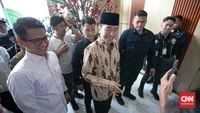
Jakarta, CNN Indonesia — Former Indonesian President Joko Widodo, commonly known as Jokowi, has broken his silence regarding the escalating political discourse concerning the potential impeachment of Vice President Gibran Rakabuming Raka, who is also his eldest son. The response comes amidst a turbulent period characterized by intense legal and constitutional scrutiny centered on the validity of the educational credentials utilized by the Vice President during his registration for the 2024 Presidential Election.
Speaking to members of the press on Thursday, November 5, following his appearance at the East Jakarta District Court in connection with a separate lawsuit concerning allegations of falsified diplomas, Jokowi maintained a measured stance. He emphasized the necessity of upholding democratic principles, the rule of law, and the constitutional rights of all citizens and political actors.
"Yes, we must respect all ongoing legal processes, and we must also respect the rights that are guaranteed within our constitution," Jokowi stated to reporters after the court session.
The discourse surrounding the impeachment of Vice President Gibran Rakabuming Raka did not emerge in a vacuum. It represents the culmination of a series of high-profile legal challenges adjudicated by the country’s supreme judicial bodies, specifically the Supreme Court (Mahkamah Agung – MA) and the Constitutional Court (Mahkamah Konstitusi – MK). These rulings have collectively ignited a fierce debate among legal scholars, civil society organizations, and lawmakers in the national parliament located in Senayan, Jakarta.
Chronology of the Legal and Political Controversy
The origins of the current controversy trace back to the administrative prerequisites established by the General Elections Commission (KPU) for candidates contesting the 2024 presidential election. As part of the mandatory registration process, candidates are required to submit proof of educational attainment demonstrating graduation from a Senior High School (SMA) or its equivalent.
The timeline of key events leading up to the current constitutional debate includes:
-
Tuesday, October 6: The Constitutional Court (MK) convened to examine a challenge regarding the evidentiary basis of Gibran’s secondary education credentials. During the proceedings, the court noted an absence of concrete evidence demonstrating that Gibran possessed a foreign diploma or certificate that could formally serve as the baseline for equivalency determinations as stipulated under the Election Law. Crucially, however, the Constitutional Court explicitly ruled that it lacked the legal authority to unilaterally annul or disqualify Gibran from his position as Vice President. Instead, the MK suggested that matters pertaining to executive accountability and administrative compliance involving high-ranking state officials fall within the purview of the legislative branch.
-
Friday, October 30: In a parallel judicial track, the Supreme Court (MA) issued a definitive ruling on a judicial review petition filed by petitioner HM Subhan. The Supreme Court granted the petition, declaring that the letter of equivalency for Gibran’s high school education—which had been utilized to fulfill candidacy requirements for the 2024 polls—was legally invalid.
-
Early November 2024: Following the Supreme Court’s decision and the Constitutional Court’s referral of the matter to the legislature, members of the House of Representatives (DPR) in Senayan initiated informal consolidations and cross-party discussions. Lawmakers began exploring the constitutional mechanisms associated with the impeachment of a sitting vice president, driving the issue to the forefront of national headlines.
-
Thursday, November 5: Former President Joko Widodo addressed the mounting political pressure for the first time, signaling a posture of compliance with institutional checks and balances while addressing the East Jakarta District Court.
Institutional Dynamics and Constitutional Frameworks
The intersection of the Supreme Court and Constitutional Court rulings has created an unprecedented institutional puzzle within Indonesia’s democratic architecture. Under Indonesian constitutional law, the impeachment or removal of a president or vice president is governed strictly by Article 7A of the 1945 Constitution. The article stipulates that a president and/or vice president may be dismissed from office during their term by the People’s Consultative Assembly (MPR) upon the proposal of the House of Representatives (DPR), specifically after the Constitutional Court has adjudicated that the official has committed treason, corruption, bribery, other felonies, or disgraceful acts, or no longer meets the requirements to hold office.
Legal experts have pointed out that while the Supreme Court holds jurisdiction over administrative legality—such as the validity of educational equivalency certificates—the formal mechanism to trigger a dismissal based on eligibility requires a multi-step legislative and judicial pathway. The Constitutional Court’s earlier declaration that it lacks direct disqualification authority over a seated vice president has effectively shifted the political weight of the decision onto the parliamentary floor.
In the wake of the Supreme Court’s October 30 ruling, political factions within the House of Representatives have experienced divergent reactions. Opposition figures and critics of the current administration have argued that the invalidation of the educational equivalency certificate undermines the foundational legitimacy of the vice-presidential candidacy. Conversely, supporting parties within the government coalition have emphasized that executive stability must be preserved, warning against the politicization of administrative disputes that could disrupt national governance and economic continuity.
Broader Implications for Governance and Stability
The unfolding situation presents a significant test for Indonesia’s judicial independence and legislative oversight mechanisms. Analysts suggest that the ongoing discourse could set a vital precedent regarding how administrative document verifications are handled for future high-level elected officials.
Furthermore, the involvement of Joko Widodo—whose tenure concluded only weeks prior to the height of these legal battles—underscores the continued political gravity associated with the former first family. Although Jokowi has consistently asserted his separation from active governance following the inauguration of President Prabowo Subianto and Vice President Gibran Rakabuming Raka, his public statements continue to carry substantial weight among political stakeholders and the broader public.
As legislative fractions continue their consultations behind closed doors in Senayan, civil society organizations have called for transparency, adherence to constitutional norms, and restraint from all political actors. Whether the exploratory discussions regarding impeachment will translate into formal parliamentary inquiries or constitutional motions remains contingent upon further legal clarifications and the strategic alignment of political parties represented in the national parliament.
