
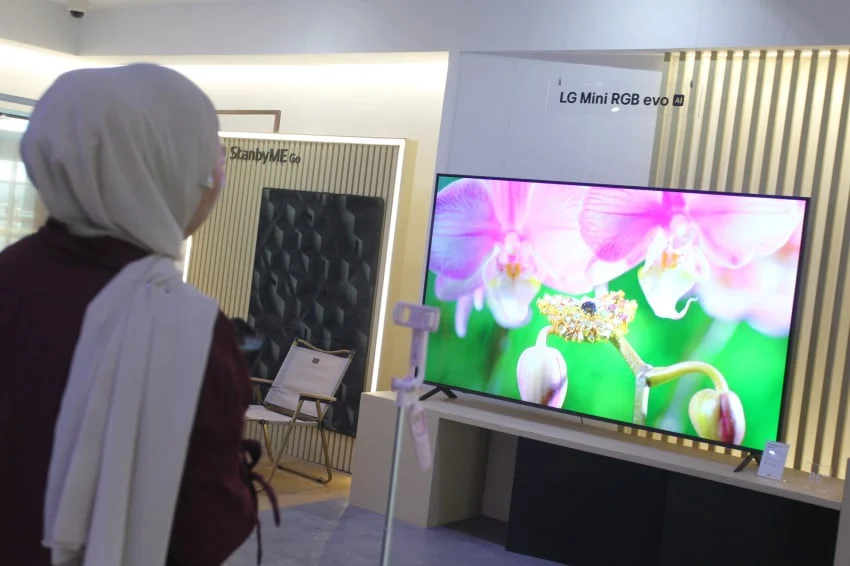
PT LG Electronics Indonesia has officially marked a historic milestone in the nation’s electronics manufacturing and technological landscape with the domestic launch of its groundbreaking flagship television series, the LG MRGB evo AI. Unveiled during a high-profile media event in Jakarta, this premium television lineup transcends the traditional boundaries of consumer electronics releases. Beyond its sophisticated hardware and cutting-edge display technology, the primary distinction of the LG MRGB evo AI lies in its origin. The television serves as a tangible testament to the capability of local Indonesian research and development talents, who played an instrumental role in conceptualizing, engineering, and bringing this world-class product to international standards.
This launch represents a strategic paradigm shift for multinational technology corporations operating within Indonesia. Historically, advanced research, development, and high-level engineering for flagship consumer electronics were predominantly centralized in headquarters located in South Korea, Japan, or North America. However, the introduction of the LG MRGB evo AI shatters this convention by positioning Indonesian engineers at the vanguard of global innovation. By proving that local expertise can directly influence and shape top-tier product development, LG Electronics Indonesia has not only redefined the standard for premium television displays but has also elevated the prestige of Indonesia’s engineering sector on the international stage.
The Genesis of Global Innovation from Local Soil
The developmental journey of the LG MRGB evo AI is deeply intertwined with the strategic growth of the LG Research and Development Subsidiary in Indonesia. Over recent years, LG has progressively expanded its operational footprint in the country, transforming local facilities from mere assembly and distribution hubs into active centers of technological creation. The engineering teams stationed in Indonesia were given the monumental task of contributing to the overarching framework of LG’s next-generation premium LCD television ecosystem.
Ha Sang-chul, President of PT LG Electronics Indonesia, expressed profound pride during the official unveiling ceremony regarding the exceptional achievements of the local R&D workforce. Addressing industry analysts, media personnel, and corporate stakeholders, Ha emphasized the unique selling proposition of the new television series.
"Inilah uniknya daya tarik TV LG MRGB evo AI. Menjadi puncak baru TV LCD premium di Indonesia, membawa inovasi kelas global yang tercipta dari kontribusi nyata talenta dalam negeri," stated Ha Sang-chul, underscoring that the pinnacle of modern LCD television technology is now fundamentally anchored in local ingenuity.
According to corporate insights shared during the launch, the active participation of Indonesian engineers in the MRGB evo AI project signifies a broader structural integration. The technical proficiencies cultivated within Indonesia’s educational and professional engineering ecosystems are no longer viewed merely as localized support systems. Instead, they have matured into an integral, indispensable component of LG’s global research and development supply chain. This evolution demonstrates that Indonesian professionals possess the rigorous analytical skills, technical acumen, and creative vision required to compete and excel in the fiercely competitive global electronics market.
Technological Anatomy of the LG MRGB evo AI

To comprehend the significance of the LG MRGB evo AI, one must examine the profound engineering breakthroughs housed within its sleek chassis. The television market has long contested the supremacy of various display technologies, particularly the ongoing rivalry between organic light-emitting diode (OLED) panels and advanced liquid-crystal display (LCD) screens equipped with sophisticated local dimming architectures. With the MRGB evo AI, LG has introduced a disruptive display typology that re-establishes the boundaries of what LCD technology can achieve, particularly in terms of brightness, color fidelity, contrast ratios, and energy efficiency.
At the core of the display’s revolutionary performance is an advanced lighting mechanism denoted by the nomenclature MRGB. This proprietary acronym represents the convergence of two cutting-edge illumination methodologies: Mini RGB and Micro RGB technologies. Unlike conventional LED-backlit televisions that utilize uniform white LEDs paired with color filters, the MRGB architecture fundamentally redesigns how light is generated, controlled, and delivered across the screen surface.
The integration of Mini RGB technology involves the deployment of significantly scaled-down light-emitting diodes to serve as the television’s backlight array. By reducing the physical dimensions of the individual diodes, engineers can pack exponentially more light sources into the exact same physical footprint behind the display panel. This physical miniaturization is complemented by Micro RGB technology, which refines the spectrum and precision of the emitted light particles.
Furthermore, the defining characteristic of this system lies in its unprecedented level of optical density and spatial precision. The microscopic LEDs are arranged with an extraordinarily tight packing density, minimizing the physical gaps between individual light sources. This ultra-dense configuration enables an exceptionally fine-grained local dimming capability. In practical terms, areas of the screen requiring absolute darkness can be dimmed with near-zero light leakage, while adjacent bright zones can achieve dazzling peak luminance levels without suffering from the dreaded "blooming" or halo artifacts that historically plagued older LED-backlit systems. The collaborative efforts of the Indonesian R&D team were heavily concentrated on optimizing this complex backlight driving algorithm, ensuring seamless synchronization between the physical LED matrix and the AI-powered video processing engine.
Artificial Intelligence Integration and Visual Processing
In alignment with modern consumer expectations for smart appliances, the LG MRGB evo AI incorporates advanced artificial intelligence algorithms designed to dynamically optimize both audio and visual performance in real time. The television does not merely display content; it actively analyzes it. Utilizing an advanced neural processor embedded within the hardware architecture, the television evaluates incoming video streams on a frame-by-frame basis, categorizing content types ranging from cinematic movies and high-speed sports broadcasts to standard-definition streaming media.
When processing legacy or low-resolution content, the AI-driven upscaling engine utilizes deep learning models trained on vast datasets of visual imagery to reconstruct missing textures, reduce compression artifacts, and enhance edge definition without introducing unnatural digital sharpening. Simultaneously, the artificial intelligence continuously monitors ambient lighting conditions within the viewing environment, automatically modulating the brightness, contrast curves, and color temperature of the MRGB panel to ensure optimal visual ergonomics regardless of whether the television is viewed in a pitch-black home theater or a sunlit living room.
Economic and Industrial Implications for Indonesia
The commercial introduction of the LG MRGB evo AI carries far-reaching economic implications that extend well beyond the consumer electronics retail sector. For Indonesia, the successful integration of local technical talent into the creation of a global flagship product serves as a powerful validation of the nation’s ongoing industrial transformation policies.

In recent years, the Indonesian government has aggressively pursued strategies aimed at moving the national economy up the global value chain. Policymakers have consistently emphasized the necessity of transitioning from a labor-intensive, low-skill manufacturing economy to a knowledge-based economy centered on technology, research, and high-value engineering. The achievement of the LG R&D Subsidiary in Indonesia serves as a tangible blueprint for how multinational corporations can successfully partner with local human capital to achieve mutually beneficial outcomes.
By fostering an environment where local engineers can collaborate directly with international counterparts on pioneering hardware and software developments, companies like LG Electronics are actively closing the skills gap that has historically hindered developing nations from participating in high-tech manufacturing. The knowledge transfer facilitated by these corporate R&D initiatives equips Indonesian engineers with invaluable expertise in advanced optics, semiconductor integration, artificial intelligence programming, and industrial design.
Market Position and Strategic Outlook
As the LG MRGB evo AI officially enters the Indonesian market, industry analysts are closely monitoring its performance within the fiercely competitive premium television segment. The domestic consumer electronics market has witnessed a steady upward trend in demand for ultra-large-screen televisions, enhanced resolution formats such as 8K and high-refresh-rate 4K, and sophisticated smart ecosystem integrations. Consumers are increasingly willing to invest in premium display solutions that offer cinematic-grade home entertainment experiences.
By positioning the MRGB evo AI as the new apex of LCD television engineering, LG is strategically targeting affluent consumers, tech enthusiasts, and early adopters who demand uncompromising visual fidelity. However, the unique narrative surrounding the product—its identity as a creation forged in part by Indonesian minds—bestows upon it a distinct emotional and patriotic resonance that foreign-exclusive imports simply cannot replicate. This localized pride is anticipated to serve as a formidable marketing advantage, fostering deep consumer brand loyalty and reinforcing the narrative that Indonesian professionals are capable of shaping the global technological vanguard.
Furthermore, the successful deployment of the LG MRGB evo AI establishes a formidable benchmark for competing electronics manufacturers operating within the region. It challenges industry norms and demonstrates that sustainable competitive advantage in the modern era relies not merely on aggressive pricing or sprawling supply chains, but on localized innovation, intellectual capital, and deep technological integration.
Conclusion: A New Era for Indonesian Engineering
The formal launch of the LG MRGB evo AI by PT LG Electronics Indonesia is much more than a routine product rollout; it is a watershed moment for the nation’s industrial and technological capabilities. By uniting global corporate resources with the brilliant minds of local researchers, LG has shattered historical glass ceilings and proven that world-class innovation knows no geographical boundaries.
As the television begins gracing homes across Indonesia and potentially making waves in international export markets, it stands as an enduring monument to what can be achieved when talent is nurtured, empowered, and provided with a global platform. The LG MRGB evo AI does not merely illuminate living rooms with its revolutionary Mini and Micro RGB technology; it illuminates the immense potential of Indonesia’s future in the global high-tech arena.
