
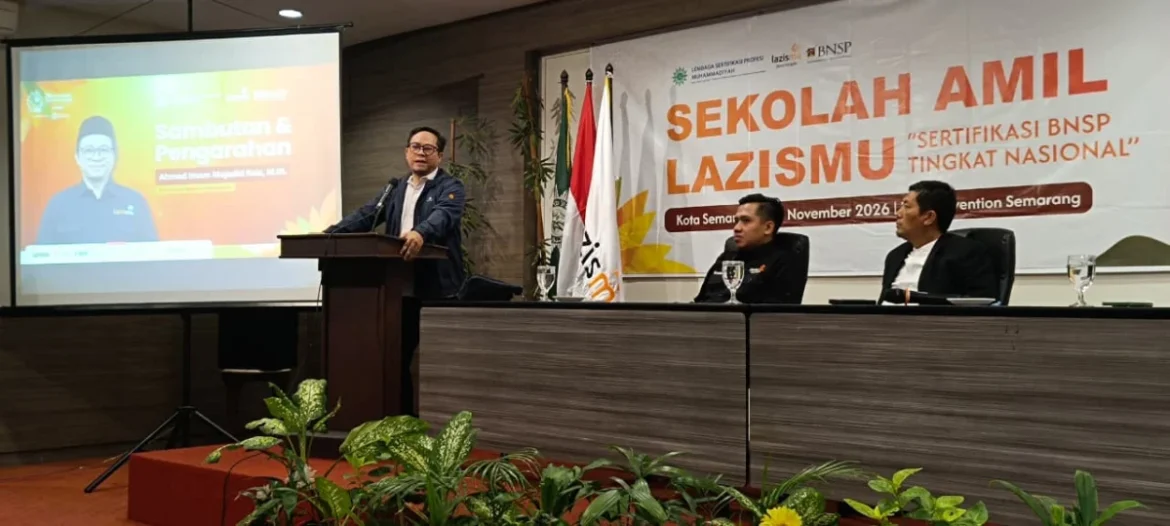
The landscape of modern Islamic philanthropy in Indonesia is undergoing a structural transformation, transitioning from traditional charity administration to a highly institutionalized, competency-driven profession. Recognizing that public trust is the foundational currency of the zakat sector, Lazismu—the official philanthropic arm of Muhammadiyah—has taken a definitive step toward institutional excellence by convening a rigorous nationwide training and certification program. Held from November 2 to 5, 2026, at the Hotel Candi Indah in Semarang, Central Java, the initiative brought together 121 delegates from regional and municipal Lazismu chapters across the archipelago. Designed to validate professional credentials through the National Professional Certification Agency (BNSP), this landmark event underscores a broader commitment to ensuring that the management of public religious funds meets the highest benchmarks of transparency, accountability, and strategic impact.
The Evolving Paradigm of the Modern Amil
Historically, the role of the amil (zakat administrator) was viewed primarily through a voluntary or informal lens, driven by religious devotion rather than formal corporate governance. However, as the volume of collected zakat, infaq, and sadaqah (ZIS) continues to scale exponentially nationwide, philanthropic institutions face increasingly complex regulatory environments, heightened public scrutiny, and the pressing demand for measurable socio-economic outcomes.
In response, Muhammadiyah has consistently advocated for the professionalization of the sector. The Semarang certification program operated under the decisive thematic banner: “Competent Amil, Superior Institution, Impactful Zakat.” This philosophy aligns directly with foundational Islamic teachings while integrating contemporary administrative frameworks. By positioning zakat management as a specialized vocation, Lazismu seeks to eliminate inefficiencies, mitigate operational risks, and maximize the utility of funds distributed to mustahik (zakat beneficiaries).
Chronology and Structural Execution of the 2026 Certification Program
The four-day intensive program was meticulously structured to balance theological grounding with technical proficiency. Serving as a key milestone leading up to the broader Muhammadiyah Zakat Summit (MZS), the agenda was divided into comprehensive instructional sessions followed by rigorous competency assessments.
The timeline of the event reflected a disciplined pedagogical approach:
- Days 1 to 3 (Thematic Instruction and Capacity Building): Participants engaged in intensive modules covering advanced zakat jurisprudence (fiqh zakat) according to the Tarjih perspective, critical studies of wealth distribution, executive zakat strategies, and persuasive donor relationship management. Technical sessions also focused on program design, monitoring frameworks, financial reporting in compliance with PSAK 409 standards, and human resource management.
- Day 4 (Competency Assessment): Candidates underwent formal evaluations administered by the Muhammadiyah Professional Certification Institute (LSP). The assessment framework was comprehensive, testing candidates across two primary competency clusters: the Collection Implementation Cluster and the Distribution and Utilization Implementation Cluster. Methods included portfolio verification, competency interviews, observational demonstrations, case studies, written examinations, and evidence cross-examination.
The operational execution of the summit was a collaborative effort, spearheaded by the Central Board of Lazismu in partnership with the Central Java Regional Board of Lazismu, alongside the Muhammadiyah LSP as the official certification certifying body.
Statistical Context: Bridging the National Certification Gap
Addressing the participants during the opening sessions, Ahmad Imam Mujadid Rais, Chairman of the Central Board of Lazismu, underscored the Quranic precedence of the amil profession while presenting a candid assessment of the organization’s current credentialing status. Referencing a semi-annual report submitted to the Central Leadership of Muhammadiyah, Mujadid Rais highlighted a historical deficit in certified personnel that the institution is actively working to correct.
Prior to the Semarang summit, national data recorded only 147 officially certified amil across the entire Lazismu network, with the central headquarters accounting for 49 of those individuals. The addition of 121 newly certified professionals from this single cohort represents a significant leap forward, more than doubling the prior operational capacity of the central body and injecting a fresh wave of standardized expertise into regional chapters.
Mujadid Rais emphasized that standardization is not merely an administrative checkbox, but a prerequisite for data-driven strategy. "With standardized amil competencies, we can more vigorously galvanize the zakat movement in Indonesia," he stated. "Amil must be equipped to read data and information as energy to formulate strategy. Data is vital in packaging collection and distribution programs. As capable amil, trusted by donors, we can instill absolute confidence and deliver transparent reporting."
Integrating Theology with Modern Management
The philosophical underpinnings of the training were further elaborated by key figures within the regional leadership. Dwi Swasana Ramadhan, Chairman of the Central Java Lazismu Board, noted that beyond the rigorous testing environment, the gathering served as an invaluable cross-regional networking platform. It allowed practitioners from diverse geographical backgrounds to share localized success stories, troubleshoot operational bottlenecks, and harmonize their community outreach methodologies.
Echoing this sentiment, Dodok Sartono, Secretary of the Muhammadiyah Regional Leadership of Central Java, delivered a strategic directive linking operational excellence to spiritual mandates. He urged participants to seamlessly integrate the ethical teachings of Surah Al-Ma’un—a core theological driver of Muhammadiyah’s social welfare movement—with contemporary corporate management principles.
Dodok elaborated that Muhammadiyah’s institutional longevity relies on a tripartite framework that synergizes the "movement of knowledge" (gerakan ilmu), the "movement of action" (gerakan amal), and the "movement of outreach/dakwah" (gerakan dakwah). Without rigorous scientific management, good intentions alone are insufficient to address the systemic structural poverty facing contemporary society.
Socio-Economic Implications and Sector-Wide Impact
The broader implications of Lazismu’s push for BNSP certification extend far beyond internal organizational metrics. As Indonesia’s Islamic economy continues to expand, regulatory bodies such as the National Zakat Agency (BAZNAS) and the Ministry of Religious Affairs have placed increasing emphasis on compliance, transparency, and the standardization of human resources across all Amil Zakat Institutions (LAZ).
By systematically certifying its workforce, Lazismu positions itself at the forefront of regulatory compliance and institutional maturity. The integration of PSAK 409 financial reporting standards ensures that institutional accounting practices withstand external audits and align with national financial reporting norms. Furthermore, by training amil in data literacy and impact monitoring, the organization shifts its evaluative focus from mere output metrics (how much funds were collected) to outcome metrics (how significantly a beneficiary’s life was improved).
In a macroeconomic climate where donors are increasingly discerning about where they channel their philanthropic contributions, institutional credibility serves as the primary driver of sustainable growth. Certified amil who possess deep technical knowledge of wealth distribution, combined with persuasive communication and transparent reporting frameworks, are uniquely positioned to unlock higher volumes of corporate and retail philanthropy.
Ultimately, the 2026 Lazismu Certification Program in Semarang marks a pivotal evolution in Indonesian Islamic philanthropy. By fusing deep-rooted theological imperatives with rigorous, state-sanctioned professional standards, Muhammadiyah is not only safeguarding public trust but is also engineering a resilient, highly competent workforce capable of turning religious obligations into tangible, long-lasting societal transformation.
