
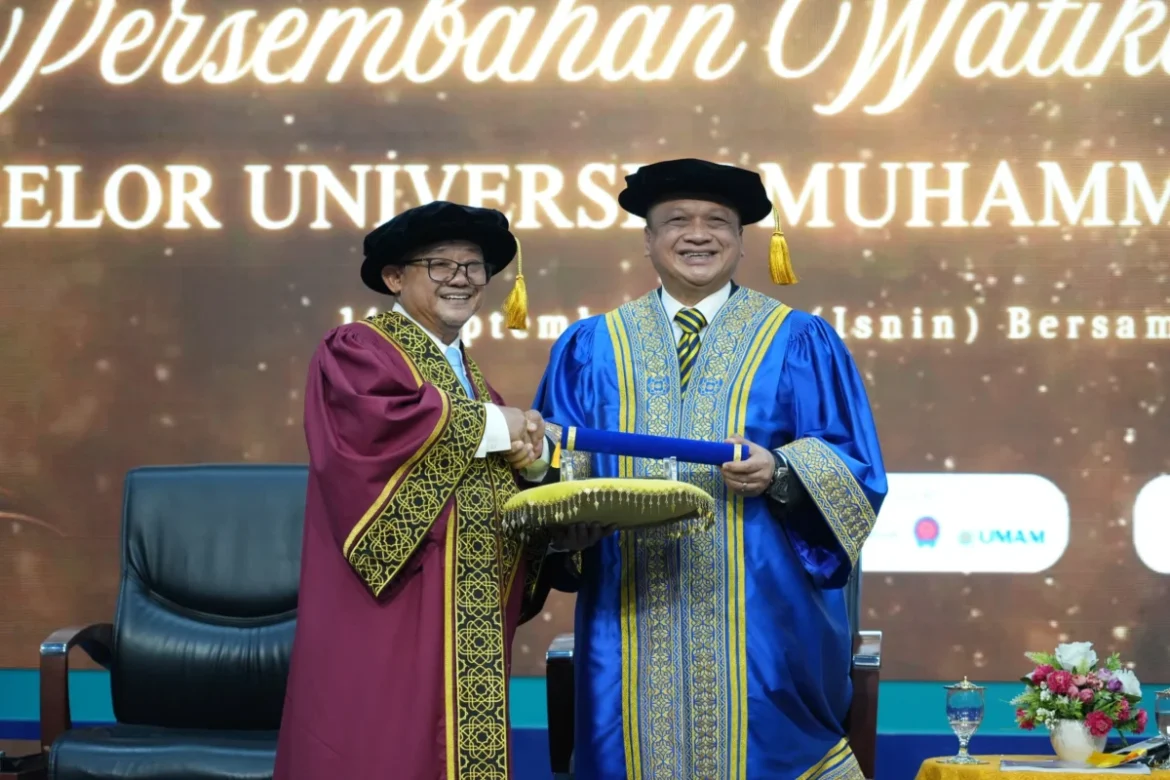
The landscape of international higher education within Southeast Asia reached a significant milestone on Monday, September 14, as Universiti Muhammadiyah Malaysia officially inaugurated His Royal Highness the Crown Prince of Perlis, Tuanku Syed Faizuddin Putra Jamalullail (representing the royal house), as its inaugural Chancellor. The historic inauguration ceremony took place at the campus of Universitas Muhammadiyah Sumatera Utara (UMSU) in Medan, Indonesia, drawing high-ranking academic figures, diplomats, and prominent leaders from both nations.
This high-profile event transcended a traditional academic investiture, serving instead as a powerful diplomatic and educational statement regarding bilateral cooperation between Indonesia and Malaysia. By anchoring the ceremony within a prominent Indonesian academic institution—UMSU—the event highlighted the deep-rooted cultural, religious, and educational ties that bind the two neighboring countries. The establishment and continuous development of UMAM represent a bold step by Muhammadiyah, one of Indonesia’s largest Islamic socio-religious organizations, to internationalize its educational mission and extend its footprint of enlightened, progressive education beyond domestic borders.
Strategic Vision and Diplomatic Significance
The inauguration was attended by key dignitaries, notably the General Secretary of the Central Board of Muhammadiyah, Abdul Mu’ti, who also serves as the Minister of Primary and Secondary Education of the Republic of Indonesia. Addressing the assembly, Mu’ti emphasized that the ceremony was far more than a routine administrative installation. Rather, it served as a strategic reinforcement of bilateral relations between Indonesia and Malaysia, executed through the vehicle of higher education development.
Muhammadiyah’s sustained commitment to building superior, sustainable human resources was central to the discussions surrounding the event. In an era defined by rapid globalization and intense economic competition, transnational educational initiatives like UMAM are designed to serve as bridges for intellectual exchange and capacity building. Mu’ti articulated a profound philosophical perspective regarding the ultimate goal of modern academic institutions during an era of profound technological disruption.
"The most crucial issue for a university is not merely how great we will become, but rather what kind of human beings we wish to produce," Mu’ti stated during his address. "This is the fundamental question that must continuously animate the journey of UMAM."
This philosophical stance addresses a growing anxiety within global academia: the tendency of modern universities to prioritize technical proficiency and labor-market metrics over holistic character development. By framing higher education as a moral and intellectual enterprise, Muhammadiyah seeks to position UMAM as an institution that balances cutting-edge capability with deep ethical grounding.
Navigating Technological Disruption and Ethical Leadership
Addressing the audience against the backdrop of the Fourth Industrial Revolution and the accelerated rise of artificial intelligence, Mu’ti noted that rapid technological advancements must be met with deliberate strategies to cultivate wisdom, intelligence, and principled leadership. The modern workforce requires more than technical dexterity; it demands moral fortitude and systemic integrity to manage the profound ethical dilemmas posed by emerging technologies.
"Because of this, UMAM must not merely chase capability. UMAM must give meaning to progress," Mu’ti asserted. This principle resonates deeply with Muhammadiyah’s long-standing educational philosophy, known locally as Islam Berkemajuan (Progressive Islam), which advocates for the harmonious integration of modern science, technology, and universal humanitarian values rooted in Islamic teachings.
In his capacity as Indonesia’s Minister of Primary and Secondary Education, Mu’ti’s presence underscored the strategic importance the Indonesian government places on regional educational partnerships. Cross-border academic ventures like UMAM help harmonize educational standards, foster mutual understanding, and create collaborative research ecosystems capable of addressing transnational challenges such as climate change, public health crises, and economic inequality within the Association of Southeast Asian Nations (ASEAN).
The Royal Mandate and Future Priorities for UMAM
Accepting his new role as the first Chancellor of Universiti Muhammadiyah Malaysia, His Royal Highness the Crown Prince of Perlis outlined an ambitious vision for the institution’s future. In his inaugural address, Tuanku Syed Faizuddin Putra Jamalullail emphasized his commitment to steering UMAM toward greater heights of academic excellence and international relevance.
The Crown Prince stressed that UMAM must now step into a broader phase of development by intensifying research output that directly addresses contemporary societal needs. In an interconnected world, universities cannot afford to remain isolated ivory towers. They must function as active problem-solvers, producing actionable research that informs public policy, drives sustainable economic development, and improves community well-being.
Furthermore, the Chancellor highlighted the expansion of international networks and strategic partnerships as an organizational priority. By fostering closer collaborations with the extensive network of Perguruan Tinggi Muhammadiyah ‘Aisyiyah (PTMA)—which comprises over 170 higher education institutions across Indonesia—as well as other global universities, UMAM is positioned to become a vibrant hub for transnational academic mobility.
"UMAM has a vast space to strengthen its role in the ASEAN higher education agenda," the Crown Prince stated. "Excellence in knowledge must go hand in hand with moral integrity, critical thinking, intellectual maturity, and a spirit of service to the Ummah and society."
Background and Evolution of Universiti Muhammadiyah Malaysia
The establishment of UMAM represents a historic milestone not only for Muhammadiyah but also for private Islamic higher education globally. As the first international university established by an Indonesian Islamic organization outside of its home country, UMAM’s journey from conception to realization reflects years of rigorous diplomatic negotiation, regulatory compliance, and institutional preparation.
Malaysia’s higher education sector is known for its stringent quality assurance frameworks, overseen by the Malaysian Qualifications Agency (MQA) and the Ministry of Higher Education. Securing approval to establish a foreign-backed private university required Muhammadiyah to demonstrate exceptional academic readiness, financial stability, and a clear vision for contributing to Malaysia’s national educational aspirations.
Located in Perlis, the northernmost state of Peninsular Malaysia, UMAM was envisioned as a boutique, research-intensive institution that would attract students and scholars from across the Malay Archipelago and beyond. The choice of the Crown Prince of Perlis as its first Chancellor adds immense institutional prestige and underscores the local royal endorsement and state-level support the university enjoys. This royal patronage provides UMAM with a unique diplomatic advantage, facilitating smoother institutional integration within the Malaysian federal system while enhancing its regional credibility.
The Broader Ecosystem: Perguruan Tinggi Muhammadiyah ‘Aisyiyah (PTMA)
To fully comprehend the significance of UMAM’s inauguration, one must examine the broader ecosystem of Muhammadiyah higher education. With a network of more than 170 higher education institutions spanning archipelago-wide Indonesia—ranging from large comprehensive universities like Universitas Muhammadiyah Malang, Universitas Muhammadiyah Yogyakarta, and UMSU itself, to specialized colleges—PTMA has long been a pillar of national development.
For over a century, Muhammadiyah has invested heavily in education, viewing schools and universities as primary instruments for social emancipation, poverty alleviation, and community empowerment. The network educates hundreds of thousands of students annually, contributing significantly to Indonesia’s gross enrollment ratio in tertiary education and producing leaders in government, judiciary, civil society, and the private sector.
The expansion into Malaysia via UMAM is the logical culmination of this domestic success. It marks the transition of Muhammadiyah from a national educational actor to an international higher education provider. By establishing a physical campus in Malaysia, Muhammadiyah aims to create a melting pot of academic talent from Indonesia, Malaysia, and other ASEAN member states, thereby promoting regional academic integration and cross-cultural understanding.
Implications for ASEAN Higher Education Integration
The inauguration of UMAM’s first Chancellor carries profound implications for the broader landscape of higher education integration within ASEAN. As the region moves toward greater economic and socio-cultural integration under the ASEAN Community blueprint, the harmonization of educational standards, student mobility, and joint research initiatives has become increasingly critical.
Higher education institutions in Southeast Asia face a dual challenge: they must enhance their global competitiveness while remaining responsive to local developmental needs. Traditional western-centric ranking metrics often sideline the unique socio-religious and communitarian contexts of Southeast Asian societies. By building a transnational educational bridge between Indonesia and Malaysia, UMAM and its affiliated PTMA institutions aim to pioneer an alternative model of academic excellence—one that marries rigorous scientific inquiry with ethical responsibility and community service.
Moreover, the leadership of figures like Abdul Mu’ti and the Crown Prince of Perlis ensures that UMAM will maintain strong policy-level connections with governmental bodies. This synergy between academic institutions, civil society organizations, and state leadership creates an enabling environment for policy innovation, curriculum reform, and large-scale collaborative grants.
Conclusion and Future Outlook
The inauguration of the Crown Prince of Perlis as the first Chancellor of Universiti Muhammadiyah Malaysia at UMSU in Medan marks a new chapter in regional academic diplomacy. By reaffirming a mutual commitment to ethical leadership, technological wisdom, and research-driven progress, the leaders of Muhammadiyah and the Malaysian royalty have set a high standard for transnational educational cooperation.
As UMAM continues to develop its academic programs, expand its research partnerships, and welcome cohorts of diverse students, it stands as a testament to the enduring vision of progressive Islamic education. In an era defined by rapid change and complex global challenges, institutions that successfully bridge the gap between technical capability and moral integrity will ultimately shape the future of society. Through strategic initiatives like UMAM, Muhammadiyah demonstrates that the pursuit of knowledge remains inextricably linked to the service of humanity.
