
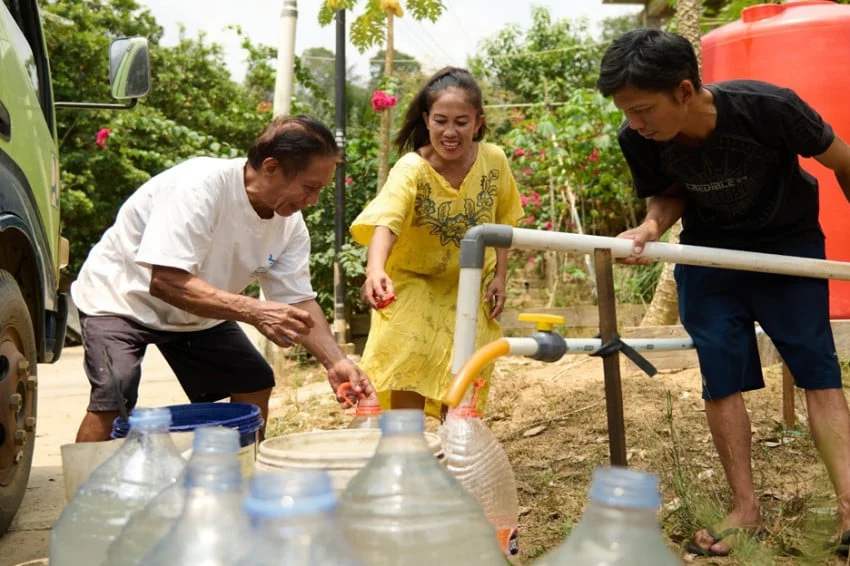
The Ministry of Public Works (PU) has intensified its emergency humanitarian and infrastructure response in East Kalimantan, distributing a total of 104,000 liters of clean water to communities grappling with severe drought conditions in Samarinda. The crisis, heavily exacerbated by the persistent impacts of the El Nino climate phenomenon, has drastically depleted raw water reserves across the region, critically drying up local water reservoirs such as the Lempake Dam and triggering extensive seawater intrusion into local freshwater aquifers. This compounding environmental stress has severely disrupted the routine distribution of potable water managed by local utilities, leaving thousands of residents across multiple neighborhoods without reliable daily access to clean water.
Operating under a coordinated emergency response framework, the central government through the Ministry of Public Works—specifically acting via the Balai Penataan Bangunan, Prasarana dan Kawasan (BPBPK) of East Kalimantan—has formed a strategic operational synergy with the Drought Disaster Handling Task Force of the Samarinda Regional Disaster Management Agency (BPBD). To bridge the immediate gap in water availability, authorities have deployed a dedicated fleet of three high-capacity water tanker trucks. These vehicles are stationed strategically to execute rapid-response deliveries, targeting residential pockets facing the most acute water scarcity.
Escalating Climate Pressures and the Root Causes of the Samarinda Water Crisis
The ongoing water emergency in Samarinda is not an isolated incident but rather part of a broader, systemic vulnerability linked to extreme weather anomalies. El Nino, characterized by prolonged periods of below-average rainfall and elevated surface temperatures, has placed unprecedented strain on East Kalimantan’s hydrological infrastructure. The regional raw water supply relies heavily on surface water bodies that are exceptionally sensitive to extended dry spells.
As seasonal precipitation plummeted, the Lempake Dam—a vital hydrological asset for the municipality—experienced critical drops in water volume, eventually reaching levels insufficient to sustain normal intake operations for water treatment plants. Simultaneously, the reduction in freshwater discharge from upstream river networks allowed saltwater from the Makassar Strait to push upstream into regional river basins. This saline intrusion contaminated primary raw water intakes, rendering standard municipal treatment processes ineffective and forcing widespread service suspensions.
Local communities, particularly those residing in elevated topography and peri-urban fringes where municipal piped networks are already sparse, bore the brunt of the shortage. Households found themselves heavily reliant on expensive commercial alternatives or vulnerable to procuring untreated water from compromised sources, elevating public health risks associated with waterborne illnesses.
Chronology of the Emergency Response
The deployment of emergency relief has followed a structured timeline coordinated closely between national agencies, regional technical units, and local disaster management boards.
- Early Phase (Mid-September 2026): Meteorological monitoring agencies flag an intensification of localized dry conditions across East Kalimantan, prompting the Ministry of Public Works to place regional technical units on high alert for potential infrastructure failures related to raw water scarcity.
- Late September 2026: Water levels at the Lempake Dam drop below critical operational thresholds, while municipal water utilities report high salinity levels at primary intake points. BPBD Samarinda formally requests emergency logistical support from the central government.
- October 1, 2026: The Ministry of Public Works, through BPBPK East Kalimantan and in active coordination with local BPBD task forces, officially initiates the emergency clean water distribution program. Three dedicated water tanker trucks are mobilized and dispatched to establish initial distribution routes.
- October 1 to November 3, 2026: Over a rigorous 34-day operational window, relief teams execute continuous distribution cycles. The operation scales up systematically, ultimately reaching 22 distinct distribution points mapped across eight vulnerable kelurahan (administrative villages) within Samarinda. By the close of this monitoring period, cumulative distributed volume reaches 104,000 liters.
- November 5, 2026: High-level evaluations are released by Ministry officials, confirming the stabilization of immediate basic needs in targeted zones while outlining long-term resilience frameworks to prevent systemic failure during future climate anomalies.
Official Statements and Institutional Coordination
Addressing the gravity of the situation, Minister of Public Works Dody Hanggodo emphasized that securing unhindered access to clean water is the cornerstone of effective disaster mitigation, particularly for vulnerable populations whose daily survival depends on swift governmental intervention.
"We do not want communities to be forced to wait until conditions deteriorate into a full-scale humanitarian crisis before they receive assistance. Field interventions must be executed rapidly, remain strictly targeted to those in need, and be customized to address the unique topographical and hydrological realities of each respective region," stated Minister Dody. He underscored that bureaucratic delays cannot be tolerated when dealing with essential human necessities such as potable water.
Echoing this sentiment, the Head of BPBPK East Kalimantan, Evry Biaktama Meliala, detailed the operational mechanics governing the rollout. He explained that the distribution strategy relies on a phased approach, continuously recalibrated against real-time data regarding community consumption rates and fluctuating water availability in affected sectors.
"Amidst a severe drought that directly undermines raw water security, the Ministry of Public Works remains steadfast in its commitment to standing alongside the community by ensuring sustained clean water distribution," remarked Evry. "We maintain continuous, real-time coordination with the regional BPBD and local government apparatus to ensure our logistical convoys penetrate deep into the zones most in need, guaranteeing that basic human requirements are met without interruption."
Broader Implications and Strategic National Context
The Samarinda water crisis reflects a broader national vulnerability to climate change, prompting the Indonesian government to aggressively re-engineer its water security architecture. The challenge extends far beyond East Kalimantan; concurrent dry spells and weather volatility across the archipelago have forced federal authorities to prioritize structural reforms in water resource management.
As part of a larger strategic push—highlighted by recent government initiatives to reinforce national water self-sufficiency from Papua to Nusa Tenggara—the Ministry of Public Works is accelerating the construction of multipurpose dams, deep groundwater wells, and piped regional transmission systems designed to buffer against future El Nino cycles. Analysts note that while emergency water trucking provides a crucial short-term lifeline, municipalities like Samarinda require permanent infrastructural adaptations. These include the development of off-stream storage reservoirs, advanced desalination or membrane-filtration technology to combat saltwater intrusion, and enhanced watershed conservation to protect existing raw water catchments from deforestation and degradation.
The successful execution of the 104,000-liter distribution campaign in Samarinda demonstrates the efficacy of cross-sectoral disaster response between central ministries and regional operational teams. However, it also serves as a stark reminder that as global climate patterns become increasingly erratic, disaster preparedness must transition from a reactive emergency posture to a proactive, climate-resilient institutional standard.
