
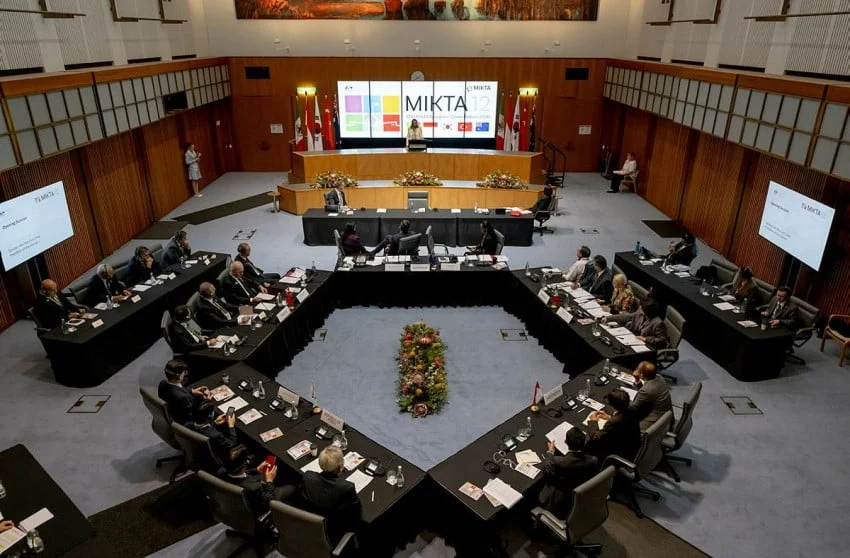
The current architecture of global governance is facing unprecedented stress, prompting international leaders to question the efficacy of post-World War II multilateral institutions. In a recent high-level address, Numan Kurtulmus, the Speaker of the Grand National Assembly of Turkey, issued a strong critique of the existing international system, specifically targeting the structural limitations of the United Nations Security Council. Speaking at the opening session of the 12th MIKTA Speakers’ Consultation in Canberra, Australia, Kurtulmus argued that the global community must proactively forge a new international order. He emphasized that the prevailing diplomatic and security framework has proven fundamentally incapable of resolving contemporary crises, preventing violations of state sovereignty, or halting military campaigns in Palestinian territories.
The high-profile meeting, hosted by the Australian Parliament in the nation’s capital, brought together legislative leaders from the MIKTA member states—comprising Mexico, Indonesia, Korea Selatan (South Korea), Turkey, and Australia. Kurtulmus delivered his remarks during the inaugural thematic session titled "Multilateralism, Parliamentary Leadership, and Shared Responsibility," following opening addresses by Australian Senate President Sue Lines and House Speaker Milton Dick. By leveraging the collective geopolitical and economic weight of the MIKTA bloc, the Turkish parliamentary leader underscored the pressing need for middle powers to step into a leadership vacuum created by the paralysis of traditional superpower-dominated forums.
Background Context and Structural Failures of the United Nations Security Council
The critique articulated by Kurtulmus centers on a long-standing debate concerning the structural obsolescence of the United Nations Security Council (UNSC). Established in 1945 in the wake of global devastation, the UNSC was designed to maintain international peace and security through its five permanent members—the United States, the United Kingdom, France, Russia, and China—each possessing veto power. However, critics, including numerous emerging economies and middle powers, argue that this composition reflects a geopolitical reality of the mid-20th century rather than the multipolar distribution of power in the 21st century.
In his address, Kurtulmus pointed directly to the ongoing conflict in Gaza as the primary empirical evidence of the international system’s collapse. Despite overwhelming global consensus, numerous General Assembly resolutions, and provisional measures ordered by the International Court of Justice, the Security Council has repeatedly failed to enforce binding ceasefires or compel a cessation of hostilities. This paralysis is predominantly attributed to the persistent use or threat of the veto by permanent members aligned with regional actors.
"Sayangnya, karena kelemahan struktural di Dewan Keamanan PBB, tidak ada yang dapat menghentikan Israel, bahkan jika seluruh dunia menginginkannya," Kurtulmus stated during the session, highlighting how institutional gridlock allows humanitarian catastrophes to persist unchecked. He further emphasized that the failure to protect Palestinian civilians undermines the foundational principles of international law, human rights, and the sovereign equality of states enshrined in the UN Charter. Consequently, the discourse surrounding global governance has shifted from institutional reform to the conceptualization of entirely alternative systems of international cooperation.
The Role of MIKTA in Navigating Escalating Geopolitical Competition
The choice of the MIKTA platform for this appeal is strategic. MIKTA—an informal partnership established in 2013—brings together five diverse middle powers spanning four continents. Representing distinct geographic, cultural, and economic profiles, Mexico, Indonesia, South Korea, Turkey, and Australia collectively possess significant global influence. They share a commitment to effective multilateralism, democratic governance, and open economies, yet they operate outside the traditional G7 or BRICS frameworks, positioning them as pragmatic bridges between the Global North and the Global South.
During the Canberra consultations, Kurtulmus elaborated on the first of five core thematic justifications for why MIKTA is uniquely positioned to help construct a new world order: the relentless intensification of geopolitical competition. The global landscape is currently undergoing a profound systemic transformation, characterized by deepening polarization, resurgent nationalism, and protracted regional conflicts that directly challenge the rules-based international order.
Kurtulmus observed that the rapid pace of global change is systematically dismantling conventional diplomatic assumptions, historical habits, and the established terminologies of the post-Cold War era. This systemic volatility has generated a widespread intellectual and political search among academics, policymakers, and diplomats for novel frameworks capable of managing transnational challenges. Because MIKTA members maintain diverse diplomatic alignments and independent foreign policies, the grouping serves as an ideal laboratory for forging consensus across ideological divides, promoting dialogue, and preventing the hardening of new Cold War-style blocs.
Transition Toward Multipolarity and the Responsibility of Middle Powers
The second major pillar supporting the proposition of a new global order is the inexorable shift toward multipolarity. For decades following the dissolution of the Soviet Union, the international system oscillated between unipolar dominance and fragmented bipolarity. However, the economic rise of Asian economies, the diversification of diplomatic partnerships in Latin America, Africa, and the Middle East, and the assertion of strategic autonomy by middle powers have rendered unipolarity obsolete.
Kurtulmus noted that while the precise contours of the emerging global architecture remain uncertain, it is unmistakably coalescing around a multipolar reality. In a multipolar system, global governance can no longer be dictated by a small oligarchy of major powers. Instead, stability depends on active minilateralism and inclusive plurilateral networks like MIKTA. These coalitions amplify the voices of states that might otherwise be marginalized in traditional security architectures.
The responsibility of parliamentary leadership within this transitional phase is critical. Legislative diplomacy—parliamentary exchanges, joint resolutions, and cross-border legislative oversight—supplements traditional executive-led diplomacy. By engaging through parliamentary networks, MIKTA members can foster people-to-people ties, enhance legislative transparency, and build robust institutional resilience against geopolitical shocks.
Chronology of MIKTA and the Canberra Consultations
To understand the trajectory of MIKTA’s ambition to influence global governance, it is instructive to examine the evolution of the grouping:
- September 2013: MIKTA is officially launched on the sidelines of the United Nations General Assembly in New York, initiated by the foreign ministers of Mexico, Indonesia, South Korea, Turkey, and Australia to enhance cooperation among influential middle powers.
- 2014–2022: The group holds regular ministerial meetings and specialized consultations focusing on sustainable development, counter-terrorism, energy security, and the reform of multilateral institutions. Over successive presidencies, MIKTA expands its agenda to address global health security and digital governance.
- February 2024: Australia assumes the rotating presidency of MIKTA for the year, focusing legislative cooperation on the theme of multilateralism, parliamentary leadership, and shared responsibility.
- Late 2024 (Canberra Summit): The 12th MIKTA Speakers’ Consultation convenes in Canberra, hosted by Australian Senate President Sue Lines and House Speaker Milton Dick. Turkish Parliament Speaker Numan Kurtulmus delivers a keynote address calling for systemic global reform and the creation of a new international order to counter aggressions against state sovereignty.
Fact-Based Analysis of Implications and Broader Impacts
The call by high-ranking officials like Kurtulmus for a new global order carries profound implications for international law, diplomatic norms, and institutional reform. While visionary, the proposition of constructing an alternative global system faces formidable practical hurdles.
- Institutional Inertia vs. Reform: The existing global architecture is deeply entrenched in international treaties, financial systems, and security pacts. Replacing or fundamentally restructuring bodies like the United Nations requires unprecedented diplomatic consensus among permanent UNSC members who benefit from the status quo. Consequently, practical reform is more likely to manifest through parallel institutions, minilateral coalitions, and regional security frameworks rather than an overnight dismantling of the UN.
- Strategic Autonomy of Middle Powers: For MIKTA members, advocating for a new global order reinforces their commitment to strategic autonomy. Countries like Indonesia and Turkey frequently champion the interests of the Global South, emphasizing that international law must apply universally without double standards. By articulating these positions in international forums, these nations pressure traditional superpowers to take demands for governance reform seriously.
- The Gaza Conflict as a Catalyst for Normative Shifts: The inability of the international community to halt the humanitarian crisis in Palestine has exposed a deep normative fracture. It signals to developing nations that the rules-based order is applied selectively. This disillusionment accelerates the fragmentation of global diplomacy, as evidenced by the expansion of alternative groupings such as BRICS and the rising assertiveness of middle powers in international litigation and mediation.
- Strengthening Minilateralism: As traditional multilateral institutions experience gridlock, minilateral platforms like MIKTA are poised to play an increasingly vital role. Offering a flexible, agenda-driven format unburdened by heavy bureaucracies, these groups can pilot innovative policy responses to emerging transnational challenges, ranging from supply chain resilience to cybersecurity regulation.
Official Responses and Future Outlook
While Australian hosts Sue Lines and Milton Dick focused the Canberra consultation on institutional resilience and parliamentary cooperation, the forceful interventions by delegations such as Turkey’s injected a sense of urgency into the proceedings. Observers note that while MIKTA members hold differing perspectives on specific regional conflicts, there is a growing internal consensus that middle powers must act collectively to uphold international law and prevent the erosion of multilateralism.
In conclusion, the 12th MIKTA Speakers’ Consultation has underscored a fundamental truth of contemporary international relations: the current global order is under severe strain, and its structural deficiencies can no longer be ignored. Whether through comprehensive reform of existing institutions or the incremental construction of a new diplomatic architecture, the advocacy led by parliamentary leaders signals that middle powers are no longer content to remain passive spectators in global governance. As geopolitical competition continues to evolve, the ability of coalitions like MIKTA to foster dialogue, bridge divides, and demand accountability will serve as a critical barometer for the future stability of the international system.
