
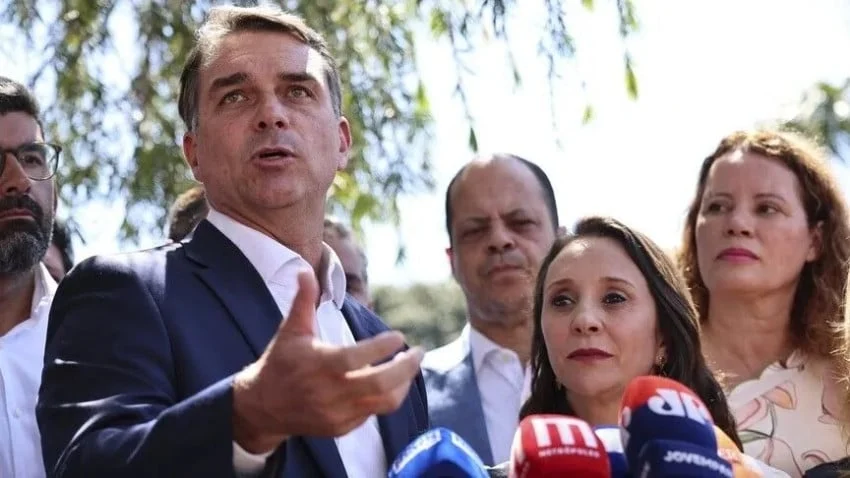
The departure of the senator, confirmed by sources cited by Reuters and Brazilian media outlet Jovem Pan on Tuesday, October 27, 2026, marks another chapter in the deepening crisis surrounding the Bolsonaro family. As the political machinery of the former administration continues to face intense legal scrutiny, Flavio’s decision to relocate to the U.S. mirrors the path previously taken by his brother, Eduardo, amid mounting allegations of corruption and abuse of power.
A Rapid Political Exit
The electoral loss of Flavio Bolsonaro in the second round of the national elections came as a shock to his supporters, especially given that he had secured the highest number of votes during the initial round held earlier this month. The defeat has effectively stripped him of his parliamentary immunity, a protection that has long shielded him from the reach of the Brazilian judiciary.
Reports from Brasilia indicate that the senator departed for the United States shortly after the results were finalized. His arrival coincides with a period of heightened diplomatic activity, as a senior official from the U.S. Department of State confirmed to the Associated Press that the Bolsonaro family would be granted U.S. visas. This decision has sparked debate regarding the intersection of political asylum, diplomatic courtesy, and the extradition requests currently being processed by Brazilian authorities.
The Legal Quagmire
Flavio Bolsonaro’s flight is widely perceived as a tactical maneuver to avoid an impending legal reckoning. He is currently the subject of several high-profile investigations, the most significant of which involves allegations of money laundering and currency evasion. These investigations are centered on his financial dealings with lawyer Willer Tomaz and a network of businesses reportedly linked to illicit online gambling operations.
Furthermore, the senator is entangled in a separate probe concerning financial irregularities related to the production of Dark Horse, a film biography of his father, Jair Bolsonaro. Prosecutors allege that the film’s funding structure was utilized as a vehicle for personal enrichment and the laundering of illicit funds. While Flavio has consistently denied any wrongdoing, describing the investigations as politically motivated "lawfare," the evidence gathered by the federal police suggests a systematic pattern of financial misconduct.
The Precedent of Eduardo Bolsonaro
The trajectory of the Bolsonaro family’s exit from Brazil was established by Eduardo Bolsonaro, the younger brother and a former congressman. In February 2025, Eduardo moved to the United States, publicly citing fears of political persecution and imminent arrest. His departure did not end his legal troubles, however.
In June 2026, a Brazilian court found Eduardo guilty of attempting to interfere with the judicial proceedings against his father. The charges stemmed from his efforts to lobby Washington to impose sanctions on Brazilian officials who were investigating the Bolsonaro family. He was subsequently sentenced to four years and two months in prison. His ongoing presence in the U.S. has since become a point of friction in bilateral relations, as Brazilian prosecutors continue to push for his extradition.
Chronology of the Bolsonaro Family Crisis
To understand the current state of affairs, one must examine the timeline of the unraveling of the Bolsonaro political dynasty:
- January 2023: Jair Bolsonaro leaves Brazil for the United States shortly before the inauguration of Luiz Inacio Lula da Silva, following a violent uprising in Brasilia by his supporters.
- May 2024: After returning to Brazil, Jair Bolsonaro is arrested and subsequently convicted on charges of abuse of power and inciting anti-democratic acts.
- February 2025: Eduardo Bolsonaro flees to the U.S., claiming he is a victim of a politically motivated purge.
- October 2026: Flavio Bolsonaro wins the first round of the senatorial election but suffers a narrow defeat in the second round, losing his legislative immunity.
- October 27, 2026: Reports confirm Flavio has arrived in the United States, securing a visa shortly after his electoral loss.
Analytical Perspective: The "Political Exile" Strategy
Political analysts observing the situation suggest that the Bolsonaro family is utilizing the United States as a sanctuary from the domestic legal system. By framing their legal challenges as political persecution, they attempt to align themselves with a specific narrative favored by international allies, including supporters of former U.S. President Donald Trump.
"The pattern is clear," notes a political science professor at the University of Brasilia. "By moving to the United States, the Bolsonaros are betting that the U.S. legal system will be more difficult for Brazilian prosecutors to navigate than the courts in Brasilia. They are seeking to transform domestic criminal investigations into matters of international diplomatic dispute."
However, this strategy carries significant risks. Should the U.S. administration decide that the charges against the Bolsonaros are purely criminal rather than political, the protection of their visas could be revoked. Furthermore, international cooperation on anti-corruption and money laundering initiatives has strengthened significantly over the past decade, potentially narrowing the window of safety for those fleeing such charges.
Official Responses and International Implications
The Brazilian Ministry of Justice has remained relatively tight-lipped regarding the specific extradition status of Flavio Bolsonaro, though officials have stated that they are prepared to follow all legal protocols to ensure that individuals under investigation remain accountable to the Brazilian judicial system.
Conversely, the U.S. State Department’s decision to grant visas has been met with quiet criticism from legal transparency advocates. Critics argue that providing sanctuary to individuals accused of high-level corruption undermines the rule of law and complicates the diplomatic relationship between the two largest democracies in the Americas.
Domestically, the flight of the senator has deepened the polarization within Brazil. Supporters of the Bolsonaro family view the move as a necessary survival tactic, while opponents characterize it as a cowardly evasion of justice. The departure of another high-ranking official serves as a potent symbol of the collapse of the right-wing populist wave that defined Brazilian politics for much of the early 2020s.
Broader Impact on Brazilian Governance
The absence of the Bolsonaros from the domestic political scene creates a power vacuum within the Brazilian right, which is currently struggling to redefine itself. With the former president incarcerated and his sons in self-imposed exile, the movement is facing a crisis of leadership.
Economically, the investigations into the Bolsonaros have shed light on the pervasive issue of financial transparency in Brazilian politics. The alleged use of film production companies and gambling rings for money laundering has prompted calls for more stringent campaign finance laws and tighter oversight of the assets of elected officials.
As the legal proceedings continue, the focus will likely shift to whether the United States will ultimately cooperate with the Brazilian judiciary. The resolution of this case will not only determine the fate of Flavio Bolsonaro but will also serve as a benchmark for how the United States manages the delicate balance between asylum claims and the international pursuit of justice.
For now, the silence from the Bolsonaro camp remains absolute. As the senator settles into his life in the United States, the legal machinery in Brazil continues to turn, setting the stage for a protracted international legal battle that will likely define the legacy of the Bolsonaro era for years to come. The era of the "Bolsonaro brand" in Brazilian governance has effectively concluded, leaving behind a complex web of legal consequences and a nation still grappling with the divisions of the past decade.
