
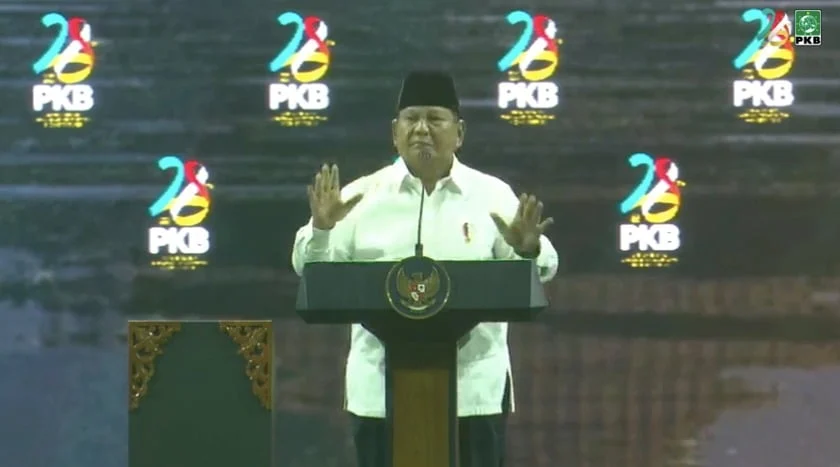
Jakarta, Indonesia – President Prabowo Subianto, speaking at the 28th anniversary celebration of the National Awakening Party (PKB) in Jakarta on Thursday, July 23, 2026, delivered a speech that touched upon a range of issues, notably including his perception of certain media outlets and a group he cryptically referred to as "Londo Ireng." The event, held at the Jakarta Convention Center (JCC), drew significant attention as it provided a platform for the President to articulate his views on national development and public discourse.
During his address, President Prabowo expressed his observation that media coverage, in his view, disproportionately highlights negative aspects of the government’s performance, even when substantial progress has been made. He cited the renovation of tens of thousands of schools as an example of government achievements that he felt were being overshadowed.
“There are also media outlets that, you know, even though we have repaired 27,000 schools, they will search for a school that has not yet been repaired and put it on the front page. They think we don’t understand,” President Prabowo stated, his tone suggesting a veiled critique of journalistic practices.
While President Prabowo acknowledged he was aware of the specific media organizations he was alluding to, he chose not to name them directly during the gala. He hinted, however, that he might reveal their identities at a later time, stating, “I won’t mention which media. At the right time, I will mention them. You already know.” This statement, delivered with a degree of theatricality, immediately sparked speculation among attendees and observers about the intended targets of his remarks.
The term "Londo Ireng," which translates to "Black Dutch" or "Dark Foreigners" in Indonesian, is not a commonly recognized political or social designation. Its usage by the President, therefore, has led to considerable interpretation and debate. Without explicit clarification from the President himself, the term is open to a wide range of meanings. It could potentially refer to internal actors perceived as being influenced by foreign interests, individuals or groups with a colonialist mindset, or even those who consistently adopt a critical and negative stance towards national development initiatives, irrespective of their background. The ambiguity of the term allows for broad application and has become a focal point of discussion following the President’s speech.
Context of the PKB Anniversary and National Development Initiatives
The 28th anniversary of the National Awakening Party (PKB) is a significant event in Indonesia’s political calendar, marking another year for a party that has consistently played a role in national governance. The PKB, founded on July 23, 1998, emerged from the Indonesian Ulema Council (MUI) and the Nahdlatul Ulama (NU) organization, positioning itself as a party rooted in Islamic values and nationalist principles. Its consistent presence in coalition governments over the past decades underscores its political relevance.
President Prabowo’s attendance and speech at this particular event hold particular weight. As the current President, his participation signals continued political alignment and support for the PKB, a key coalition partner. The timing of his remarks, coinciding with a celebration of a prominent political party, amplifies their significance, suggesting that his observations are not merely casual comments but are intended to convey a message to both the political elite and the broader public.
The President’s mention of infrastructure development, specifically the renovation of schools, points to a broader narrative of national progress that his administration aims to highlight. The figure of 27,000 schools renovated is a substantial undertaking, indicative of a significant investment in the nation’s educational infrastructure. This detail, when juxtaposed with his criticism of media focus on the unrenovated schools, suggests a concern about the framing of national achievements and the potential for negative reporting to undermine public perception of progress.
Chronology of the President’s Remarks
The President’s address at the PKB anniversary event on Thursday, July 23, 2026, can be broken down into several key moments related to his controversial statements:
- Early in the speech: President Prabowo began by acknowledging the government’s efforts in national development, including the significant undertaking of renovating a large number of schools.
- Transition to media critique: He then shifted his focus to the media, expressing his dissatisfaction with what he perceived as a disproportionate emphasis on negative news. He used the example of school renovations to illustrate his point, stating that media outlets often chose to highlight the few schools that remained unrepaired rather than the thousands that had been improved.
- Introduction of "Londo Ireng": It was during this segment of his speech that President Prabowo introduced the term "Londo Ireng," linking it implicitly to the critical media narrative. While he did not explicitly define the term, his juxtaposition of it with the media’s selective reporting implied a connection between the two.
- Vague identification of media: He further fueled speculation by stating that he knew which media outlets he was referring to but chose not to name them publicly at that moment, promising to do so "at the right time." This deliberate withholding of names added an element of suspense and intrigue to his address.
Supporting Data and Analysis of Development Initiatives
The Indonesian government, under President Prabowo’s leadership, has been actively pursuing various development agendas. The renovation of 27,000 schools, as mentioned by the President, is a significant project that aligns with the broader goal of improving educational access and quality across the archipelago. To provide context for this figure:
- Scale of the Project: Indonesia, with its vast geography and large student population, faces continuous challenges in maintaining and upgrading its educational facilities. The figure of 27,000 schools represents a substantial portion of the nation’s educational infrastructure, indicating a considerable national effort.
- Funding and Resources: Such a large-scale renovation project would require substantial budgetary allocations from the national government, potentially supplemented by regional and local funding. The success and scope of such initiatives are often indicative of a government’s commitment to human capital development.
- Impact on Education: Improved school facilities can directly impact student learning environments, teacher morale, and overall educational outcomes. Well-maintained classrooms, laboratories, and libraries are crucial for effective teaching and learning.
However, the President’s critique suggests that the impact of these renovations might not be fully reflected in public discourse. This points to a potential disconnect between the government’s narrative of progress and the way it is being communicated or perceived by segments of the media and the public.
Potential Interpretations of "Londo Ireng"
The term "Londo Ireng" is a colloquial Indonesian phrase, and its interpretation can vary significantly depending on the context and the speaker’s intent. Several possible meanings can be inferred:
- Neo-colonialism or Foreign Influence: Historically, "Londo" refers to the Dutch, the former colonial power in Indonesia. "Ireng" (black) could imply a continuation or manifestation of foreign influence, perhaps in a more insidious or covert manner, influencing domestic affairs or discourse. This interpretation suggests a concern about external actors attempting to undermine national sovereignty or progress.
- Internal Critics with a Negative Bias: Alternatively, "Londo Ireng" might refer to Indonesian citizens or groups who, regardless of their background, consistently adopt a highly critical and negative stance towards national policies and achievements. This could include individuals who are perceived as being out of touch with the realities of the nation or who possess a mindset that is resistant to change and progress.
- A Combination of Factors: It is also possible that the term encompasses both external influences and internal actors who are perceived to be acting in alignment with or in furtherance of such influences. This would suggest a concern about a network of individuals or entities working against the national interest.
The ambiguity of the term allows President Prabowo to address a broad spectrum of perceived opposition or criticism without having to explicitly identify specific individuals or groups, thereby maintaining a strategic advantage and leaving room for further political maneuvering.
Official Responses and Broader Implications
As of the time of this report, there have been no immediate official statements from any media organizations directly addressing President Prabowo’s remarks. The absence of a direct response, however, does not diminish the potential implications of his comments.
- Impact on Media-Government Relations: The President’s veiled criticism could signal a period of heightened tension between the government and certain media outlets. This could lead to increased scrutiny of media reporting and potentially more cautious or self-censored reporting from journalists.
- Political Messaging: By using a charged term like "Londo Ireng," President Prabowo is likely aiming to galvanize his support base and frame his political opponents or critics in a negative light. This could be a tactic to consolidate power and to create a narrative of national unity against perceived external or internal adversaries.
- Public Discourse: The term "Londo Ireng" is now a subject of public discussion, prompting citizens to question its meaning and to consider who might be included in this category. This could lead to increased public awareness of political dynamics and a greater engagement with the nuances of national discourse.
- Future Actions: The President’s promise to name specific media outlets at a later date suggests that his remarks may be a precursor to more direct actions or interventions. This could range from public shaming to more formal measures, depending on the political climate and the President’s strategic objectives.
The President’s address at the PKB anniversary serves as a potent reminder of the complex interplay between political power, media scrutiny, and national development narratives in Indonesia. The use of the term "Londo Ireng," while ambiguous, has undoubtedly injected a new layer of intrigue and potential conflict into the ongoing political discourse, leaving many to ponder its true meaning and its far-reaching implications for the nation’s future. The coming weeks and months will likely reveal more about the intended targets and consequences of President Prabowo’s remarks.
