

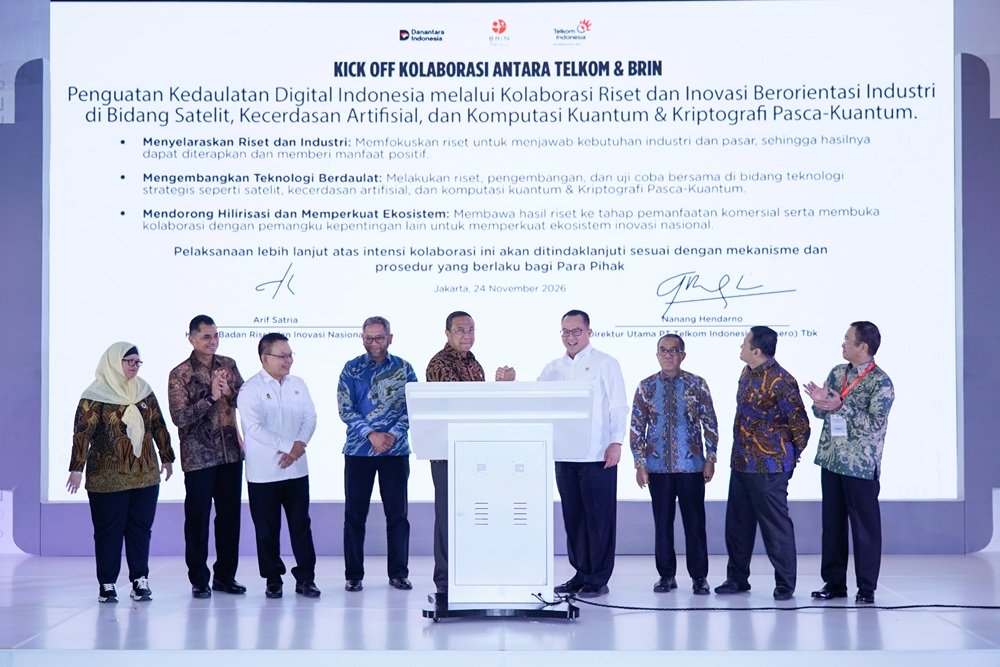
In a landmark move to fortify Indonesia’s digital autonomy, Telkom Indonesia and the National Research and Innovation Agency (BRIN) have formally entered into a strategic collaboration aimed at accelerating the nation’s technological prowess. The partnership, solidified through an Intensi Kolaborasi (Collaboration Intention) agreement signed in Jakarta on November 24, 2026, marks a pivotal shift in how Indonesia bridges the gap between academic research and commercial industrial application. By integrating BRIN’s sophisticated research capabilities with the expansive business ecosystem of TelkomGroup, the initiative seeks to move beyond mere technology adoption, fostering an environment where home-grown innovations in Artificial Intelligence (AI), satellite communications, and quantum computing can thrive.
The agreement was signed by BRIN Head Arif Satria and Telkom Indonesia President Director Nanang Hendarno. The framework of this collaboration is built on a "joint innovation-to-commercialization" model. This approach is designed to ensure that the scientific breakthroughs emerging from BRIN’s laboratories are not left to stagnate in academic journals but are instead pressure-tested, refined, and deployed as viable commercial solutions for both the private sector and the general public.
The Strategic Imperative for Digital Sovereignty
For Indonesia, the push for technological self-reliance is more than an economic ambition; it is a matter of national security. During the signing ceremony, Nanang Hendarno emphasized that true digital sovereignty is unattainable if a nation remains solely a consumer of foreign technology. "Indonesia possesses significant research capacity within BRIN," Hendarno stated. "Telkom’s role is to act as the conduit, connecting this immense research potential with market realities. We are moving from a model of importing solutions to a model of creating them domestically."
This sentiment reflects a growing consensus among Indonesian policymakers that relying on third-party technological stacks introduces risks regarding data privacy, security, and long-term economic dependency. By fostering a domestic pipeline for AI and satellite infrastructure, the collaboration aims to shield critical national data and communication channels from external vulnerabilities.
Technical Pillars of the Collaboration
The partnership focuses on three high-impact technological sectors, each chosen for its potential to reshape the digital landscape of the archipelago.
1. Artificial Intelligence and the ModelHub Platform
The AI component of the collaboration is arguably the most ambitious. The primary focus is the development of Large Language Models (LLM) and Small Language Models (SLM) specifically optimized for the Indonesian language and cultural context. Through a dedicated platform known as ModelHub, researchers and industry partners will be able to refine models that understand the nuances of local dialects and domestic business processes.
The initiative has already secured early-stage support from major industrial players, including Danantara Indonesia, MIND ID, Pertamina, and Garuda Indonesia. By deploying these AI models across sectors as diverse as agriculture, fisheries, healthcare, and mining, the project aims to optimize operational efficiency. For instance, in the mining sector, AI-driven predictive analytics could revolutionize resource extraction, while in agriculture, it could provide smallholder farmers with hyper-local climate data and yield predictions.
2. Satellite Connectivity and Infrastructure
Indonesia’s geography—a sprawling archipelago of over 17,000 islands—makes satellite technology an essential utility rather than a luxury. The collaboration aims to optimize the use of Geostationary Earth Orbit (GEO) satellites by developing more affordable and portable user terminals. This is a critical step in bridging the digital divide for remote communities that lack terrestrial fiber-optic connectivity.
Furthermore, the partnership is setting its sights on the future of Low Earth Orbit (LEO) satellite constellations. While GEO satellites have served the country well, LEO systems offer lower latency and higher bandwidth, which are essential for modern internet-of-things (IoT) applications and real-time data monitoring. By leveraging the expertise of Telkomsat, Telkom’s dedicated satellite subsidiary, the collaboration intends to enhance the nation’s Positioning, Navigation, and Timing (PNT) capabilities, providing a robust backbone for logistics, defense, and maritime navigation.
3. Quantum Computing and Post-Quantum Cryptography (PQC)
Perhaps the most forward-looking aspect of the agreement is the integration of quantum computing and Post-Quantum Cryptography (PQC). As quantum computers become more powerful, they pose a significant threat to current encryption methods, which could be cracked in seconds by quantum algorithms.
To prepare for this "quantum apocalypse," the collaboration is developing PQC solutions that can secure digital signatures, IoT device communications, and Virtual Private Networks (VPNs). By establishing these security protocols now, Telkom and BRIN are positioning Indonesia to be resilient against the next generation of cyber threats, ensuring that government and private sector communications remain impenetrable in the post-quantum era.
The "Quick Win" Strategy
Recognizing that large-scale research projects often suffer from long implementation cycles, the partners have identified three "quick win" initiatives to demonstrate immediate value:
- Ground Segment as a Service (GSaaS): Providing infrastructure to support satellite operations from the ground, allowing for more efficient data management and command capabilities.
- Localized LLM/SLM Development: Fast-tracking the release of language models that can be integrated into existing customer service and internal operations platforms.
- PQC-Ready Digital Signatures: Piloting quantum-resistant security measures for electronic documents, ensuring that legal and financial transactions maintain their integrity as quantum technology evolves.
Institutional Synergies: BRIN’s Infrastructure and Telkom’s Reach
The success of this collaboration hinges on the distinct but complementary roles of the two institutions. BRIN contributes its high-performance computing (HPC) facilities, which are essential for training complex AI models and processing massive datasets. These facilities allow for the deep-learning simulations required for advanced scientific discovery.
Conversely, TelkomGroup provides the "commercial engine." Through its extensive network, cloud infrastructure, and customer base, Telkom is uniquely positioned to perform the vital "go-to-market" validation. This involves testing prototypes with real-world users, gathering feedback, and iterating on the products until they meet commercial standards. This feedback loop is the missing link that has historically hindered research-to-industry transitions in Indonesia.
Broader Economic and Geopolitical Implications
The partnership is set against a backdrop of increasing global competition for dominance in emerging technologies. As major economies like the United States, China, and the European Union pour billions into AI and quantum research, Indonesia’s move to consolidate its own national capabilities is a strategic defensive measure.
From an economic perspective, the project could spark a new wave of local tech startups and specialized service providers. By opening the ModelHub and other infrastructure to broader industry players, Telkom and BRIN are creating an ecosystem that lowers the barrier to entry for local developers. This, in turn, could reduce the outflow of capital currently spent on foreign software licensing and cloud-based AI services.
Moreover, the emphasis on sectors like healthcare and agriculture aligns with Indonesia’s long-term economic development goals. By providing these industries with advanced data analytics and predictive tools, the collaboration could drive significant gains in national productivity and resource management.
Looking Ahead
As the partnership moves into its first year of operation, the focus will remain on stabilizing the "quick win" projects and refining the governance structure for joint intellectual property. Both parties have expressed a willingness to involve other stakeholders, including academic institutions and private tech firms, to further expand the innovation ecosystem.
The collaboration between Telkom and BRIN is a signal that Indonesia is maturing as a global technological player. While the challenges—ranging from the high cost of quantum infrastructure to the difficulties of training large language models—are significant, the systematic approach of pairing research-led innovation with market-led commercialization offers a realistic and sustainable path forward. In the years to come, this alliance may well be remembered as the cornerstone of Indonesia’s transition into a self-sufficient digital power, capable of not only consuming global innovations but also contributing its own to the international stage.
