
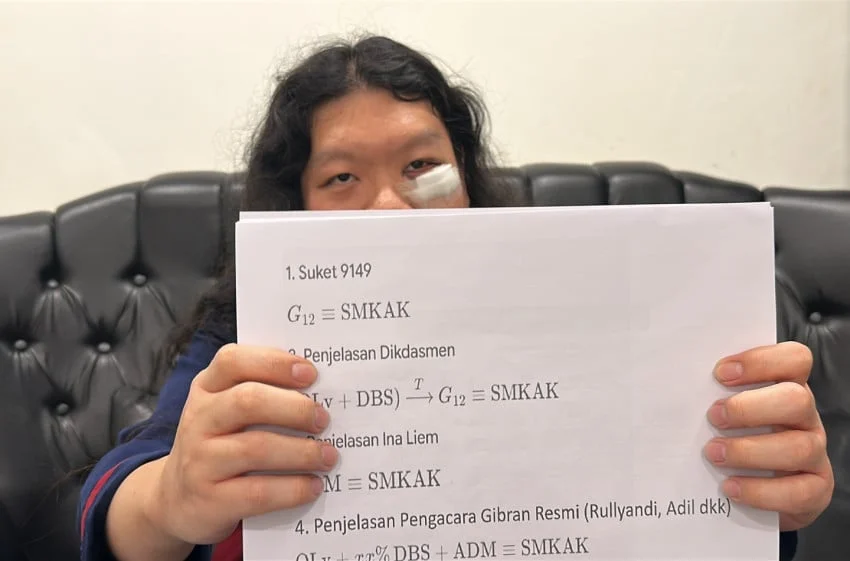
The ongoing public discourse surrounding the educational credentials of high-ranking Indonesian officials has taken a technical and legally rigorous turn. Luke Susilo, an activist representing the advocacy group Terus Jadi Anti Pembual (Terjal), has sharply criticized what he describes as profound data confusion and administrative inconsistencies underpinning the official certificate of equivalence (surat keterangan penyetaraan) for Vice President Gibran Rakabuming Raka.
According to Susilo, the controversy has evolved far beyond a routine verification of a diploma. Instead, it centers on structural anomalies within the equivalence document itself—anomalies that he argues reflect a manipulation of regulatory logic and a deeply flawed institutional transition process. Utilizing systematic modeling tools to analyze the available public records, Susilo’s recent findings have brought administrative transparency, regulatory compliance, and the burden of institutional accountability back to the forefront of national headlines.
Core Findings and Systematic Analysis of Equivalence Versions
Speaking in Jakarta, Susilo detailed an exhaustive breakdown of the documentation surrounding the Vice President’s academic background. His analysis highlights four distinct versions of the equivalence narrative currently circulating in the public domain. These range from the literal text printed on the official equivalence certificate to statements made during Constitutional Court (Mahkamah Konstitusi) hearings, alongside various claims presented by legal experts and the defense teams representing the administration.
At the heart of Susilo’s critique is a fatal contradiction between established ministerial regulations and the practical implementation of academic credential evaluation in the field. He pointed directly to the Regulation of the Minister of Education and Culture (Permendikbud) Number 29 of 2014, specifically Article 1, Paragraph 7. Under this legal framework, the fundamental criterion for determining the equivalence of a foreign educational certificate is the substantive comparability of the curriculum, rather than the mere duration of study or time spent in the educational system.
"If the underlying logic is that time spent is the primary factor for equivalence, a university student who takes fourteen semesters to complete an undergraduate degree could arbitrarily demand a direct equivalence to a master’s degree. This is absurd. The regulation explicitly mandates an evaluation of the curriculum," Susilo stated in Jakarta.
This regulatory emphasis on academic content over chronological duration forms the foundation of Terjal’s broader challenge. The group argues that administrative shortcuts undermine the integrity of Indonesia’s educational credential verification systems, potentially setting a dangerous precedent for future recognitions of foreign schooling.
The Phenomenon of Institutional "Leapfrogging"
One of the most prominent aspects of Susilo’s investigation is the tangled web of educational institutions cited to justify the Vice President’s academic progression. Publicly available defenses and statements from legal representatives and supporters have variously referenced Orchard Park Secondary School, UTS Insearch in Australia, and the Management Development Institute of Singapore (MDIS) to substantiate a status equivalent to both senior high school completion and an undergraduate degree.
Susilo highlights what he terms an "operasi lompat kodok" (leapfrog operation) in the documentation trail. He notes a glaring discrepancy between the official equivalence certificate—which explicitly records UTS Insearch as a primary credential base—and the arguments presented by subject-matter experts aligned with the related parties, who pivot to rely on an Advanced Diploma from MDIS to bridge the qualification gap.
This shifting institutional foundation, Susilo argues, introduces critical vulnerabilities into the administrative record. When different bodies within a single credential verification pathway substitute for one another without clear regulatory harmonization, public trust in the certifying institutions diminishes. The lack of a singular, coherent institutional narrative has consequently fueled persistent skepticism among watchdogs, civil society organizations, and academic observers.
Context and Background of the Credential Controversy
The scrutiny surrounding Vice President Gibran Rakabuming Raka’s educational background is not an isolated event. It is part of a broader wave of legal and administrative challenges that have targeted the inner circle of the current and former executive leadership in Indonesia. Over the past several years, activist groups, independent researchers, and legal coalitions have increasingly utilized public information requests, administrative tribunals, and judicial review mechanisms to challenge the authenticity and procedural validity of official documents held by public figures.
The tension intensified following a series of public hearings and courtroom sessions addressing educational credentials at various judicial bodies, including the East Jakarta District Court (PN Jaktim) and the Constitutional Court. The atmosphere surrounding these legal battles has occasionally grown tense; notably, activist Luke Susilo himself was reportedly subjected to an assault by unidentified individuals near the East Jakarta District Court following his attendance at a related hearing concerning presidential credentials. This incident underscored the high stakes and polarized emotions attached to ongoing transparency campaigns.
Despite the controversies, the official apparatus maintains that all equivalence procedures were conducted in strict accordance with the prevailing laws and ministerial guidelines applicable at the time of evaluation. Ministries responsible for education and culture possess discretionary authority to assess foreign curricula, and government defenders have consistently asserted that the documentation issued to Gibran Rakabuming Raka underwent standard bureaucratic scrutiny before final approval.
Chronology of Events and Escalation
- Initial Enrollment and Overseas Study: The foundational years of the controversy trace back to the educational journey of Gibran Rakabuming Raka, who completed secondary and preparatory programs at institutions abroad, including Orchard Park Secondary School and preparatory pathways linked to Australian and Singaporean educational providers.
- Application for Credential Equivalence: Upon returning to Indonesia or seeking formal recognition for professional and academic advancement, applications were filed with the relevant educational authorities to secure official equivalence certificates (suket penyetaraan ijazah) matching foreign qualifications to domestic standards.
- Issuance of Suket and Public Scrutiny: The Ministry of Education and Culture issued the respective equivalence documents. However, as political roles elevated, public interest groups began auditing the documentary trails, noticing variances in how secondary and tertiary completions were framed.
- Legal and Constitutional Court Inquiries: The issue entered the formal legal sphere through challenges lodged in the Constitutional Court and district courts, where legal teams, expert witnesses, and activist watchdogs debated the technical validity of the paperwork.
- Terjal Systemic Analysis (Current Phase): Activist group Terjal, led by Luke Susilo, introduced system modeling techniques to map out the four distinct versions of equivalence claims, culminating in the public exposure of the regulatory contradictions regarding Permendikbud No. 29/2014 and the "leapfrog" institutional references.
Broader Implications and Expert Perspectives
The dispute over the Vice President’s equivalence certificate carries significant implications for administrative governance and the rule of law in Indonesia. Legal scholars and policy analysts observing the situation point out that the controversy highlights structural weaknesses in how the state manages, verifies, and archives foreign educational credentials for public officials.
On one hand, supporters of the administration argue that administrative procedures for foreign credential evaluation are inherently complex, often involving multi-tiered institutional pathways that adapt to international educational partnerships. From this perspective, minor discrepancies in public statements or legal defense arguments do not invalidate the administrative legality of a certificate duly issued by an authorized government ministry.
On the other hand, good-governance advocates contend that absolute transparency in the educational backgrounds of top-tier elected officials is vital for democratic legitimacy. When inconsistencies arise—such as shifting references between Australian preparatory programs and Singaporean advanced diplomas—the burden rests entirely on the state bureaucracy and the officials concerned to provide clear, uniform, and verifiable documentation. Failure to resolve these ambiguities risks eroding public confidence in the administrative neutrality of regulatory bodies such as the Ministry of Education, Culture, Research, and Technology.
As civil society groups like Terjal continue to press for deeper administrative audits and legal accountability, the debate over institutional consistency and regulatory compliance looks set to remain a fixture of Indonesia’s political landscape. Whether formal state institutions will initiate a comprehensive review of the disputed equivalence documents to put the matter to rest remains to be seen, but the pressure for documentary clarity has never been higher.
