
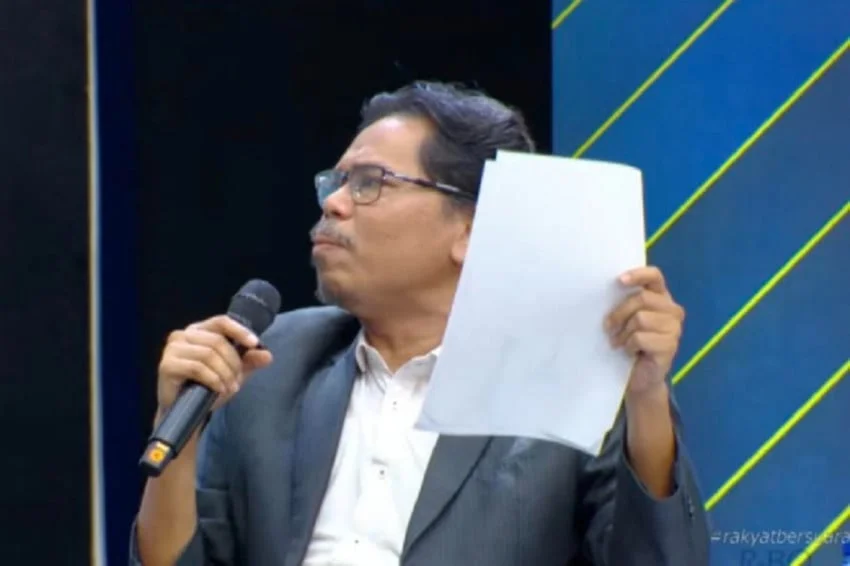
The ongoing national discourse surrounding the educational background of Vice President Gibran Rakabuming Raka has taken a new turn following detailed administrative and legal assessments presented by researcher Bonatua Silalahi. Speaking during a televised public discussion program broadcasted on iNews titled "Ada Pasal Selundupan di Kasus Ijazah?" on Tuesday, October 27, 2026, Silalahi argued that the educational credentials utilized for the equalization of Gibran’s overseas studies do not constitute a formal diploma or degree, but rather a certificate of attendance.
This assertion adds another layer of complexity to the protracted debate over the authenticity and administrative equivalency of the Vice President’s academic history abroad—a topic that has persistently surfaced across various legal forums, including the Constitutional Court (MK) and the State Administrative Court (PTUN). As public scrutiny intensifies regarding the transparency of official credentials in Indonesian politics, this latest investigation sheds light on the strict regulatory frameworks governing foreign educational equivalence in the country.
Background Context of the Educational Equivalence Controversy
The controversy surrounding Vice President Gibran Rakabuming Raka’s academic credentials is not an isolated incident but part of a broader trend of heightened public and legal scrutiny directed at the educational backgrounds of high-ranking public officials in Indonesia. In an era where transparency and accountability are paramount, the educational qualifications of elected leaders frequently become subjects of intense public interest, verified meticulously by activists, researchers, and political opponents alike.
Gibran’s academic journey, particularly his secondary and tertiary education pursued overseas, has long been a point of discussion. Critics and independent investigators have sought to verify whether his foreign qualifications fully comply with the rigorous administrative standards set by the Indonesian Ministry of Education, Culture, Research, and Technology. The process of credential evaluation—known locally as penyetaraan ijazah—requires foreign graduates to submit comprehensive documentation proving that their completed coursework meets national educational benchmarks, curriculum standards, and credit hours equivalent to domestic programs.
According to regulatory frameworks enforced by the Directorate General of Primary and Secondary Education, as well as the Directorate General of Higher Education, the validation of foreign schooling is subjected to stringent oversight. Investigators like Bonatua Silalahi have taken it upon themselves to review these administrative procedures, utilizing freedom of information channels and participating in legal proceedings to demand greater institutional transparency.
Chronology of the Investigation and Legal Proceedings
The inquiry into the Vice President’s educational documents has evolved systematically over several months, marked by legal challenges and administrative hearings across multiple judicial bodies.
The timeline of the investigation and related legal developments can be structured as follows:
- Initial Discovery and Research Phase (Mid-2025 – Early 2026): Independent researchers, including Bonatua Silalahi, began collecting administrative data, school prospectuses, and regulatory guidelines regarding foreign education equivalency to examine how specific overseas institutions are classified under Indonesian law.
- Constitutional Court Hearings (October 2026): The debate entered formal judicial arenas when related petitions and evidentiary reviews were brought before the Constitutional Court (MK). During these sessions, legal teams and independent analysts debated the precise nature of the credentials submitted for administrative verification.
- Public Disclosure on iNews (October 27, 2026): Researcher Bonatua Silalahi publicly detailed his investigative findings on the iNews program Rakyat Bersuara, asserting that the document in question functions administratively as a certificate of participation or attendance rather than an accredited diploma or graduation certificate.
- Ongoing PTUN Proceedings (Late October 2026): Concurrently, legal representatives for the state and related parties prepared comprehensive document portfolios to be presented in ongoing State Administrative Court (PTUN) hearings, aiming to settle the dispute regarding the complete educational trail from elementary school through higher education.
Analysis of Regulatory Frameworks and Administrative Standards
At the core of Silalahi’s recent presentation is the strict interpretation of educational regulations, specifically referencing the Regulation of the Director General of Primary and Secondary Education Number 33 of 2018. During his television appearance, Silalahi emphasized that the process of equating foreign educational documents cannot bypass established legal standards that dictate how international curricula are measured against domestic benchmarks.
Under Indonesian administrative law, a formal diploma (ijazah) signifies the successful completion of an entire educational curriculum, confirming that a student has met all graduation requirements, passed standardized examinations, and earned the necessary academic credits. In contrast, a certificate of attendance or participation simply verifies that an individual was enrolled in a program or institution for a specified duration, without necessarily certifying the completion of a graduation-level curriculum.

"This has been ongoing for quite some time. Ever since October, I have been presenting evidence regarding the certificate of his [Gibran’s] credentials. Until yesterday in the Constitutional Court, it officially marked two full semesters dedicated to studying this matter," Silalahi stated during the broadcast.
The crux of the legal debate rests on whether the documentation originally submitted for equivalency met the precise statutory definitions required for public office eligibility and academic validation. If independent investigators demonstrate that the document is legally classified merely as a certificate of attendance, questions may arise regarding how the administrative equalization process was previously approved by authorized government bodies.
Official Responses and Legal Defense
In response to ongoing allegations and public skepticism, representatives and legal counsels defending the authenticity of the Vice President’s educational background have maintained a stance of absolute transparency. Legal teams have asserted that all educational milestones—spanning from elementary school (SD), junior high school, senior high school, up to higher education—are fully documented, authentic, and compliant with prevailing laws.
Speaking on related developments, legal representative Rullyandi emphasized that the complete educational portfolio would be formally presented in upcoming PTUN hearings to dispel any lingering public doubts. According to the defense, all required academic transcripts, institutional letters, and equalization certificates have been secured and organized to withstand judicial scrutiny.
"The complete educational documents of Gibran Rakabuming Raka, ranging from elementary school all the way to higher education, will be shown in the PTUN trial. Everything is complete and verifiable," Rullyandi remarked in a statement addressing the judiciary proceedings.
Government officials and administrative bodies responsible for issuing equivalency letters have historically maintained that any certification granted to citizens returning from overseas studies undergoes standard bureaucratic verification. They argue that administrative decisions made by directorates within the education ministry are based on official transcripts, institutional accreditations, and direct confirmations from the respective foreign learning institutions.
Broader Impact and Implications on Governance and Public Trust
The ongoing controversy surrounding the educational documentation of high-ranking state officials carries significant implications for Indonesian governance, institutional credibility, and the rule of law. As public awareness regarding administrative integrity grows, the demand for absolute transparency in the credentials of leaders becomes a cornerstone of democratic accountability.
From a political perspective, debates over academic credentials can influence public perception and become focal points for political opposition. While legal victories or the formal presentation of physical documents in courts like the PTUN and the Constitutional Court aim to provide legal closure, the court of public opinion often operates on nuances of institutional trust and administrative clarity.
Furthermore, this case highlights potential systemic vulnerabilities or ambiguities within the bureaucratic procedures of foreign credential evaluation. If regulatory frameworks governing educational equivalence—such as the aforementioned Directorate General regulations—are perceived as inconsistent or opaque, it could prompt legislative calls for regulatory reform. Strengthening the oversight mechanisms of the Ministry of Education to ensure crystal-clear distinctions between diplomas, degrees, and certificates of attendance would prevent future legal ambiguities.
Ultimately, the resolution of this dispute will depend heavily on the formal judicial findings of the State Administrative Court. As the legal teams submit comprehensive documentation for judicial review, the final verdict will not only impact the individual standing of the Vice President but also set a vital legal precedent for how foreign educational credentials are verified, contested, and validated within the Indonesian administrative system.
