
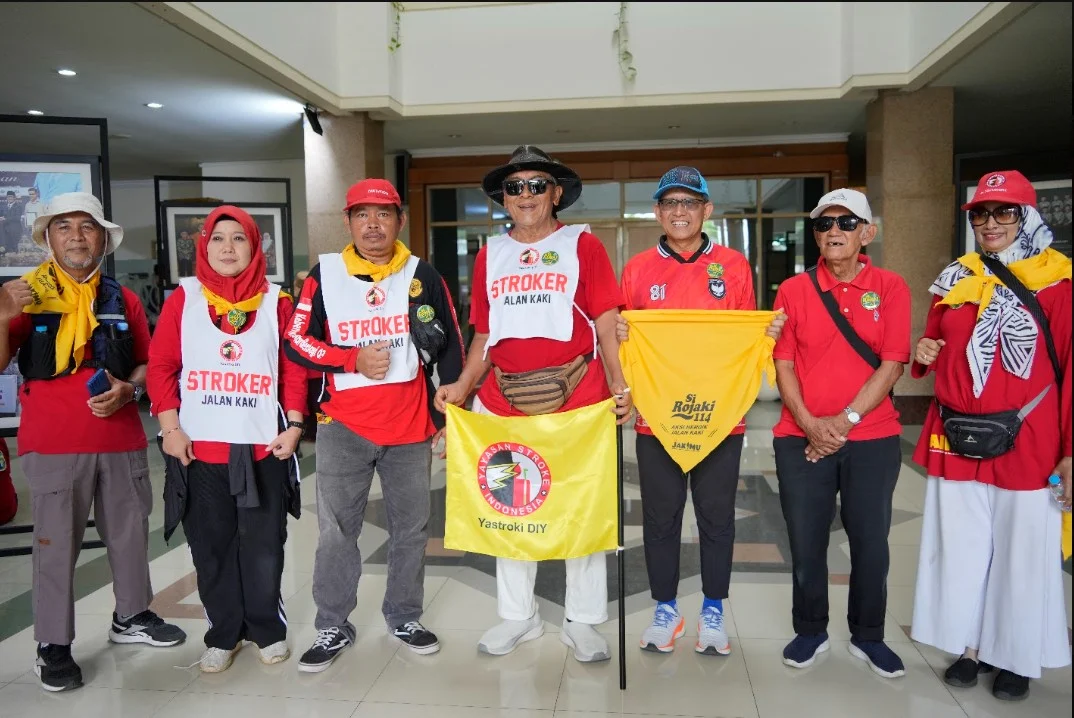
Yogyakarta — In an era dominated by sedentary lifestyles, rapid urbanization, and a heavy reliance on motorized transport, physical inactivity has emerged as a silent public health crisis. This challenge is particularly acute in Indonesia, a country that gained international attention following a landmark 2017 study by researchers at Stanford University. The study, which tracked smartphone activity data across 111 countries, revealed that Indonesia ranked dead last in pedestrian mobility, averaging a mere 3,513 steps per day—nearly half the global recommended threshold of 7,000 to 10,000 steps.
While these statistics highlight a concerning cultural shift away from basic human locomotion, grassroots counter-movements are beginning to emerge. Among the most proactive is the Muhammadiyah Walking Community, known locally as Jaki Mu (Komunitas Jalan Kaki Muhammadiyah). Operating under the auspices of the Community Da’wah Board (Lembaga Dakwah Komunitas – LDK) of the Special Region of Yogyakarta (DIY) Muhammadiyah Regional Leadership (PWM), Jaki Mu has taken up the mantle to reverse this trend. By systematically reintroducing walking into the daily fabric of Indonesian society, the community aims to foster sustainable health habits, promote environmental awareness, and champion radical social inclusivity.
The Genesis and Evolution of Jaki Mu
The institutionalization of Jaki Mu in 2025 was not a sudden bureaucratic creation, but rather the culmination of years of targeted community mobilization. Its roots trace back to an inspiring initiative launched in 2024 in collaboration with the Indonesian Stroke Association (Yayasan Stroke Indonesia – Yastroki) DIY branch. The catalyst for the movement was AR Iskandar, a stroke survivor associated with Yastroki DIY, who envisioned a monumental physical challenge to coincide with the 112th anniversary of Muhammadiyah.
This vision materialized as "Aksi Heroik Jalan Kaki" (Heroic Walking Action), affectionately acronymized as Si Rojaki. Designed as an annual commemorative event, Si Rojaki bridges two deeply symbolic dates in the Indonesian historical and religious calendar: National Heroes Day on November 10 and the founding anniversary of Muhammadiyah on November 18. The inaugural 2024 event set a high benchmark, with participants undertaking a grueling 112-kilometer trek that underscored both physical endurance and psychological resilience.
Building upon the success of the initial campaign, the initiative was formalized in 2025 under the LDK PWM DIY framework, giving birth to Jaki Mu as a permanent, structured community. The leadership recognized that sporadic, one-off health campaigns are rarely sufficient to enact permanent behavioral changes. Therefore, Jaki Mu was designed to instill long-term cultural habits, addressing not just the general public, but also specific demographic groups whose physical readiness is paramount, such as prospective Indonesian pilgrims preparing for the physically demanding rituals of Hajj and Umrah.
Scaling Up: The 2026 Chronology and Route Planning
As Jaki Mu gains momentum, its organizing committee has scaled up its ambitions for future iterations. For the upcoming 2026 observance, Si Rojaki is slated to cover a staggering 114 kilometers, meticulously structured to reflect the age of the Muhammadiyah movement.
According to Ananto Isworo, Chairman of LDK PWM DIY, the 2026 journey will be divided into nine distinct etapas (legs), aligning with the milestone anniversary. Each leg will cover a minimum distance of 12 kilometers, with average daily stretches ranging between 14 and 15 kilometers. This carefully calculated progression ensures that participants are pushed to improve their stamina without facing hazardous overexertion.
The geographic footprint of the 2026 route is designed to showcase the diverse landscapes of the Special Region of Yogyakarta and its surrounding peripheries. The itinerary spans urban centers, historical landmarks, and rural countrysides, including:
- The heart of Yogyakarta City
- The historic grounds of the Keraton Yogyakarta (Sultanate Palace)
- The rugged terrain of Gunungkidul Regency
- The historical cultural site of Pleret in Bantul Regency
- The agrarian landscapes of Minggir and Turi in Sleman Regency
- The scenic river valleys of Kalibawang in Kulon Progo Regency
This cross-regional approach does more than test physical endurance; it transforms the act of walking into a mobile exploration of local heritage and geography.
Beyond Marathon Treks: Regular Ecotourism Walks
While the annual Si Rojaki event captures widespread public attention due to its sheer scale, Jaki Mu’s day-to-day operations focus on sustainable, routine engagement. Diverging sharply from the conventional model of Indonesian mass "fun walks"—which typically span short distances and culminate in prize drawings and immediate dispersal—Jaki Mu has pioneered a distinct operational philosophy.
Every three months, the community organizes regular walks covering distances of 5 to 7 kilometers. These events are executed in close partnership with rotating local Muhammadiyah Branch Leadership units (Pimpinan Cabang Muhammadiyah – PCM). Crucially, these outings are anchored in a dual objective: cultivating physical wellness and promoting local ecotourism.
"The goal of Jaki Mu is genuinely about building a healthy culture, paired with an ecotourism concept where we introduce local tourist attractions along the route," explained Ananto Isworo.
By embedding these walks within local neighborhoods, Jaki Mu stimulates grassroots economic interest in lesser-known community spots while making regular cardiovascular exercise accessible to families, students, and elderly citizens alike. The demographic makeup of these walks is remarkably diverse. The inaugural stage of the recent Si Rojaki drew approximately 100 participants, comprising dedicated Muhammadiyah members, the general public, students, educators, and crucially, stroke survivors—all closely monitored and safeguarded by Muhammadiyah’s dedicated emergency ambulance services.
Inclusivity in Motion: The Triumph of Stroke Survivors
Perhaps the most compelling dimension of Jaki Mu’s mission is its unwavering commitment to radical inclusivity, proving that physical rehabilitation and community service are not mutually exclusive. This ethos is vividly embodied by participants like Nur Katarisman, a resident of Sleman Regency who has lived with the debilitating effects of a stroke for nearly two years.
Katarisman, a member of the Happy Stroke Community (Komunitas Stroker Bahagia – KSB) and Yastroki DIY, participated in Jaki Mu events for the first time recently. Despite acknowledging that his gait remained unsteady, his motivation was absolute. "The point is, I want to recover and be healthy," Katarisman stated during a brief respite along the route.
For Katarisman, joining the walk was about much more than physical therapy. It offered an invaluable psychological lifeline—an opportunity to forge solidarity with fellow survivors and patients. Furthermore, his participation served as a powerful statement that stroke survivors retain both the right and the capability to contribute meaningfully to community life and religious-social organizations like Muhammadiyah.
Logistical hurdles did not deter him. Because other dates conflicted with his mandatory medical check-ups, Katarisman deliberately registered for three specific etapas of the Si Rojaki program. Among the contingent of roughly 13 stroke survivors participating in the initiative, Katarisman’s medical hurdles were noted as among the most severe, underscoring the sheer willpower required to complete the course.
Rather than viewing his condition as a limitation, Katarisman views his journey as a blueprint for others facing similar health crises. "The point is, I want to be an example," he concluded. "If this succeeds, I want to invite my friends in KSB to join."
Implications and Public Health Analysis
The rise of initiatives like Jaki Mu offers vital lessons for public health policy and civil society engagement in developing nations undergoing rapid epidemiological transitions. As non-communicable diseases (NCDs)—such as stroke, cardiovascular disease, and type 2 diabetes—account for an increasing share of morbidity and mortality in Indonesia, structural interventions that encourage physical activity are urgently required.
Public health analysts point out that state-led healthcare campaigns often struggle with community-level penetration and sustained behavioral modification. Grassroots religious and community organizations, however, possess deep social capital and trust networks that can effectively mobilize populations. By framing physical activity not merely as a secular medical prescription, but as a holistic lifestyle choice tied to communal solidarity, historical commemoration, and spiritual readiness (such as Hajj preparation), Jaki Mu bridges the gap between clinical necessity and cultural practice.
Moreover, the active integration of marginalized groups—such as stroke survivors—challenges prevailing societal stigmas regarding disability and aging. It reframes rehabilitation from an isolated, clinical endeavor into an active, public celebration of resilience.
Looking ahead, as Jaki Mu prepares for its expansive 2026 milestones, the community serves as a shining example of how local civil society actors can creatively address macro-level societal challenges. By putting one foot in front of the other, Muhammadiyah’s walking movement is slowly but steadily altering the epidemiological landscape of Yogyakarta, proving that cultural inertia can be overcome through persistent, community-driven action.
