
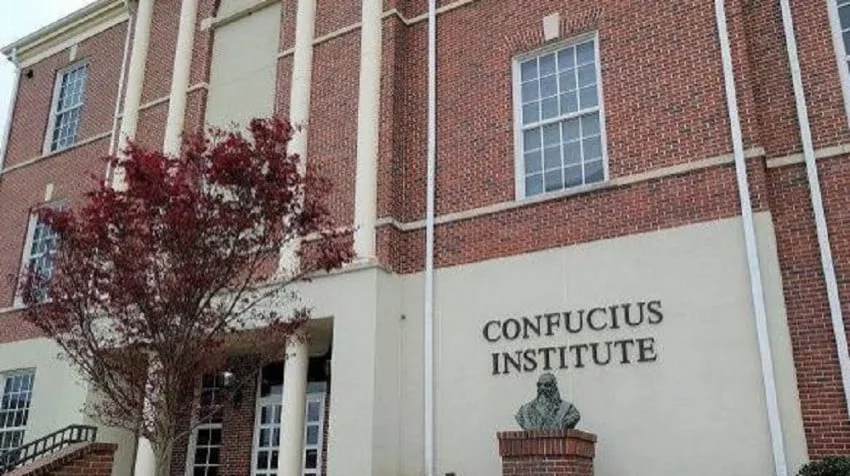
The United States Department of Defense has officially designated the network of China-funded educational centers known as Confucius Institutes as a significant threat to American national security. This development, confirmed by Secretary of Defense Pete Hegseth, marks a major escalation in the ongoing geopolitical and technological friction between Washington and Beijing. The Pentagon’s move reflects a broader strategic shift in American foreign policy, which increasingly views academic and cultural exchanges with China through the lens of national defense, intellectual property protection, and ideological containment.
The Confucius Institutes (CIs), which were once lauded as tools for fostering cross-cultural understanding and language acquisition, have been under intense scrutiny for years. While the Chinese government, through the Office of Chinese Language Council International (Hanban), initially presented these institutes as non-profit educational collaborations, the Pentagon’s recent stance categorizes them as active components of China’s global influence strategy. Secretary Hegseth, in a series of public statements, characterized these institutions as clandestine "propaganda cells" designed to penetrate the American intellectual ecosystem.
A Chronology of Growing Distrust
The friction surrounding Confucius Institutes did not emerge overnight; it is the culmination of a decade-long degradation in bilateral academic relations. The trajectory of this conflict can be traced through several pivotal moments:
- 2004: The first Confucius Institute opens at the University of Maryland. By the mid-2010s, over 100 institutes had been established across U.S. campuses, providing funding for language programs and cultural events.
- 2014: The American Association of University Professors (AAUP) issues a report criticizing the institutes for their potential to compromise academic freedom and institutional autonomy.
- 2018: The U.S. Congress passes the National Defense Authorization Act (NDAA), which restricts the Department of Defense from funding Chinese language programs at universities that host Confucius Institutes.
- 2020: The U.S. State Department designates the Confucius Institute U.S. Center as a "foreign mission" of the People’s Republic of China, requiring them to disclose staffing and assets.
- 2023-2024: Mounting reports from intelligence agencies suggest that while many original institutes were closed or rebranded, new entities with similar operational frameworks began emerging under different names.
- 2025: Secretary Hegseth announces that the Department of Defense has identified and systematically moved to dismantle dozens of these "rebranded" entities, citing national security concerns.
The Pentagon’s Security Rationale
Secretary Hegseth’s justification for the recent crackdown centers on the assertion that these centers operate under a veneer of cultural exchange to achieve strategic objectives. According to the Pentagon, there are currently 80 new "propaganda cells" operating across 30 U.S. universities. These entities, the Defense Department alleges, operate under varied titles and charters, effectively masking their ties to the Chinese state while pursuing a singular agenda: the acquisition of proprietary research and the subversion of academic discourse.
The concerns cited by defense officials are threefold. First is the risk of intellectual property (IP) theft. By embedding themselves within university research environments, these institutes potentially gain proximity to sensitive dual-use technology and scientific data. Second is the issue of academic freedom. Critics have long argued that Confucius Institutes discourage discussion of topics sensitive to the Chinese Communist Party (CCP), such as the status of Taiwan, the situation in Xinjiang, or the 1989 Tiananmen Square protests. Third is the concern regarding foreign influence operations, which the Department of Defense now treats as a counterintelligence priority.
Supporting Data and the "Rebranding" Phenomenon
The rapid closure of traditional Confucius Institutes—which peaked at approximately 118 locations in the U.S. in 2017—did not signal a total withdrawal of Chinese soft power, according to government reports. Instead, data suggests a process of metamorphosis. As federal pressure mounted, many universities shuttered their institutes to maintain eligibility for federal research grants. However, internal Pentagon reviews suggest that the personnel, curricula, and funding mechanisms simply transitioned into new, less transparent organizations.
This "rebranding" phenomenon has complicated the oversight process. While the original Confucius Institutes were easily identifiable by their naming conventions and contracts with Hanban, the new entities often operate as independent language centers or cultural foundations, making them harder to track. The Department of Defense has stated that in the last two months, it has conducted a systematic review to identify these entities, leading to the current directive to sever their influence within the American academic infrastructure.
The Perspective from Beijing
The response from the Chinese government has been one of indignation and sharp criticism. The Ministry of Commerce in Beijing has consistently labeled the U.S. actions as discriminatory and politically motivated. In official statements, Chinese spokespersons have urged Washington to "respect the facts" and cease what they describe as the suppression of normal academic and cultural exchanges.
From Beijing’s perspective, these institutes serve as vital platforms for global language learning and are a standard part of China’s "going global" strategy, mirroring the cultural outreach efforts of other nations, such as the British Council (UK), the Goethe-Institut (Germany), or the Alliance Française (France). Beijing argues that the U.S. approach is driven by a "Cold War mentality" and that the security concerns are fabricated to justify the decoupling of educational ties between the two global powers.
Analysis: Broader Implications for Higher Education
The Pentagon’s aggressive stance against these institutes carries significant implications for the landscape of American higher education. Universities are now caught between two powerful forces: the necessity of maintaining robust international research partnerships and the requirement to comply with stringent federal national security mandates.
The implications are twofold:
- Academic Decoupling: The closure of these centers often results in the termination of language programs that are expensive to run. For many mid-sized universities, the funding provided by these institutes was the only viable way to offer Chinese language instruction. Their absence may lead to a long-term decline in the number of American students attaining proficiency in Mandarin, a skill considered vital for future diplomatic and economic engagement.
- Increased Scrutiny on Research Collaboration: The "security-first" approach is likely to extend to other forms of academic collaboration. Universities may face increased pressure to vet international students and visiting scholars from China, particularly those working in STEM fields. This could result in a more guarded, less collaborative environment, potentially impacting the speed of scientific innovation in the United States.
The Future of U.S.-China Academic Relations
As the Department of Defense continues its efforts to dismantle what it identifies as hostile influence, the question remains whether these actions will effectively mitigate security threats or simply lead to a more fragmented and opaque system of collaboration.
The current environment suggests that the "era of engagement"—characterized by the belief that educational ties would naturally lead to political liberalization and mutual understanding—has effectively concluded. In its place is a paradigm of "managed competition." For American universities, the challenge will be to maintain academic excellence and global engagement while navigating a security landscape that increasingly views international partnerships as potential liabilities.
As the Pentagon moves forward with its systematic review, the academic community awaits further guidance on how to distinguish between legitimate cultural exchange and state-sponsored influence operations. The case of the Confucius Institutes will likely be studied as a landmark moment in the intersection of national security policy and the open exchange of ideas in the 21st century. Whether this policy shift will result in a more secure academic ecosystem or simply a more isolated one remains a subject of intense debate among policymakers, educators, and national security experts alike.
Ultimately, the designation of these institutes as security threats serves as a stark reminder that in the modern era, the boundaries between the classroom and the command center have become increasingly blurred, requiring a new framework for balancing national defense with the traditional ideals of global intellectual inquiry.
