
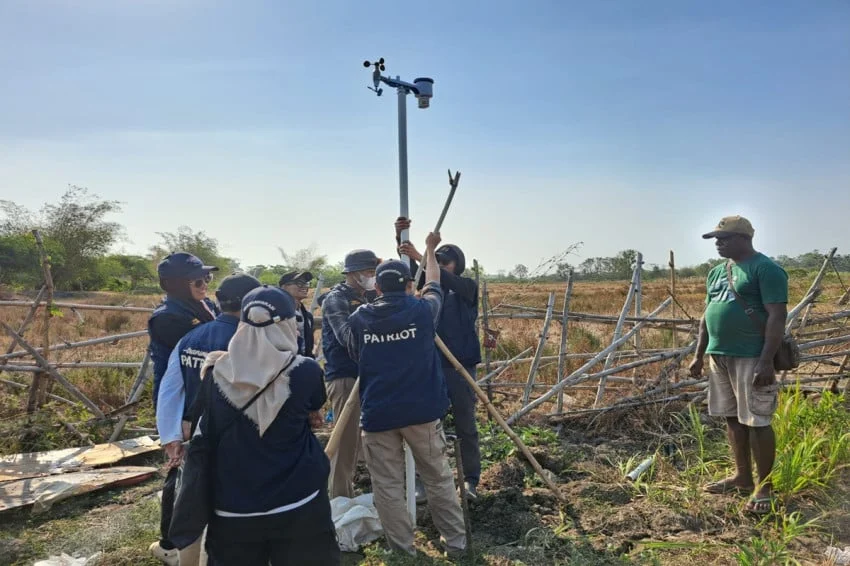
Merauke, South Papua — In an effort to address escalating climate unpredictability and safeguard the livelihoods of local farmers and transmigrant communities, the IPB University Patriot Expedition Team has successfully installed an advanced Automatic Weather Station (AWS) in Kurik District, Merauke Regency, South Papua. The deployment of this state-of-the-art digital weather monitoring infrastructure is designed to provide accurate, real-time meteorological data, enabling agrarian communities to anticipate extreme weather events, mitigate the risks of prolonged drought, and curb potential pest infestations that threaten regional food security.
The agricultural sector in South Papua, particularly in designated food estate and transmigration zones like Kurik District, has long faced significant hurdles stemming from shifting weather patterns. For generations, farmers in villages such as Kampung Harapan Makmur have relied heavily on traditional knowledge and seasonal instincts to determine planting schedules. However, intensifying climate anomalies, characterized by erratic rainfall and prolonged dry spells associated with global climatic phenomena, have rendered historical farming calendars increasingly unreliable. These climatic uncertainties have frequently culminated in widespread crop failures, threatening the economic stability of local farmers and transmigrant families who depend entirely on agricultural yields for their sustenance and income.
Recognizing the urgent need for technological intervention in Indonesia’s eastern agricultural frontiers, the IPB University Patriot Expedition Team initiated a comprehensive field deployment plan. The installation of the Automatic Weather Station serves as a foundational step toward modernizing farming practices in Merauke through targeted digital transformation.
Understanding the Technology and Operational Scope
The newly installed Automatic Weather Station is a self-contained, solar-powered digital meteorological unit equipped with a suite of sensors designed to measure key atmospheric parameters. These instruments continuously monitor ambient temperature, relative humidity, rainfall accumulation, wind speed and direction, solar radiation, and barometric pressure.
What sets this deployment apart is its integration with user-friendly digital applications accessible via smartphones and local computing terminals. Farmers in Kampung Harapan Makmur and surrounding agricultural pockets no longer need to speculate about upcoming weather conditions. Through the companion digital interface, local growers can access high-resolution meteorological data updated in real time.
Furthermore, the system features predictive modeling capabilities that allow farmers to forecast micro-climatic conditions up to 15 days in advance. This forward-looking data is critical for optimizing the agricultural value chain. With precise precipitation forecasts, farmers can optimize irrigation schedules during dry periods, delay fertilizer application immediately before heavy downpours to prevent nutrient runoff, and prepare preemptive pest management strategies when humidity and temperature thresholds favor the proliferation of agricultural pathogens and destructive insects.
With an operational transmission and monitoring radius extending up to 40 kilometers, a single AWS unit can cover vast expanses of agrarian land, ensuring that multiple farming communities benefit from centralized, highly localized weather intelligence.
Community Reception and Socio-Economic Implications

The introduction of the digital weather station has been met with overwhelming enthusiasm by the transmigrant and indigenous farming communities in Kurik District. For decades, transmigrant farmers have faced unique socio-economic challenges, transitioning from different agro-ecological zones in Java and other densely populated islands to the distinct tropical wetland and savanna ecosystems of southern Papua. Adapting to local soil and weather dynamics has been a persistent trial-and-error process.
Community representatives in Kampung Harapan Makmur have emphasized that access to empirical weather data marks a historic turning point for regional agriculture. By removing guesswork from the farming equation, the technology directly protects household incomes from sudden agricultural shocks. Crop failures not only lead to immediate financial distress for individual farmers but also disrupt local supply chains, inflate regional food prices, and place strain on local government assistance programs.
Agricultural economists and rural development experts note that bridging the digital divide in remote agricultural regions is essential for national food security. Indonesia has placed strategic importance on developing Merauke as a major national food barn (food estate) to secure long-term agricultural self-sufficiency. However, large-scale agricultural expansion must be accompanied by grassroots technological support to ensure smallholder resilience against climate change. The IPB University initiative demonstrates how targeted, low-maintenance digital interventions can yield disproportionately high socio-economic dividends for rural populations.
Broader Context: Climate Resilience in Indonesia’s Eastern Regions
The initiative by the IPB University Patriot Expedition Team aligns with broader national strategies aimed at enhancing climate resilience across Indonesia’s agricultural sector. As an archipelago situated along the equator, Indonesia is acutely vulnerable to the impacts of climate change, including shifting monsoon cycles, rising sea levels, and unpredictable precipitation anomalies.
In recent years, government bodies such as the Meteorology, Climatology, and Geophysical Agency (BMKG) alongside various academic institutions have accelerated the deployment of advanced meteorological instruments across strategic sectors, ranging from maritime logistics hubs to vital agricultural corridors. However, while national forecasting systems provide macro-level insights, smallholder farmers often struggle to translate broad regional forecasts into actionable, farm-level decisions.
Projects like the AWS installation in Merauke bridge this critical gap by translating macro-meteorological data into hyper-local, actionable intelligence. By empowering farmers with the tools to interpret weather trends, academic institutions and civil society organizations are fostering a culture of climate-smart agriculture at the grassroots level.
Future Outlook and Scaling Up
Following the successful calibration and integration of the Automatic Weather Station in Kurik District, the IPB University Patriot Expedition Team plans to conduct comprehensive training workshops for local farmers. These educational sessions will focus on teaching community members how to interpret the digital dashboard, utilize the 15-day predictive models effectively, and integrate meteorological insights into their daily farm management routines.
Stakeholders hope that the success of the Kurik pilot project will serve as a blueprint for wider replication across other districts in Merauke Regency and the broader South Papua province. As climate volatility continues to challenge traditional agrarian systems worldwide, the integration of digital weather monitoring infrastructure in Indonesia’s frontier regions represents a vital stride toward sustainable agricultural productivity, economic empowerment, and long-term regional food security.
