
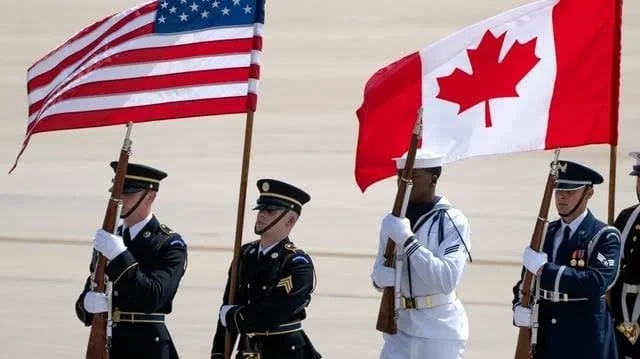
WASHINGTON — In a development that signals a notable cooling of relations between two of North America’s closest historic allies, the United States Department of Defense has reportedly issued a classified directive scaling back certain facets of military collaboration with Canada. The memo, signed by U.S. Secretary of Defense Pete Hegseth, has sent ripples through diplomatic channels, even as officials from both Washington and Ottawa attempt to downplay the operational impact of the new guidance.
The emergence of this directive highlights a deepening political and economic rift under the administration of U.S. President Donald Trump. While bilateral ties between the two founding members of the North Atlantic Treaty Organization (NATO) have weathered decades of shared strategic vision, continental defense commitments, and robust economic integration, recent policy shifts threaten to upend the foundational assumptions of the U.S.-Canada partnership.
Main Facts and the Washington Post Leak
The existence of the classified Pentagon memo first came to public attention through a report published by The Washington Post. Citing anonymous U.S. officials familiar with the internal directive, the report indicated that Secretary Hegseth distributed the memo outlining broad limitations on military engagement with Canadian defense counterparts.
Although the media outlet acknowledged that reporters had not independently reviewed the physical text of the document, sources familiar with the matter suggested that the restrictions could be interpreted by Ottawa as a significant diplomatic snub. The classified nature of the guidance has fueled speculation regarding the true breadth of the pullback, leaving military analysts and international observers scrambling to assess whether the directive represents a symbolic political gesture or a substantive pivot in North American defense strategy.
Despite the turbulence reported in Washington, Canadian officials have maintained a posture of calm assurance. Canadian Defence Minister David McGuinty publicly stated that Ottawa has yet to observe any tangible disruptions in day-to-day military operations or intelligence sharing. "I haven’t seen that document," McGuinty told reporters, adding that the armed forces of both nations continue to collaborate closely across multiple domains.
Chronology of Fraying Relations Under the Trump Administration
The friction dividing Washington and Ottawa does not exist in a vacuum; it is the culmination of a deteriorating diplomatic trajectory that has accelerated significantly during Donald Trump’s tenure in the White House.
The relationship began facing severe strains as the U.S. administration adopted an increasingly transactional and aggressive posture toward traditional allies. President Trump repeatedly raised eyebrows in diplomatic circles by floating controversial rhetorical concepts, including the notion of incorporating Canada as the "51st state" of the United States. While often dismissed by some political commentators as rhetorical hyperbole, these remarks struck a sensitive nerve in Canada, touching upon long-standing sensitivities regarding national sovereignty and cultural identity.
Economic tensions have run parallel to geopolitical posturing. Washington has levied a series of aggressive tariffs on Canadian goods, publicly accusing Ottawa of "exploiting" the United States through trade imbalances. These protectionist measures shattered the post-NAFTA consensus of seamless continental trade, forcing Canadian leadership into a defensive posture.
By September, the discourse surrounding bilateral security had crossed into unprecedented territory. Mark Carney, speaking in his capacity as a prominent Canadian political figure and policy voice, acknowledged in an interview with The New York Times that while military action by the United States against Canada remained an "extreme risk with a very low probability," failing to plan for such a contingency would constitute a gross dereliction of duty.
Shortly thereafter, investigative reporting by The Globe and Mail revealed that elements of the Canadian military had indeed begun quietly developing strategic responses to the theoretical scenario of a U.S. incursion. Among the reported contingency models were asymmetric resistance strategies inspired by historical insurgencies, such as the tactics employed by Afghan mujahideen against Soviet forces during the 1979–1989 war.
Protecting Core Frameworks: NORAD and Intelligence Sharing
In the wake of the Pentagon memo leak, senior defense figures in both countries have rushed to clarify that critical bilateral and multilateral defense frameworks remain insulated from the new restrictions.
Sean Parnell, a spokesperson for the Pentagon
, sought to quell anxieties during a press briefing by emphasizing that the newly minted guidance carries no operational consequences for foundational security architectures. "This guidance does not impact defense intelligence cooperation, the binational NORAD command, or our cooperation through NATO," Parnell asserted.
The North American Aerospace Defense Command (NORAD), established in 1958 at the height of the Cold War, represents the bedrock of continental security. Operating as a joint command staffed by personnel from both nations, NORAD is tasked with aerospace warning, aerospace control, and maritime warning for the United States and Canada. Any disruption to NORAD would severely compromise the collective security posture of North America, making its exclusion from the Pentagon memo a vital relief to military planners.
Similarly, intelligence-sharing arrangements—most notably the Five Eyes alliance, which includes the U.S., Canada, the United Kingdom, Australia, and New Zealand—appear untouched by the directive. Counterterrorism, cyber defense, and signals intelligence cooperation continue to function through established channels, ensuring that operational readiness against external adversaries is not compromised by political friction at the executive level.
Dissecting the Scope: Focusing on "Social Activities"
To better understand the practical implications of Secretary Hegseth’s memo, U.S. lawmakers have offered clarifying insights into the document’s actual intent. U.S. Senator Mike Rounds, a Republican representing South Dakota, addressed the media to characterize the directive as a narrow and largely bureaucratic adjustment rather than a wholesale severing of military ties.
According to Senator Rounds, the memo is primarily designed to curtail routine "social activities" and secondary engagements between defense bureaucracies. This includes limiting the participation of U.S. defense officials in think-tank forums, academic panels, and non-essential symposia hosted in Canada.
"We do not anticipate any real change compared to what has been taking place over the past year to a year and a half," Rounds explained, suggesting that the policy formalizes an informal cooling-off period that has characterized cross-border institutional interactions for some time.
This perspective was echoed by defense analysts who note that while high-level strategic commands and joint operational units remain active, the web of lower-tier military exchanges, joint training symposia, and bilateral conferences has steadily thinned. Such activities, while beneficial for long-term alliance building, are often the first to be trimmed when political directives mandate a retrenchment in foreign engagements.
Broader Impact and Strategic Implications
The issuance of this classified directive, regardless of its operational limitations, carries profound symbolic and strategic implications for North American geopolitics. For over eighty years, the defense relationship between the United States and Canada has been defined by the Ogdensburg Agreement of 1940 and the subsequent establishment of NORAD and NATO, creating an unprecedented level of military integration often described as an unbroken shield.
The introduction of political animus into this equation forces military planners in Ottawa to confront a reality that was previously unthinkable: a geopolitical landscape where the United States is no longer reliably viewed through the lens of an unconditional ally, but rather as an unpredictable actor requiring risk mitigation.
From a strategic perspective, the divergence between Washington and Ottawa may accelerate Canada’s long-standing debate regarding defense self-reliance. For decades, critics have argued that Canada’s reliance on the U.S. nuclear umbrella and conventional military might has allowed successive federal governments to underfund the Canadian Armed Forces, routinely failing to meet NATO’s benchmark of spending two percent of Gross Domestic Product (GDP) on defense.
If Canadian leadership perceives a permanent shift in U.S. reliability, it could provide the political catalyst needed to modernize and expand domestic defense capabilities, diversify international security partnerships—particularly with European allies within NATO and Indo-Pacific partners—and reduce asymmetrical vulnerabilities vis-à-vis its southern neighbor.
Conversely, for the United States, pulling back from institutional engagement with Canada risks eroding the deep-seated cultural and operational familiarity that has historically allowed the two militaries to seamlessly integrate during coalition operations abroad. While NORAD and intelligence networks remain functional, the erosion of trust at the bureaucratic level could complicate future joint responses to emerging non-traditional threats, such as Arctic security challenges, maritime sovereignty disputes in the Northwest Passage, and transnational cyber warfare.
As the situation continues to evolve, international observers will be watching closely to see whether the Pentagon memo remains a contained bureaucratic adjustment or serves as the opening chapter in a profound restructuring of North American security architecture. For now, officials in both capitals maintain that the core machinery of continental defense is turning, even if the diplomatic climate surrounding it has grown noticeably colder.
