
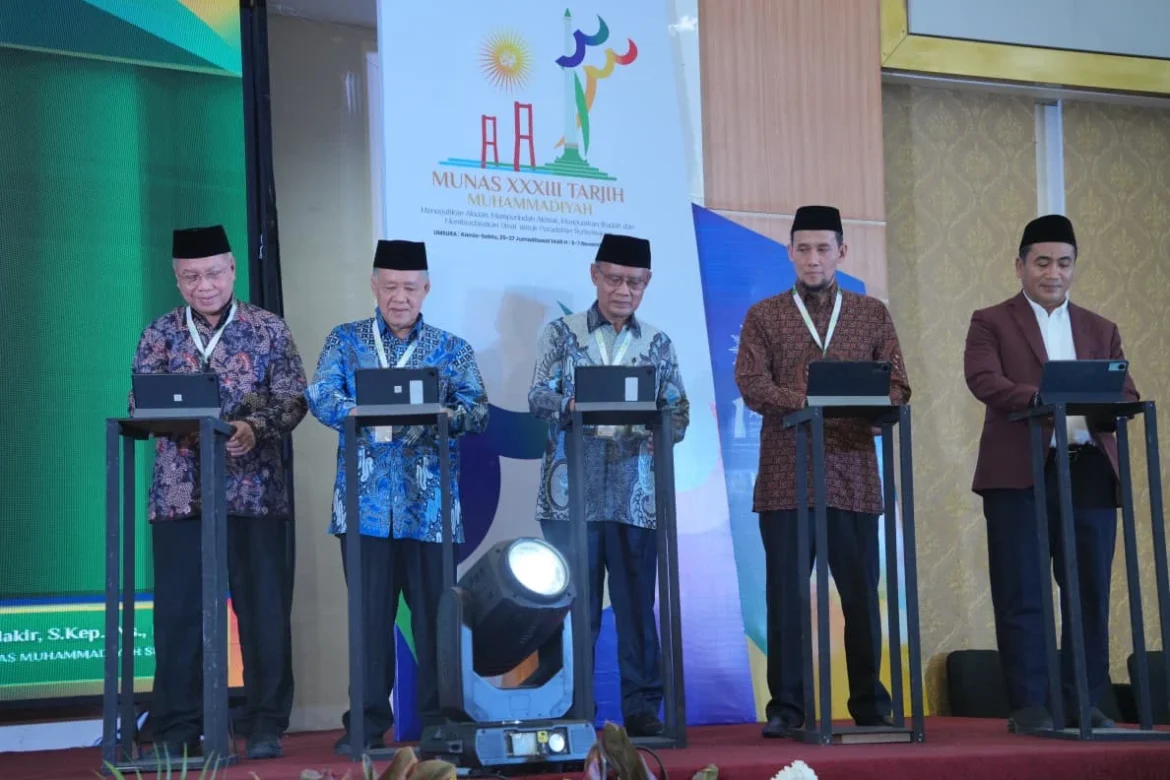
The Majelis Tarjih
dan Tajdid (MTT) of the Central Board (PP) of Muhammadiyah officially commenced its landmark XXXIII National Congress (Munas Tarjih XXXIII) on Thursday, November 5, at Universitas Muhammadiyah Surabaya (UM Surabaya). This high-profile intellectual gathering serves as a cornerstone event for the organization, bridging a rich century of religious scholarship with the complex, contemporary challenges facing modern Indonesian society and the global community at large. Operating under the profound guiding theme, Strengthening Aqidah, Embellishing Morals, Fortifying Worship, and Empowering the Ummah for a Progressive Civilization, the congress marks a significant milestone in the century-long trajectory of the Majelis Tarjih and Tajdid, an institution that has long served as the intellectual and jurisprudential compass for one of Indonesia’s largest Islamic reformist organizations.
A Century of Scholarly Tradition and Institutional Evolution
To fully appreciate the gravity of the XXXIII National Congress, one must contextualize the historical weight carried by the Majelis Tarjih and Tajdid. Established during the early decades of Muhammadiyah’s foundational era, the Majelis Tarjih was conceived as an authoritative body dedicated to ijtihad (independent reasoning) and tajdid (reform/renewal). Over the past hundred years, the council has systematically navigated the complex intersection between classical Islamic jurisprudence (fiqh) and the rapid transformations of modernity, science, and socio-political structures in Indonesia.
The centennial momentum of the Majelis Tarjih is not merely a celebration of longevity; it is a critical reassessment of how religious thought can remain dynamic, adaptive, and deeply transformative. By choosing UM Surabaya as the host venue for this centennial congress, the organization underscores the synergy between higher education institutions within the Muhammadiyah network and its religious-intellectual councils. The event brings together approximately 320 elite Islamic scholars, jurists, academics, and regional delegates from across the Indonesian archipelago, transforming Surabaya into a vibrant intellectual hub for contemporary Islamic discourse.
Five Core Jurisprudential Pillars of the XXXIII Congress
At the heart of the congress agenda are five deeply pressing and diverse thematic pillars designed to address contemporary ethical, social, and economic realities. These focal points reflect a deliberate shift toward addressing systemic societal vulnerabilities and institutional preparedness in the twenty-first century:
- Fiqh of the Elderly (Fiqh Lansia): A comprehensive legal and social framework addressing the spiritual, physical, and psychological well-being of aging populations.
- Fiqh of Food Sovereignty: An ethical and practical jurisprudential inquiry into agricultural sustainability, food security, equitable distribution, and ecological stewardship.
- The Risalah of Islamic Aqidah (Risalah Akidah Islam Muhammadiyah): A systematic refinement and articulation of Muhammadiyah’s foundational creed in the face of contemporary theological challenges and pluralism.
- The Risalah of Practical Morals (Risalah Akhlak Praktis): Actionable ethical guidelines aimed at fostering personal integrity, social justice, and civic responsibility in daily life.
- Development of Worship Guidelines on Tatswib: A technical jurisprudential review regarding specific procedural elements of congregational worship and ritual practices.
Opening Address and Visionary Insights from Haedar Nashir
Delivering his keynote address at the opening ceremony, PP Muhammadiyah General Chairperson Haedar Nashir emphasized that the outcomes of the congress must transcend theoretical abstraction. He urged the assembled scholars to engage in deep, comprehensive deliberations that yield tangible benefits for the Indonesian nation and universal humanity, framing the event as a true manifestation of progressive Islamic thought (Islam berkemajuan).
"As a manifestation of the perspective of progressive Islam, the discussions held here must resonate with the practical realities of our society," Haedar stated during his address.
As a trained and widely respected sociologist, Haedar brought a critical socio-economic lens to the discussions, paying special attention to the proposed framework on the Fiqh of the Elderly. He issued a direct caution to the scholarly commission drafting the guidelines, stressing that policies and social designs concerning the elderly must not become elitist or detached from the lived realities of lower-income communities.
"So that the design model for elderly development is not elitist, we must embrace all social components," Haedar elaborated. He noted that rapid demographic shifts, including Indonesia’s impending transition toward an aging population, require inclusive institutional safety nets, healthcare access, and social support systems that prioritize marginalized and working-class elderly citizens who lack private financial cushions.
Scholarly Contributions and Structural Commissions
Echoing the sentiments of the General Chairperson, MTT PP Muhammadiyah Chairman Ustadi Hamzah highlighted the logistical and intellectual scale of the congress. He confirmed that approximately 320 elite participants have been strategically distributed into specialized commissions to dissect the five core themes. These scholars are tasked with producing authoritative, highly applicable religious fatwas and policy recommendations that serve both the internal structure of the Muhammadiyah organization and the broader Muslim ummah.
"We hope that this 33rd Tarjih Congress will produce something extraordinary," Ustadi remarked, expressing optimism regarding the rigorous committee work underway.
Beyond the formal closed-door and plenary commission sessions, the congress features two major academic seminars designed to broaden the intellectual scope of the event. The first seminar zeroes in on national food sovereignty, addressing structural agrarian issues, climate vulnerabilities, and ethical consumption from an Islamic perspective. The second seminar pays tribute to the historical legacy of KH Mas Mansur, a towering national hero and intellectual giant within Muhammadiyah who made profound contributions to both religious jurisprudence and the Indonesian independence movement. In conjunction with this seminar, the organizing committee has scheduled special events to honor the surviving family members of KH Mas Mansur alongside a heritage trail (napak tilas) commemorating his historical struggles in East Java.
Institutional Synergy and Host Preparations in Surabaya
The selection of Universitas Muhammadiyah Surabaya as the host institution for the centennial congress was met with deep appreciation from regional leadership. Pimpinan Wilayah Muhammadiyah (PWM) East Java Chairperson Sukadiono expressed his gratitude to the Central Board for bestowing this prestigious responsibility upon the East Java region.
Sukadiono, who previously served as the Rector of UM Surabaya, underscored the vital role played by Amal Usaha Muhammadiyah (AUM)—the extensive network of schools, universities, hospitals, and social institutions managed by the organization—in sustaining the movement’s overarching mission. He noted that the seamless collaboration between academic institutions and religious councils demonstrates the structural resilience and organizational maturity of Muhammadiyah.
Meanwhile, current UM Surabaya Rector Mundakir detailed the extensive infrastructural and logistical preparations undertaken by the university to ensure the comfort and productivity of the hundreds of visiting scholars. Drawing upon traditional cultural values, Mundakir likened the university’s hosting philosophy to classical Javanese hospitality principles, which emphasize utmost respect, warmth, and comprehensive service toward guests (tamu agung). Specialized teams were deployed to manage airport arrivals, local transportation logistics, high-end accommodation, and technical facilities across the campus to support the rigorous multi-day schedule.
Implications and Broader Impact of the Congress
The conclusions and fatwas issued at the conclusion of the XXXIII National Congress of Tarjih carry significant weight for Indonesia’s socio-religious landscape. As one of the two largest Islamic organizations in the country alongside Nahdlatul Ulama, Muhammadiyah’s official stances on contemporary issues such as food sovereignty and elderly care frequently shape national public policy discourses, academic curricula, and community-level social programs.
By tackling food sovereignty through a jurisprudential lens, the council aims to mobilize millions of adherents toward sustainable agriculture, local food consumption, and ecological defense at a time when climate change threatens agrarian stability. Simultaneously, the formulation of a populist Fiqh of the Elderly provides a timely blueprint for civil society organizations and government agencies alike as Indonesia prepares for a demographic shift toward an aging society.
Ultimately, the Surabaya congress reinforces Muhammadiyah’s historical commitment to rational, dynamic, and socially conscious religious reform. As the deliberations conclude, the resulting texts and guidelines are expected to serve as foundational references for millions of believers, ensuring that classical Islamic jurisprudence remains robustly equipped to answer the ethical and structural questions of the twenty-first century.
