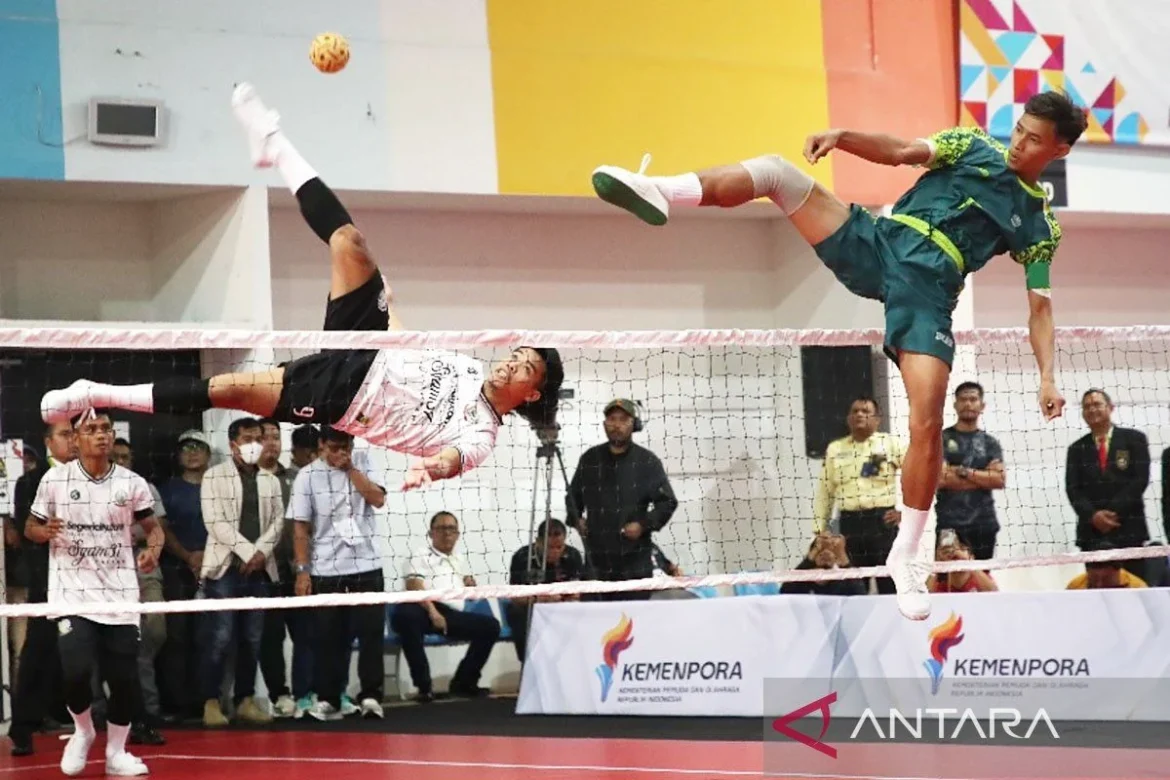
Sepak Takraw stands as one of the most visually spectacular and physically demanding athletic disciplines in the world, uniquely merging the strategic ball placement of volleyball with the breathtaking aerial acrobatics of association football, all while strictly prohibiting the use of hands. Often romanticized globally as "kick volleyball," this indigenous Southeast Asian team sport commands deep cultural roots, fierce regional rivalries, and an increasingly passionate international following. Played across a court mirroring the dimensions of a badminton court, athletes leverage exceptional flexibility, laser-focused coordination, and immense lower-body strength to launch a woven rattan sphere across a high net using only their feet, knees, chest, shoulders, and head.
As the global sporting community continues to embrace diverse cultural athletic traditions, Sepak Takraw has steadily transitioned from a regional pastime into an internationally regulated competitive spectacle. Governed at the highest level by the International Sepaktakraw Federation (ISTAF), the sport has achieved significant milestones in recent years, including prominent inclusion in regional multi-sport events like the Asian Games and Southeast Asian (SEA) Games. However, navigating its modern professional landscape has not been without administrative hurdles. Recent resolutions regarding organizational governance within key member nations underscore the sport’s ongoing institutional maturation, signaling a robust future for athletes, coaches, and federations dedicated to the discipline’s global expansion.
Etymology and Linguistic Roots of the Sport
To understand the essence of Sepak Takraw, one must examine the linguistic synthesis that defines its name. The term itself is a bilingual portmanteau reflecting the deep historical and cultural exchanges within the Malay Peninsula and Indochina. The word "Sepak" originates from Malay, translating directly to "kick," while "Takraw" is derived from the Thai language, specifically referring to a traditional woven ball constructed from split rattan.
Literally translated, Sepak Takraw means "to kick a rattan ball." Despite this unified linguistic designation, the sport maintains a fascinating array of localized nomenclature throughout Southeast Asia. In Indonesia, Malaysia, Brunei, and Singapore, variations of the game are historically and colloquially known as Sepak Raga. In the Philippines, players engage in a closely related variant called Sipa. Meanwhile, Myanmar cherishes its artistic, non-competitive performance version known as Chinlone, and Thailand proudly preserves the overarching structural framework under the umbrella of Takraw. These localized identities highlight the deep, interwoven heritage of the sport, demonstrating how a singular physical concept was adapted, refined, and cherished across diverse cultural landscapes over centuries.
Historical Evolution and Chronology
The historical trajectory of Sepak Takraw is a subject of rich scholarly discussion, with various Southeast Asian nations tracing its origins back several hundred years. Historical chronicles suggest that forms of the game were played in the Malay royal courts as early as the 15th century, serving as both a recreational pursuit and a test of physical agility for nobility and commoners alike. Over the subsequent centuries, the game migrated organically across borders, reaching the Indonesian archipelago by the 16th century, where it took root under the localized banner of Sepak Raga.
Parallel to its Southeast Asian evolution, historians have noted striking similarities between Sepak Takraw and ancient Chinese military exercises. Many sports historians theorize that the discipline shares distant ancestral ties with Cuju, an ancient Chinese military training game identified by the Fédération Internationale de Football Association (FIFA) as one of the earliest historical precursors to modern association football. Cuju involved soldiers keeping a leather ball in the air using their feet and bodies as a test of endurance and coordination.
The turning point toward institutionalization occurred in the mid-20th century. In 1945, a pivotal moment unfolded in Penang, Malaysia, when a local enthusiast named Hamid Mydin introduced a net to the traditional game, effectively distinguishing it from non-net variants like Sepak Raga. This newly structured variation was dubbed "Sepak Raga Jaring," or net-ball Sepak Raga.
By 1960, the institutional foundations of the modern sport solidified with the establishment of the Malaysian Sepak Raga Federation in Penang. A monumental milestone was reached in 1965 when the sport was officially incorporated into the Southeast Asian Peninsular (SEAP) Games. It was during this historic regional competition that the name was formally standardized to "Sepak Takraw." To govern the sport on a global scale and ensure standardized officiating, equipment, and international competition standards, the International Sepaktakraw Federation (ISTAF) was officially founded in 1988, paving the way for worldwide tournaments and standardized world championships.
Core Structure, Court Specifications, and Player Positions
Sepak Takraw is played on a court identical in size to a badminton court, measuring 13.4 meters by 6.1 meters, clear of any obstructions up to a height of 8 meters. The net, constructed of fine ordinary cord or nylon, divides the court symmetrically and stands at a height of approximately 1.52 meters for men and 1.42 meters for women, though junior and exhibition dimensions may occasionally vary.
A standard competitive match features two teams—commonly referred to as Regus—typically consisting of three starting players and strategic substitutes. The strategic architecture of a Regu relies heavily on specialized player positions, each requiring distinct physical and technical competencies:
- The Tekong: Serving as the primary tactician and powerhouse of the service game, the Tekong is positioned at the back of the court. This player is tasked with initiating the game through explosive, high-velocity serves that must cross the net precisely into the opponent’s designated service quadrant.
- The Feeder: Operating near the net, the Feeder acts as the playmaker. Their primary responsibility is to control the incoming ball with precision, cushioning and redirecting it to set up the ideal trajectory for the team’s designated striker.
- The Killer (or Striker): Positioned alongside or in front of the Feeder, the Killer is the offensive spearhead. Equipped with exceptional leaping ability and acrobatic flexibility, the Killer executes devastating, spiking kicks—often incorporating bicycle or scissors-kick motions—to drive the ball downward into the opponent’s floor with maximum velocity.
Comprehensive Rules of Play and Match Dynamics
The mechanics of Sepak Takraw demand rigorous adherence to strict technical fouls and scoring protocols. The game begins with a coin toss, the winner of which decides whether to execute the opening service or select their preferred side of the court.
Unlike volleyball, where players use their hands to control and strike the ball, Sepak Takraw mandates that participants utilize exclusively their feet, lower legs, knees, chest, shoulders, and head. Touching the ball with the hand or arm results in an immediate technical fault and awards a point to the opposing team. Each team is permitted a maximum of three consecutive touches to return the ball across the net, and no individual player may hit the ball twice in succession during a single play sequence.
The scoring system is designed for high-paced intensity. Points are awarded whenever the ball touches the ground within the opponent’s boundaries, when an opposing player commits a foul (such as touching the net, crossing the centerline, or using their hands), or when an opponent fails to return the ball across the net within the permitted three touches. Matches are typically contested in a best-of-three sets format. Each standard set is played to 21 points, provided a team maintains a minimum two-point advantage. If a deuce occurs at 20-20, play continues until one team establishes a decisive two-point lead, or until a ceiling score is reached depending on tournament regulations. Winning two sets secures the match victory for the Regu.
Administrative Resilience and Recent Governance Milestones
As Sepak Takraw continues to expand its global footprint, the administrative stability of national governing bodies remains critical to the sport’s sustainable growth. Recent developments in Indonesia highlight the ongoing efforts by sports authorities to resolve internal administrative friction and unify national representation under a single, cohesive banner.
The resolution of dualism within Indonesia’s Sepak Takraw governing bodies—successfully mediated by the Indonesian National Sports Committee (KONI) and the Indonesian Olympic Committee (KOI)—has been met with widespread acclaim from international stakeholders, most notably the International Sepaktakraw Federation (ISTAF). Administrative clarity at the national level allows athletes to focus entirely on training, development, and international competitions without the distraction of organizational discord. Government sports ministries have continuously emphasized that resolving internal governance issues across national sports federations is vital for fostering elite athletic performance and ensuring seamless participation in prestigious multi-sport events such as the Asian Games and world championships.
Broader Implications and Future Outlook
The cultural and athletic trajectory of Sepak Takraw illustrates the enduring power of traditional sports in the modern era. By preserving ancient physical disciplines while adopting rigorous international standardization, the sport has successfully captivated younger generations of athletes and spectators worldwide.
The global appeal of Sepak Takraw lies in its mesmerizing visual dynamics. The sheer athleticism required to execute mid-air defensive blocks and acrobatic offensive strikes places the discipline among the most demanding team sports in existence. As national federations continue to strengthen their administrative foundations, and as international bodies like ISTAF push for broader broadcasting and grassroots development, Sepak Takraw is exceptionally well-positioned to cement its status as a premier global sport. Through a harmonious blend of historical heritage and contemporary athletic excellence, the humble rattan ball continues to soar across nets around the world, uniting cultures through extraordinary feats of human agility.