
NVIDIA Corporation has officially announced the continued global rollout of its cutting-edge Deep Learning Super Sampling 5 (DLSS 5) technology, extending comprehensive software support to three major gaming titles throughout November 2026. Following its initial commercial debut in NBA 2K27, the next-generation AI-powered rendering framework is making its way to Avalanche Software’s open-world fantasy RPG Hogwarts Legacy, Gaijin Entertainment’s military simulation title War Thunder, and Everstone Studio’s upcoming Wuxia epic Where Winds Meet.
This latest wave of adoption marks a significant milestone in NVIDIA’s hardware and software strategy, demonstrating the industry’s accelerating transition away from traditional rasterization and basic upscaling methodologies toward advanced neural graphics pipelines. As graphics hardware architectures face mounting pressure to deliver photorealistic real-time path tracing at high frame rates, AI-driven rendering frameworks like DLSS 5 have rapidly evolved from optional graphical settings into foundational components of modern video game development.
The Chronology of DLSS 5 Rollout and Release Windows
The integration of DLSS 5 into the gaming ecosystem is proceeding on a structured timeline tailored to each developer’s engineering cycles. The rollout commences with Hogwarts Legacy, which received its official DLSS 5 patch on November 5, 2026. This update delivers immediate visual and performance enhancements to players exploring the sprawling castle grounds, Hogsmeade, and the surrounding Scottish highlands.

Following the Hogwarts Legacy deployment, Gaijin Entertainment is scheduled to integrate the technology into War Thunder during the middle of November 2026. This update aims to modernize the long-running multiplayer combat title by overhauling its rendering pipeline for massive armored engagements and aerial dogfights. Finally, Where Winds Meet will incorporate DLSS 5 upon its regional launch phase in the United States on November 23, 2026, allowing players to experience its cinematic martial arts action with state-of-the-art visual fidelity.
Technical Evolution: Moving Beyond Traditional Upscaling
To understand the significance of the DLSS 5 expansion, industry analysts and technical experts emphasize the fundamental architectural shift separating it from previous iterations, such as DLSS 4.5. While earlier versions primarily focused on advanced temporal reconstruction and high-performance upscaling to deliver high-resolution frames from lower internal rendering targets, DLSS 5 introduces a proprietary framework known as 3D-Guided Neural Rendering.
Rather than merely reconstructing pixel grids using historical frame data, DLSS 5 leverages sophisticated neural networks trained on spatial 3D geometry data. This allows the AI model to understand the physical depth, surface normals, and material properties of objects within the three-dimensional scene graph. Consequently, the technology generates hyper-realistic lighting, intricate shadow boundaries, complex reflections, and micro-surface textures that would traditionally require exorbitant computational overhead via hardware-intensive path tracing alone.
Game-Specific Implementations and Visual Enhancements

Each of the three newly supported titles utilizes the 3D-Guided Neural Rendering architecture in distinct ways, reflecting the diverse technical requirements of their respective genres and artistic directions.
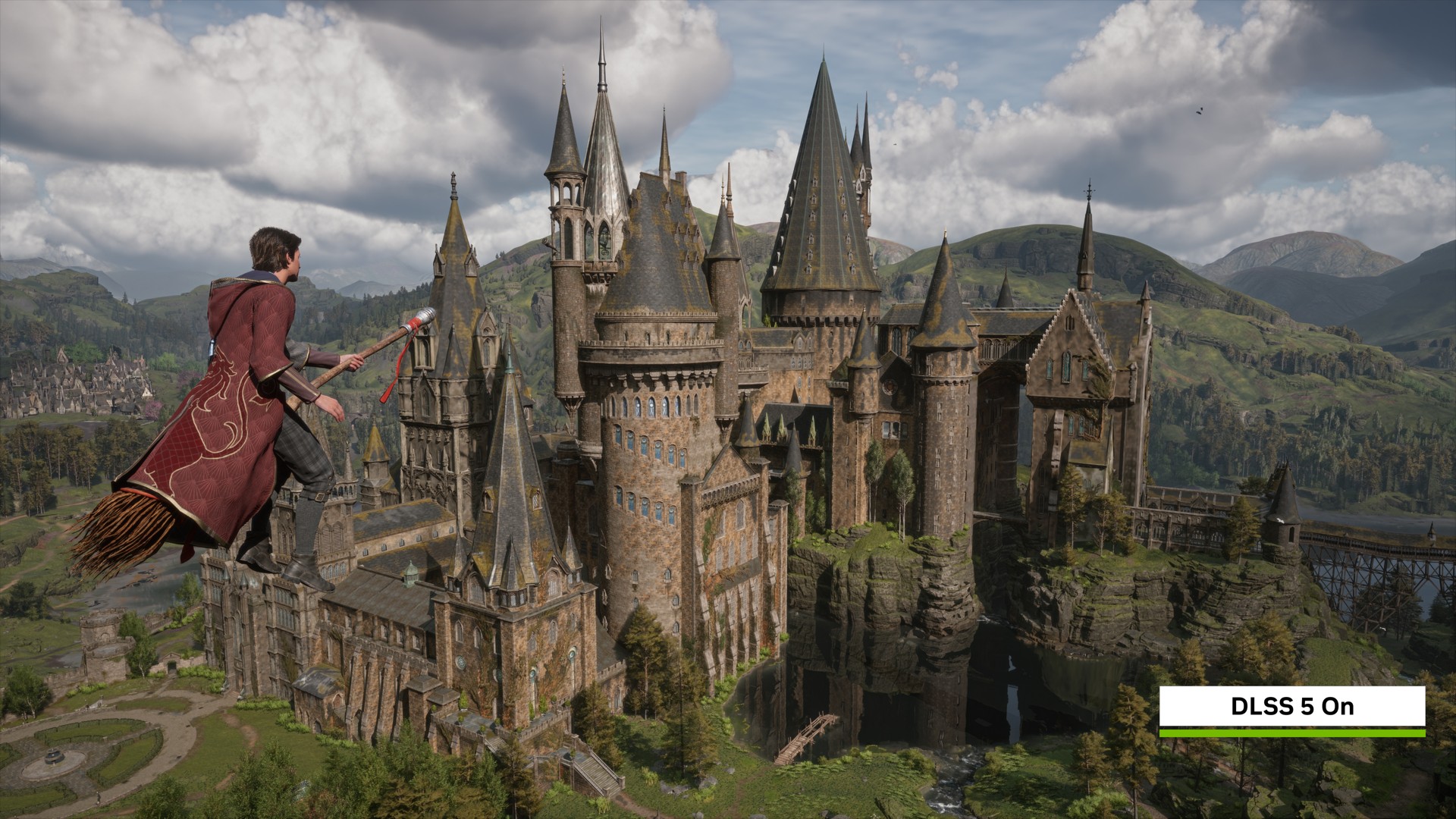
In Hogwarts Legacy, the partnership between Avalanche Software and NVIDIA focuses heavily on enriching the magical atmosphere. The integration elevates global illumination, ambient occlusion, and ray-traced reflections across the vast open world. Character facial textures, intricate wizarding robes, and sprawling interior environments benefit from enhanced material clarity. Crucially, Avalanche Software worked closely with NVIDIA engineers to fine-tune the intensity of the neural rendering effects, ensuring that the enhancements preserve the distinct, whimsical artistic identity established by the developers rather than introducing artificial visual noise or uncanny valley artifacts.
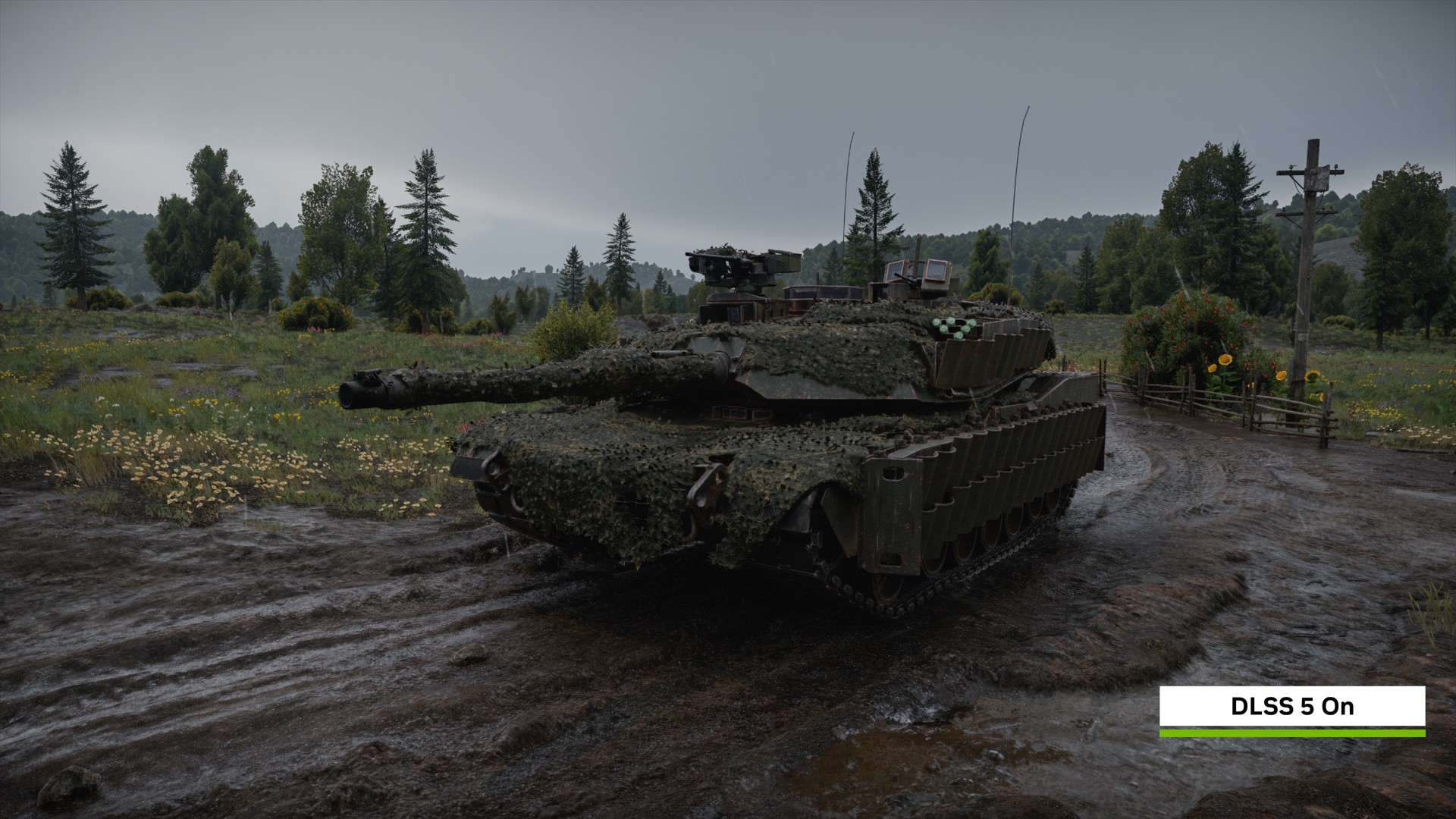
For War Thunder, the implementation targets the granular details crucial for competitive military simulations. The DLSS 5 patch significantly improves how light interacts with complex metallic surfaces, composite armor plating, and turbulent environmental conditions such as smoke, dust, and dynamic weather. Tanks, aircraft, and naval vessels render with sharper geometric fidelity and more accurate self-shadowing, giving players clearer visual feedback during high-stakes multiplayer combat scenarios.
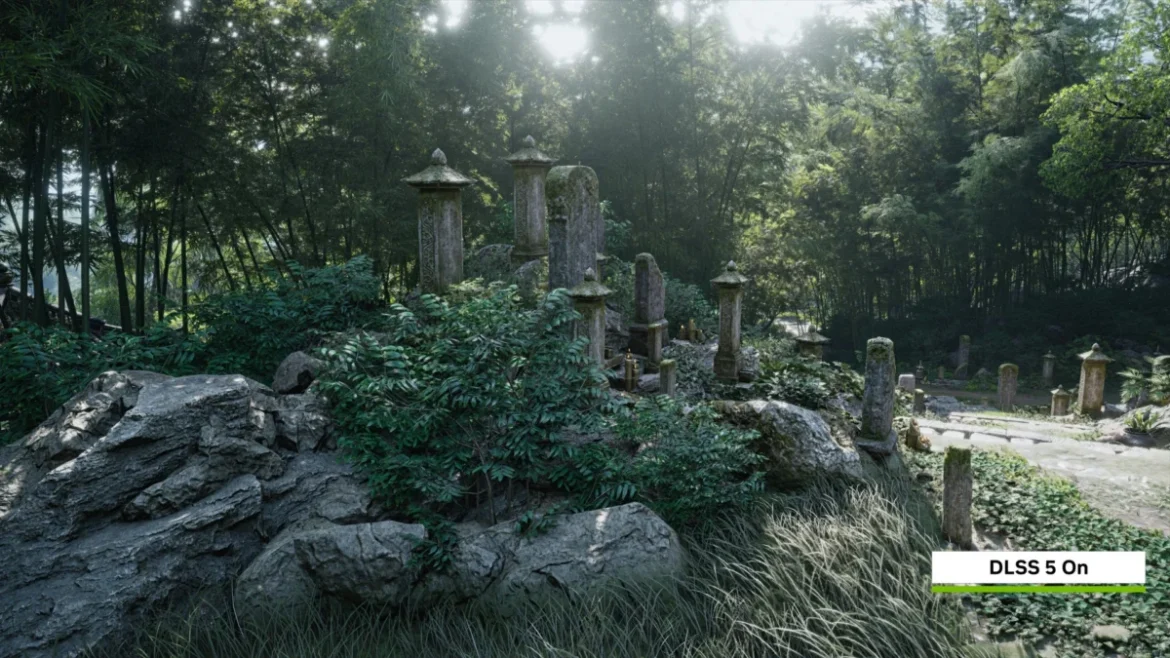
Where Winds Meet adopts DLSS 5 to elevate its atmospheric Wuxia aesthetic. The title’s vast open-world landscapes, characterized by dense bamboo forests, traditional ancient Chinese architecture, and fluid martial arts combat animations, demand exceptionally high fidelity to maintain immersion. The neural rendering pipeline sharpens environmental assets and character models alike, ensuring that sweeping cinematic vistas and fast-paced swordplay maintain pristine clarity without compromising performance.
Addressing Community Concerns Over Artistic Integrity
When NVIDIA first detailed the underlying mechanics of its neural rendering technology, segments of the gaming community expressed apprehension regarding the potential over-reliance on artificial intelligence. Critics voiced concerns that aggressive AI-driven graphic manipulation could homogenize game aesthetics, wash out distinct color palettes, or distort the intentional artistic direction conceived by game directors.
In response to these industry-wide discussions, NVIDIA and its development partners have emphasized developer control as a core pillar of the DLSS 5 architecture. Unlike legacy filters or uncalibrated post-processing effects, DLSS 5 provides studios with granular controls over algorithmic intensity, neural weight parameters, and localized rendering targets. Developers retain the final authority to dictate how aggressively the AI interacts with specific geometry layers, ensuring that a game’s moody atmosphere, stylized graphics, or specific color grading remain entirely intact. The successful integration into culturally rich and stylistically unique titles like Hogwarts Legacy and Where Winds Meet serves as empirical proof that neural rendering can enhance fidelity without eroding artistic intent.
Broader Industry Implications and Market Outlook
The rapid expansion of DLSS 5 highlights a broader paradigm shift within the PC gaming and hardware manufacturing sectors. As real-time ray tracing and path tracing demand increasingly massive computational resources, brute-force hardware scaling has hit diminishing returns due to power consumption and thermal limits. Software-defined rendering solutions accelerated by dedicated AI Tensor Cores have thus become the primary vehicle for generational leaps in visual fidelity.
Market analysts note that NVIDIA’s proactive collaboration with major third-party studios and live-service developers solidifies its dominant position in the GPU ecosystem. By establishing DLSS 5 as a standard-setting benchmark for neural rendering, NVIDIA not only drives hardware upgrades among consumers seeking to leverage these advanced features but also establishes a collaborative framework that software developers can rely on to future-proof their titles.
As the November 2026 rollout progresses, industry observers will closely monitor player reception, performance benchmarks, and frame-rate stability metrics across Hogwarts Legacy, War Thunder, and Where Winds Meet. If these implementations perform as robustly in consumer hands as they have in controlled developer environments, the gaming industry may witness an even more aggressive acceleration toward fully neural-rendered virtual worlds in the years ahead.
