
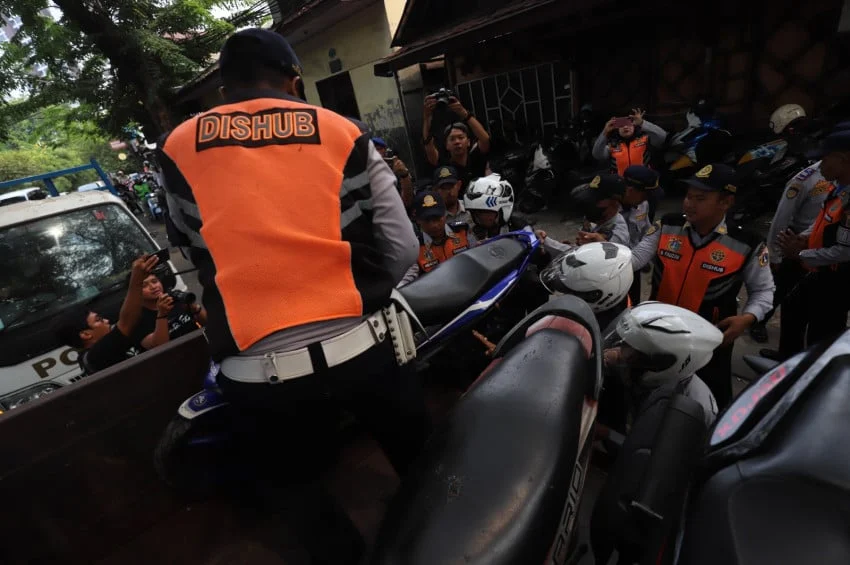
The South Jakarta Transportation Sub-agency (Sudinhub) intensified its enforcement operations against illegal motorcycle parking on Monday, October 26, 2026, targeting high-traffic corridors known for chronic congestion. The operation, which resulted in the removal of 13 motorcycles, marks a significant escalation in the city’s efforts to reclaim public spaces, particularly sidewalks and road shoulders, from motorists who disregard parking regulations. The sweep was conducted as a direct response to a growing volume of public grievances submitted through the Jakarta Kini (JAKI) and Cepat Respons Masyarakat (CRM) digital platforms.
Chronology of Enforcement Operations
The enforcement action commenced at approximately 13:30 WIB, strategically timed to address the afternoon peak congestion period. A joint task force, comprising 22 personnel from the South Jakarta Transportation Sub-agency, the Kebayoran Lama Transportation Task Force, the Military Police (POM TNI), and the Public Order Agency (Satpol PP), descended upon two critical locations: Jalan KH Muhammad Syafi’i Hadzami, adjacent to the Gandaria City commercial hub, and Jalan Melawai Raya.
The operation was executed with precision. By the time the sweep concluded, the joint force had successfully identified and secured 13 motorcycles that had been abandoned on sidewalks or prohibited road shoulders. Of these, 11 vehicles were impounded from the Jalan KH Muhammad Syafi’i Hadzami area, while two were removed from Jalan Melawai Raya. To facilitate the removal, the agency deployed a robust operational fleet, including two tow trucks, two patrol vehicles, two transport trucks, and one motorcycle patrol unit. Following the seizure, the vehicles were transported to the South Jakarta Transportation Sub-agency office located at Jalan MT Haryono Kav. 45–46 for administrative processing and potential fines.
Public Accountability and the Role of Digital Reporting
The decision to launch this specific operation was not arbitrary; it was a data-driven response to citizen feedback. Ebenezer L. Tobing, an official representing the South Jakarta Transportation Sub-agency, emphasized that the department is increasingly reliant on the JAKI application—a digital portal designed to bridge the gap between Jakarta’s residents and its municipal governance.
"This enforcement is a direct consequence of the complaints we have received via the JAKI and CRM platforms," Tobing stated during the post-operation briefing. "Illegal parking is not merely a violation of traffic laws; it is an infringement on the rights of pedestrians and a major catalyst for traffic congestion. We are committed to responding swiftly to these reports to restore order and accessibility in our public spaces."
The integration of the JAKI platform into municipal operations represents a broader shift toward "smart city" governance in Jakarta. By crowdsourcing reports of traffic violations, the city administration can deploy resources more efficiently, focusing on areas where illegal parking is most detrimental to public flow. This reactive model, however, is being supplemented by ongoing surveillance to deter repeat offenders.
Contextualizing the Crisis of Public Space
The prevalence of illegal parking in South Jakarta is a multifaceted issue rooted in rapid urbanization, insufficient parking infrastructure, and behavioral challenges. In commercial districts like Gandaria and Melawai, the sheer density of retail establishments often outstrips the availability of official parking facilities. When motorists perceive a lack of affordable or accessible parking, many resort to occupying sidewalks, effectively forcing pedestrians—including children, the elderly, and persons with disabilities—to walk on the edge of busy vehicular lanes.
Beyond the immediate inconvenience, the presence of these motorcycles creates a "bottleneck effect." When a significant portion of the road shoulder is occupied by parked vehicles, the effective capacity of the thoroughfare decreases. This leads to reduced vehicle throughput, increased idling times, and higher emissions—a primary concern for a city struggling with air quality management.
Supporting Data and Broader Implications
While 13 motorcycles might seem like a modest number in a city of millions, the operation serves as a symbolic and practical warning to the public. Historically, the South Jakarta Transportation Sub-agency has struggled to maintain continuous enforcement across all hotspots. Data from previous years indicates that the most common areas for illegal parking violations are concentrated near transit-oriented developments, shopping malls, and traditional markets.
The implications of this enforcement are two-fold. Firstly, it sends a deterrent signal to motorists. The cost of retrieving an impounded vehicle—which includes administrative fines and potential storage fees—often far exceeds the cost of a standard parking fee. Secondly, it highlights the ongoing tension between commercial growth and urban design. Urban planners argue that until Jakarta significantly expands its off-street parking capacity or optimizes public transit connectivity, "wild" parking will remain a recurring challenge.
Furthermore, the involvement of the Military Police (POM TNI) alongside civilian authorities reflects a serious commitment to upholding the rule of law. By involving multiple agencies, the Jakarta provincial government aims to minimize potential confrontations between motorists and enforcement officers, ensuring that the operation is carried out with a high degree of authority and procedural integrity.
Future Outlook: A Sustainable Path Forward
The success of the October 26 operation invites questions regarding the sustainability of current enforcement methods. Is manual removal of vehicles enough to solve the problem, or does Jakarta require a more permanent infrastructure solution?
Experts suggest that the current crackdown is an essential component of traffic management but must be paired with better infrastructure planning. This includes the installation of bollards to prevent vehicles from mounting sidewalks, the creation of designated motorcycle parking zones, and the enhancement of public transport integration to reduce the reliance on private vehicles for short-distance trips to commercial hubs.
As the Jakarta government continues to utilize the JAKI platform, the frequency of such enforcement actions is expected to rise. The digital trail created by user reports provides a heat map of problem areas, which can inform long-term urban development strategies. For the motorists of South Jakarta, the message is clear: the era of unchecked, free-roaming parking in high-traffic corridors is coming to an end. The city is increasingly prioritizing the mobility of the many over the convenience of the few.
Conclusion
The swift response by the South Jakarta Transportation Sub-agency on October 26 serves as a reminder of the evolving landscape of civic responsibility in the capital. By leveraging citizen-led reports and coordinating inter-agency efforts, the city is reclaiming its infrastructure from unauthorized use. As enforcement continues, the focus will likely shift from purely reactive measures to more holistic, preventative strategies aimed at creating a safer, more accessible, and orderly environment for all residents of Jakarta. The cooperation between the public, through platforms like JAKI, and the authorities remains the linchpin of this ongoing urban transformation.
