
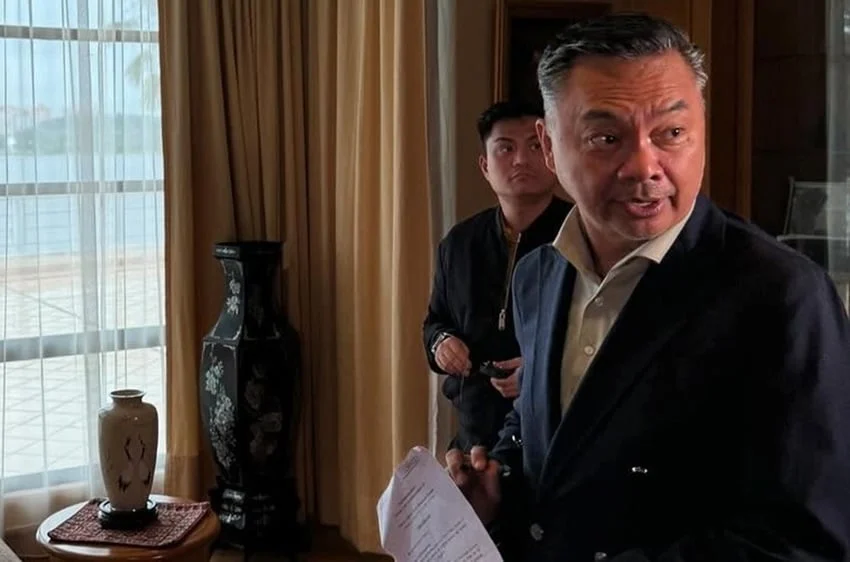
Former Indonesian Deputy Minister of Foreign Affairs Dino Patti Djalal has publicly raised critical questions regarding a high-profile wiretapping controversy allegedly involving former National Police (Polri) Chief General Listyo Sigit Prabowo. The unfolding scandal has captured national attention, sparking intense debates among political analysts, legal experts, and the public regarding state surveillance, institutional boundaries, and the political motivations behind covert intelligence operations.
The controversy centers on explosive allegations that former police leadership engaged in unauthorized electronic surveillance directed at high-ranking government officials, culminating in reported actions intersecting with the administration of President Prabowo Subianto. Taking to his verified personal account on the social media platform X, Dino Patti Djalal focused his inquiry on the stark operational disparity displayed by the former police chief across two distinct presidential administrations: that of the seventh Indonesian President, Joko Widodo (Jokowi), and the current administration led by President Prabowo Subianto.
"An interesting question: If LSP [Listyo Sigit Prabowo] as the National Police Chief never intended nor dared to wiretap President Jokowi, why has LSP as the National Police Chief since 2024 intended and dared to wiretap President Prabowo? What is the answer?" Dino wrote in a statement that quickly circulated across domestic media outlets.
This probing query has injected a new layer of complexity into an already volatile political landscape, prompting demands for transparency, comprehensive investigations, and a thorough re-evaluation of institutional accountability within Indonesia’s primary law enforcement and security apparatus.
Background Context and Evolution of the Wiretapping Allegations
To understand the weight of Dino Patti Djalal’s remarks, it is essential to examine the broader context surrounding the alleged surveillance activities. In modern democratic states, the use of wiretapping and electronic surveillance by law enforcement agencies is strictly regulated under specific statutory frameworks. Typically, such measures are reserved for counter-terrorism, major organized crime investigations, or serious national security threats, and they generally require rigorous judicial authorization or oversight from specialized oversight bodies.
When allegations emerge that top-tier law enforcement officials have allegedly weaponized or misapplied intelligence-gathering capabilities against the nation’s highest executive office, it touches upon foundational constitutional principles. The executive branch relies on a secure environment to formulate foreign policy, manage national defense, and execute governance. Any breach of this security—particularly one allegedly orchestrated from within domestic security institutions—represents a profound institutional crisis.
The involvement of a former National Police Chief adds unprecedented gravity to the situation. General Listyo Sigit Prabowo served a prominent tenure at the helm of the Indonesian National Police under President Joko Widodo, navigating numerous high-profile institutional challenges, domestic security incidents, and major policy rollouts. The transition of power to President Prabowo Subianto in late 2024 brought shifts in administrative priorities, cabinet appointments, and the operational postures of various state security and intelligence agencies.
The core of the current public debate, as highlighted by political commentators and security observers, lies in why surveillance activities would seemingly shift or escalate toward the sitting head of state during a transition period, contrasting sharply with the administrative continuity observed during the previous presidential term.
Chronology of Public Disclosures and Reactions
The discourse surrounding the alleged wiretapping did not emerge in a vacuum. In the days leading up to Dino Patti Djalal’s public intervention, multiple public figures, retired high-ranking military and police officials, and legal analysts began voicing suspicions regarding potential political motives underpinning the intelligence leaks and surveillance claims.
Among the prominent voices addressing the controversy was former high-ranking police official Oegroseno, who publicly expressed deep suspicions regarding the alleged wiretapping activities linked to Listyo Sigit and associated networks. Oegroseno explicitly called for a rigorous investigation into potential elements of treason (makar) or subversion, suggesting that unauthorized surveillance targeting the highest echelons of state leadership transcends ordinary institutional friction and borders on a direct threat to constitutional stability.

The progression of events has underscored a growing polarization within political circles regarding how state institutions should be reformed or audited. Observers note that allegations of this magnitude require swift, impartial clarification from independent oversight bodies, such as the National Police Commission (Kompolnas), the House of Representatives (DPR RI) commissions overseeing legal and security affairs, and relevant intelligence oversight mechanisms.
However, navigating these allegations presents a delicate challenge for state authorities. On one hand, failing to thoroughly investigate claims of unlawful wiretapping against a sitting president undermines the rule of law and leaves the executive branch vulnerable to internal security threats. On the other hand, handling the case improperly risks sparking prolonged institutional friction between the police force, intelligence agencies, and the broader government machinery.
Comparative Analysis: Institutional Dynamics Across Administrations
Dino Patti Djalal’s comparison between the Jokowi era and the Prabowo administration touches upon a fundamental question of political science and institutional loyalty: how state apparatuses function during political successions.
During Joko Widodo’s decade-long presidency, the relationship between the executive branch and the Indonesian National Police underwent various structural tests, including high-profile internal scandals that required delicate political management. Despite these internal pressures, public records and institutional norms maintained a baseline of operational deference toward the presidency. The suggestion that a top law enforcement official would allegedly contemplate or execute surveillance against President Prabowo Subianto—if substantiated—indicates a significant departure from established protocols of statecraft.
Analysts point out that transitions between different presidential administrations naturally involve adjustments in strategic alignment, trust-building, and command-and-control dynamics. When leaders with distinct leadership styles and security backgrounds assume power, institutional actors must adapt to new directives and heightened accountability standards. The introduction of alleged unauthorized intelligence-gathering operations during such a transitional phase raises critical questions about internal discipline, the autonomy of intelligence units, and the potential influence of external political interests within law enforcement structures.
Furthermore, the public nature of Dino Patti Djalal’s query reflects a broader trend among former diplomats, senior statesmen, and public intellectuals in Indonesia who feel compelled to use digital platforms to demand institutional clarity. In an era where information—and misinformation—spreads rapidly across social media, high-profile commentary from experienced diplomatic figures serves to frame public discourse, urging formal institutions to address uncomfortable truths rather than letting controversies fade into political obscurity.
Broader Implications and the Path Forward
The ongoing controversy carries profound implications for the future of governance, intelligence oversight, and civil-military-police relations in Indonesia. As the nation continues to consolidate its democratic institutions under the Prabowo administration, maintaining public trust in the integrity of state security apparatuses is paramount.
-
Strengthening Oversight Mechanisms: Legal and security experts have repeatedly emphasized the urgent need to modernize and strictly enforce legal frameworks governing electronic surveillance. Clear boundaries must be established to ensure that intelligence and police agencies operate strictly within their legally mandated spheres, with robust judicial or parliamentary oversight to prevent abuse of power.
-
Restoring Institutional Trust: The involvement of senior figures in public spats and allegations of covert operations risks damaging the internal morale and public reputation of the Indonesian National Police. Swift, transparent, and objective investigations are essential to clear innocent personnel, hold accountable any individuals found guilty of violating the law, and restore public confidence in law enforcement impartiality.
-
Political Stability and Governance: President Prabowo Subianto’s administration has consistently emphasized national stability, anti-corruption reforms, and strong governance as core pillars of its national agenda. Addressing security breaches or politically motivated surveillance attempts decisively will demonstrate the administration’s commitment to upholding the constitutional order and safeguarding the democratic process against internal subversion.
As public pressure mounts and legal experts continue to debate the appropriate judicial and administrative remedies, the questions raised by Dino Patti Djalal remain a focal point of Indonesia’s political dialogue. Whether formal state institutions will initiate a comprehensive, transparent inquiry into the alleged wiretapping remains one of the most closely watched developments in contemporary Indonesian politics.
