
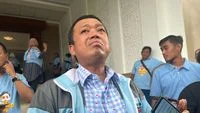
The ongoing legal proceedings surrounding the high-profile corruption scandal involving the 2023–2024 additional Hajj quota took a dramatic turn at the Jakarta Corruption Court. Ishfah Abidal Azis, a former Special Staffer to former Minister of Religious Affairs Yaqut Cholil Qoumas for the 2019–2024 period—frequently known as Gus Alex—testified under oath that a staggering sum of US$1 million was funneled directly to the leadership of the House of Representatives’ (DPR) Special Committee (Pansus) on Hajj 2024.
The assertion was delivered firmly by Ishfah during a court hearing held at the Central Jakarta District Court. According to his testimony, the vast financial distribution was systematically orchestrated to reach Nusron Wahid, who served as the Chairman of the 2024 Hajj Pansus. This disclosure brings a new layer of scrutiny to an already extensive investigation into state financial losses amounting to hundreds of billions of rupiah, spotlighting the intersection of legislative oversight and administrative abuse within Indonesia’s sacred pilgrimage management system.
The Allegation and the Mechanics of the Transfer
Detailing the mechanics of the alleged bribery during an adjournment interview at the Tipikor Court, Ishfah maintained absolute conviction regarding the final destination of the funds. He pointed to a sophisticated intermediary chain utilized to mask the paper trail of the illicit transactions.
"Specifically for that Pansus, it was 1 million US dollars," Ishfah stated to journalists outside the courtroom.
When questioned about how such a massive sum successfully changed hands without immediate detection, Ishfah identified an individual named Zainal Abidin as the primary conduit. According to the former ministerial aide, Zainal functions as a close associate of Nusron Wahid. To further solidify the operational network involved in the delivery, Ishfah noted the presence of two other individuals, identified as Khomsen and Acong, who allegedly facilitated the logistical execution on the ground.
"I am certain it reached Nusron, routed through Zainal Abidin, with individuals named Khomsen and Acong present in the scheme," Ishfah elaborated.
In light of these serious allegations, journalistic attempts were immediately initiated to secure a response from the accused legislative figure. Reporters from major national outlets repeatedly contacted Nusron Wahid via telephone to verify the claims made by his former bureaucratic counterpart. However, at the time of publication, the telephone number registered to Nusron remained entirely inactive, leaving his direct perspective absent from the immediate discourse.
Unraveling the Financial Trail: Testimony of Syaiful Bahri
The courtroom revelations did not emerge in a vacuum; they built upon prior testimonies delivered earlier in the month by co-defendants and key witnesses. At the center of this supporting testimony is Syaiful Bahri—also known as Bajak Laut—a former staff member of the Executive Board of Nahdlatul Ulama (PBNU).
During a pivotal evidentiary session earlier in September, both Ishfah and Syaiful Bahri cross-examined the specifics of financial handovers, explicitly confirming the transfer of approximately US$400,000 destined for the DPR Hajj Pansus.
During the courtroom exchanges, Ishfah directly questioned Syaiful regarding the operational directives given to him prior to the handover.
"Does the witness know that at that time, I asked you to meet someone named Erik to hand over a sum of 400 thousand US dollars to fulfill the request of Zainal Abidin, the friend of Pak Nusron Wahid?" Ishfah queried during the hearing.
Syaiful admitted his initial ignorance regarding the ultimate recipient, noting that clarity only came after retrospective inquiry. "At that time I didn’t know, sir, but after a few days I asked you who that actually was, and only then did you tell me," Syaiful responded under oath.
"Only after that did I tell you that Zainal Abidin made a request, then at that time I asked you to hand it over to him, that he is Pak Nusron Wahid’s friend. Correct?" Ishfah pressed further.
"Yes," Syaiful replied.
"Okay. Meaning you understand, right, that it was at the request of Zainal Abidin and I asked you to hand it over through Erik?" Ishfah concluded, to which Syaiful affirmed, "Ready, after being told."
This corroborating testimony solidified the connection between the funds managed by mid-level operatives and the broader political machinery of the legislative inquiry committee. Earlier disclosures in the trial of Asrul Azis Taba—Chairman of the Kesthuri Association and Commissioner of PT Raudah Eksati Utama—revealed that Syaiful had initially been entrusted by Asrul with funds intended for Ishfah, which were subsequently redirected to satisfy the operational demands of the Hajj Pansus under Nusron’s leadership. Furthermore, investigators noted that the supplementary injection of US$400,000 was allegedly prepared by Mohammad Nuruzzaman, a former Special Staffer to the Minister of Religious Affairs for Institutional Relations, who secured the liquidity by taking out loans from various external parties.
Background and Chronology of the Hajj Quota Scandal
The roots of this legal crisis trace back to contentious policy decisions made during the management of the 2023–2024 Hajj seasons. The controversy primarily centers on the controversial allocation of additional Hajj quotas provided by the Kingdom of Saudi Arabia. Under standard international agreements and domestic religious regulations, the distribution of regular versus special Hajj quotas is bound by strict statutory proportions set by the Hajj Financial Management Agency (BPKH) and the Ministry of Religious Affairs in consultation with the House of Representatives.
However, allegations emerged that the Ministry of Religious Affairs arbitrarily modified the quota distribution split—reportedly shifting a significant portion of the additional quota intended for regular pilgrims to special pilgrimage organizers (PIHK), allegedly in exchange for financial kickbacks and operational concessions. This regulatory deviation prompted immense public outcry, leading the House of Representatives to form the special investigative committee (Pansus Haji) in mid-2024 to probe potential administrative malpractice, abuse of power, and corruption within the ministry.
Ironically, the current revelations suggest that the very legislative body established to investigate irregularities may have itself been compromised by financial inducements from stakeholders attempting to influence the committee’s findings or secure favorable recommendations.
The Defendants and the Scope of State Financial Losses
The judicial proceedings currently active at the Jakarta Corruption Court involve four primary defendants whose alleged orchestration of the quota manipulation has caused monumental losses to the state treasury. According to the official Audit Report on Investigative Examinations issued by the Audit Board of the Republic of Indonesia (BPK), the total financial loss sustained by the state in this singular corruption case reaches a staggering Rp622,090,207,166.41—commonly cited as Rp622 billion.
The four individuals formally processed through the criminal justice system are:
- Yaqut Cholil Qoumas, the former Minister of Religious Affairs who held the portfolio from 2019 to 2024.
- Ishfah Abidal Azis, the former Special Staffer whose recent testimonies have expanded the scope of the investigation into legislative corridors.
- Ismail Adham, serving as the Director of Operations for Maktour, a prominent travel agency allegedly implicated in securing preferential quota access.
- Asrul Azis Taba, the General Chairman of the Kesthuri Association and Commissioner of PT Raudah Eksati Utama.
Beyond these primary figures, investigative findings indicate that the corrupt practices systematically enriched numerous auxiliary entities, most notably identifying at least 313 Special Hajj Pilgrimage Organizers (PIHK) who reaped massive financial windfalls from the irregular distribution of the pilgrimage slots at the expense of ordinary citizens languishing on decades-long waiting lists.
Broader Implications and Systemic Impact on Governance
The unfolding trial serves as a stark reminder of the vulnerabilities inherent in the administration of religious affairs in Indonesia, a sector historically guarded by public trust yet continually marred by rent-seeking behaviors. The allegation that US$1 million found its way into the hands of a parliamentary oversight committee chair highlights a profound conflict of interest within institutional checks and balances.
When legislative oversight bodies—tasked with investigating executive corruption—become financially entangled with the very ministries they are mandated to audit, the fundamental integrity of democratic governance is deeply compromised. Legal analysts observing the Tipikor proceedings suggest that if prosecutors can substantiate the money trail from the ministry staffers through intermediaries like Zainal Abidin directly to legislative leaders, the fallout could trigger a wider wave of indictments extending deep into the halls of parliament.
As the judicial process moves forward, the primary focus of the court will remain on corroborating the digital and financial trails, testing the veracity of testimonies provided by figures like Ishfah Abidal Azis and Syaiful Bahri, and determining the legal culpability of both executive administrators and legislative overseers. For the millions of Indonesian Muslims awaiting their sacred journey to Mecca, the trial represents both a measure of accountability and a painful exposure of how administrative corruption has historically undermined the pillars of national religious governance.
