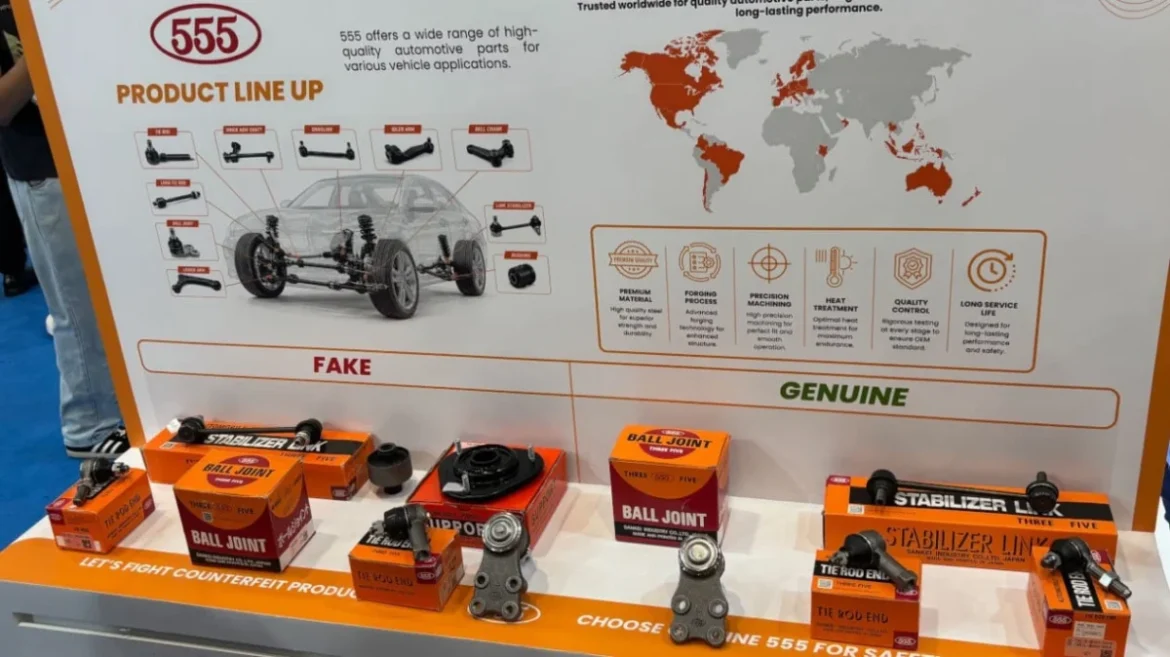
Tangerang, Automotive Industry Desk — In the modern automotive landscape, the allure of deeply discounted spare parts often proves irresistible to vehicle owners seeking to minimize maintenance expenses. However, automotive experts and industry stakeholders continually warn that prices significantly below standard market rates frequently serve as a primary indicator of counterfeit components. Distinguishing between genuine and counterfeit automotive parts has evolved beyond a simple visual check of product packaging, demanding heightened scrutiny of manufacturing precision, material quality, and distribution channels.
This critical consumer education initiative took center stage at the prestigious Automechanika Jakarta 2026 exhibition, held at the Nusantara International Convention Exhibition (NICE) in Tangerang. Amidst a sprawling showcase of cutting-edge automotive technologies, aftermarket innovations, and heavy-duty components, PT Timur Raya Anugerah Damai (TRAD) emerged as a key educator. The company drew significant crowds by mounting a side-by-side display of authentic and counterfeit spare parts, offering industry professionals, fleet managers, and everyday motorists a rare opportunity to examine the tangible differences between real components and their illicit counterparts up close.
Unmasking the Counterfeit Market at Automechanika Jakarta 2026
The Automechanika Jakarta 2026 trade fair serves as Southeast Asia’s premier platform for the automotive aftermarket sector, drawing manufacturers, suppliers, distributors, and enthusiasts from across the globe. Within this bustling hub of commerce and innovation, PT Timur Raya Anugerah Damai (TRAD) utilized its exhibition booth to address a persistent and dangerous shadow economy: the proliferation of counterfeit automotive components.
Counterfeit spare parts present severe risks to vehicular safety, yet they continue to infiltrate supply chains due to consumer demand for bargain pricing. To combat this phenomenon, TRAD’s interactive display stripped away the guesswork by placing genuine parts directly next to fake alternatives. Visitors were encouraged to run their fingers along surfaces, inspect structural alignments, and scrutinize structural finishes.
According to TRAD representatives, physical inspection remains one of the most effective lines of defense for vehicle owners who lack access to specialized laboratory testing equipment. By breaking down the specific manufacturing flaws inherent in pirated parts, the company sought to empower everyday consumers to make safer, more informed purchasing decisions.
Physical Anatomy of Authenticity: Precision vs. Poor Craftsmanship
During the exhibition, technical experts from PT Timur Raya Anugerah Damai highlighted several distinct structural anomalies that separate certified original equipment from illicit knockoffs. One of the most glaring physical discrepancies can be found in the alignment and execution of component holes and mounting points.
Genuine parts, manufactured under strict quality control protocols and utilizing high-precision computer-numerical-control (CNC) machinery, exhibit perfectly centered, highly symmetrical holes designed to integrate seamlessly into a vehicle’s assembly. In stark contrast, counterfeit components frequently display misaligned, irregularly shaped, or off-center openings. These flaws not only complicate the installation process but also create uneven tension points when bolted onto an engine chassis or suspension system, dramatically increasing the likelihood of mechanical failure under stress.
Another critical differentiator lies in the quality of the casting and surface finishing. Authentic components undergo rigorous metallurgical processes, resulting in smooth, uniform exterior surfaces free of micro-cracks, pitting, or excess material residue. Counterfeit parts, typically produced in clandestine operations using substandard metal alloys and crude sand-casting or mold techniques, invariably feature rough, grainy, and uneven surfaces.
Jessica Kwan, Sales and Marketing Manager at PT Timur Raya Anugerah Damai, emphasized that relying solely on upfront price tags or visual impressions of outer wrapping is a dangerous gamble. “If it is genuine, it will certainly be more precise and of vastly superior quality. The counterfeit ones are usually much rougher,” Kwan noted during the exhibition. Her insights underscore a fundamental rule of automotive maintenance: structural integrity cannot be faked once a component is subjected to the intense thermal and mechanical loads of everyday driving.
The Packaging Trap: Why Boxes Can Be Deceiving
A common misconception among vehicle owners is that high-quality packaging guarantees a genuine product. Illegitimate manufacturers have grown increasingly sophisticated in replicating corporate branding, holographic security seals, instruction manuals, and cardboard cartons.
Jessica Kwan addressed this vulnerability directly, explaining that while product boxes serve as a preliminary checkpoint, they should never be the sole criterion for authentication. Packaging can easily be manufactured, replaced, or recycled to house inferior goods.
“When it comes to packaging, it can easily be swapped out or replicated. Therefore, if you are purchasing genuine items, you must look closely at the specific physical characteristics of the component itself and verify the credibility of the place where you are buying it,” Kwan explained.
This reality shifts the burden of security onto the integrity of the supply chain. Authorized dealerships, certified franchise workshops, and official brand distributors remain the safest harbors for consumers seeking guaranteed authenticity. Conversely, unverified online marketplaces, independent third-party discounters operating without verifiable credentials, and brick-and-mortar storefronts offering unexplained clearance sales demand heightened skepticism.
Economic Pressures and the Allure of Discounted Parts
The proliferation of counterfeit automotive components does not occur in a vacuum. Macroeconomic pressures, fluctuating inflation rates, rising costs of living, and steep tariffs on imported original equipment manufacturer (OEM) parts have squeezed vehicle owners financially. For commercial fleet operators balancing tight profit margins and private motorists facing expensive routine maintenance bills, the temptation to opt for cheaper alternatives is entirely understandable.
However, financial analysts and automotive safety advocates frequently remind the public of the "hidden costs" associated with counterfeit parts. While a pirated brake pad, suspension arm, oil filter, or timing belt may cost a fraction of its OEM counterpart, its premature failure often leads to catastrophic collateral damage. A substandard brake rotor can fracture under high-speed deceleration; a counterfeit oil filter can disintegrate, starving an engine of lubrication and causing complete engine seizure; and a faulty suspension component can snap, resulting in a severe loss of directional control. Consequently, what begins as an initial cost-saving measure frequently translates into exponential repair expenses, extensive vehicle downtime, and, most tragically, life-threatening traffic accidents.
The Whack-A-Mole Dilemma: The Ever-Evolving Counterfeit Supply Chain
Combatting automotive counterfeiting resembles a relentless game of digital and physical whack-a-mole. Illegitimate manufacturing syndicates operate with high agility, rapidly adapting their production methods whenever law enforcement agencies or trademark holders crack down on a specific illicit supply line.
Jessica Kwan elaborated on the immense regulatory and investigative challenges faced by legitimate parts distributors in the modern market. When industry watchdogs successfully educate the public on identifying a specific counterfeit product variant, counterfeiters simply pivot, introducing new batches featuring updated visual aesthetics, redesigned knockoff packaging, or entirely different product categories to the market.
“Because there are so many of them, for instance, if we conduct an education campaign today, tomorrow there may be many new ones emerging. So it is rather difficult to track them all down permanently,” Kwan stated, highlighting the systemic nature of intellectual property theft within the global automotive aftermarket.
This dynamic fluidness necessitates a multi-layered defensive strategy involving stricter border controls, aggressive legal prosecution of intellectual property violators, continuous public awareness campaigns, and enhanced traceability technologies—such as blockchain-based serial numbers and interactive QR-code authentication systems embedded directly into product bodies rather than detachable packaging.
Broader Industry Implications and the Path Forward
The issues highlighted at Automechanika Jakarta 2026 resonate far beyond the exhibition halls of Tangerang; they reflect a global crisis within the automotive aftermarket. As vehicles incorporate increasingly complex electronic systems, advanced driver-assistance systems (ADAS), and precision-engineered mechanical assemblies, the margin for component error narrows exponentially.
Automotive industry associations, regulatory bodies, and major manufacturers are being forced to adopt proactive stances. Collaboration between law enforcement and private enterprises is intensifying, targeting illegal manufacturing hubs, clandestine import channels, and unauthorized digital storefronts that facilitate the distribution of unverified components.
Simultaneously, consumer education remains the ultimate line of defense. Industry leaders stress that transforming consumer mindset—moving away from a culture of blind bargain-hunting toward an ethos of lifecycle value and vehicular safety—is paramount. By recognizing that legitimate manufacturing requires substantial investment in research, metallurgy, precision tooling, and quality assurance, vehicle owners can better contextualize why authentic parts command premium pricing.
Ultimately, the insights shared by PT Timur Raya Anugerah Damai at Automechanika Jakarta 2026 serve as a timely reminder for the automotive community. As counterfeiters grow bolder and more sophisticated, vigilance cannot be outsourced. Whether inspecting the symmetry of a mounting hole, evaluating the smoothness of a cast metal surface, or meticulously verifying the credentials of an auto parts supplier, vehicle owners hold the ultimate responsibility for ensuring that the components keeping their vehicles safely on the road are as authentic as the journeys they undertake.