
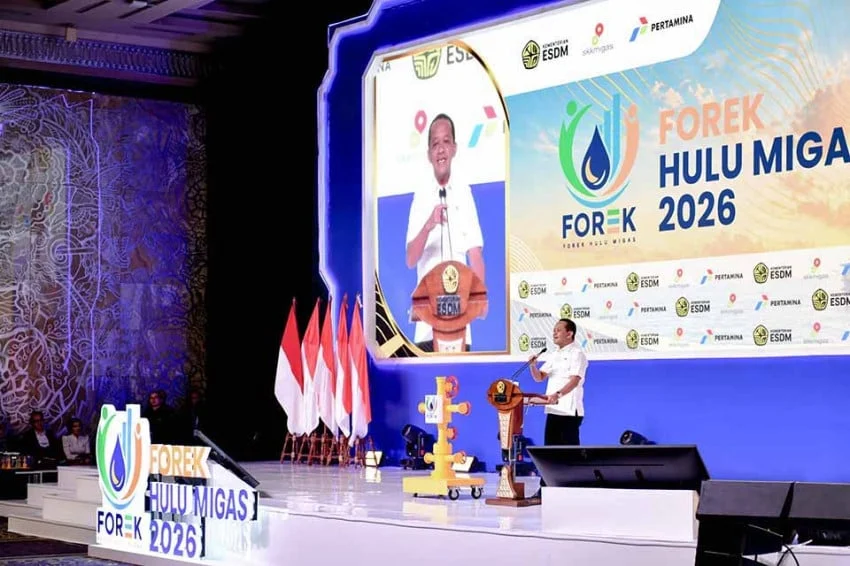
Jakarta — The transition of oil and gas procurement mechanisms in Indonesia is currently underway, shifting certain responsibilities toward the Lemigas research and development center under the Ministry of Energy and Mineral Resources (ESDM). Coordinating Minister for Downstreaming and Energy Transition and Minister of ESDM, Bahlil Lahadalia, addressed the ongoing institutional adjustment on the sidelines of the Forum Kapasitas Nasional (FOREK) Hulu Migas 2026 in Jakarta, emphasizing that the restructuring process requires careful coordination before full implementation.
The reform involves a reorganization of the nation’s crude oil and refined petroleum import pathways. Historically, state-owned energy giant PT Pertamina (Persero) has managed the bulk of import operations independently. Under the newly formulated framework, authorized by a recently issued Presidential Regulation (Perpres), these pathways are being recalibrated to involve Lemigas, aiming to streamline national supply chain governance.
Despite the regulatory foundation already being established, the operational rollout remains in an intermediary phase. Government stakeholders are actively engaging in extensive consultations with Pertamina’s management to ensure a seamless transition that avoids disruptions to the domestic energy supply chain.
Institutional Background and Structural Shift
The restructuring of Indonesia’s petroleum supply chain is part of a broader national strategy to optimize energy independence, enhance transparency, and strengthen state oversight in strategic commodity imports. Lemigas, historically recognized as a scientific research and technical testing institution under the ESDM Ministry, is poised to take on an expanded operational role in supervising or facilitating procurement processes that were previously centralized strictly within commercial corporate structures.
Energy sector analysts note that Indonesia continues to rely heavily on imports to meet domestic fuel consumption demands, as domestic crude production has steadily declined over recent decades while consumption scales upward. By recalibrating how oil and gas are procured, the government seeks to address long-standing vulnerabilities in the supply chain, minimize logistical inefficiencies, and ensure greater alignment with national energy security objectives.
However, integrating a research and technical institution into the procurement framework requires intricate regulatory and administrative adjustments. Systems governing auditing, quality assurance, financial clearance, and inter-agency coordination must be thoroughly restructured to prevent bureaucratic bottlenecks.
Financial Independence and Fiscal Clarification
A critical point emphasized by Minister Bahlil during his address to media personnel was the financial architecture supporting the new procurement model. Bahlil explicitly dismissed concerns that the operational transition would draw upon the State Budget (Anggaran Pendapatan dan Belanja Negara / APBN).
"It does not use the APBN, no," Bahlil stated firmly when questioned about the funding mechanisms behind the Lemigas-involved procurement scheme.
By avoiding direct reliance on state funds, the government intends to structure the mechanism through corporate-level financing, commercial business-to-business arrangements, or self-sustaining institutional mechanisms managed via state revenues and operational efficiencies. This approach is designed to insulate the national budget from the volatile fluctuations of global crude oil prices and foreign exchange rates, which regularly impact import costs.
Economists and fiscal observers have underscored the importance of maintaining fiscal prudence in state-backed energy initiatives, noting that utilizing non-APBN financing shields public funds while still allowing the state to exert strategic control over vital import channels.
Scope of Application: State-Run Operations Versus Private Sector Autonomy
Addressing concerns regarding the reach of the new policy, Bahlil clarified that the mandate is primarily targeted at procurement activities historically managed by PT Pertamina (Persero) and other strategic assignments concerning public welfare and national energy resilience.
Importantly, the minister drew a clear line between state-controlled import channels and private sector commercial operations. Private energy entities operating within Indonesia will retain their autonomy and will not be legally compelled to route their independent crude and refined product procurement through Lemigas.
"For the private sector, of course not. Private sector matters are their own business," Bahlil affirmed.
This distinction is designed to maintain investor confidence and ensure that the domestic downstream market remains competitive. Private fuel retailers and independent industrial consumers rely on flexible, market-driven procurement strategies to manage their supply chains. Imposing state-managed intermediary steps on private enterprises could introduce compliance burdens and deter foreign and domestic investment in Indonesia’s downstream energy sector.
Chronology of Regulatory Implementation
The journey toward modifying Indonesia’s oil and gas procurement framework has evolved through several critical milestones:
- Initial Policy Formulation: Government evaluations highlight structural vulnerabilities in national fuel reserves, prompting discussions around reforming import mechanisms and reducing reliance on traditional tender models.
- Issuance of Presidential Regulation: The legal foundation for the policy shift is formally established through a newly issued Presidential Regulation (Perpres), outlining the expanded scope for state-backed institutions in energy oversight.
- Consolidation Phase (Current): Minister Bahlil confirms that despite the legal framework being in place, implementation is paused for a transition period. The ESDM Ministry and related bodies are conducting deep institutional consolidations with PT Pertamina (Persero).
- Future Full Implementation: Following the alignment of technical, administrative, and logistical protocols, the refined procurement pathways are scheduled to take full effect.
Implications for PT Pertamina and National Energy Security
The involvement of Lemigas in the procurement architecture represents a notable evolution for Pertamina, which has long held a dominant, centralized role in managing national energy security imports. While Pertamina will remain the primary operational backbone of Indonesia’s energy sector, sharing supervisory or procedural responsibilities with an ESDM-affiliated body marks a structural decentralization of import governance.
Industry experts suggest that this transition could foster a multi-layered oversight system. Proponents argue that increased institutional visibility can enhance accountability and reduce pricing discrepancies in international spot-market purchases. Conversely, critics and logistics specialists caution that adding institutional layers could potentially slow down rapid procurement responses required during sudden global supply shocks.
The ongoing consultations between the government and Pertamina are therefore focused on establishing clear Standard Operating Procedures (SOPs) that preserve operational agility. Because refined product and crude oil procurement require rapid decision-making in response to fluctuating geopolitical tensions and OPEC+ output adjustments, administrative delays must be minimized.
Broader Economic and Geopolitical Context
Indonesia’s ongoing energy transition strategy encompasses not only the shift toward renewable energy sources but also the immediate necessity of stabilizing fossil fuel imports during the transitional decades. As the nation balances its dual commitments to achieving net-zero emissions by 2060 and maintaining affordable energy for its population of over 275 million, managing the fossil fuel supply chain remains a critical balancing act.
Global oil markets have faced persistent volatility driven by supply chain realignments, currency fluctuations, and geopolitical conflicts in key producing regions. In this environment, Indonesia’s efforts to reform its procurement pathways reflect a broader administrative drive to tighten state control over strategic commodities, prevent supply bottlenecks, and protect the domestic economy from external price shocks.
As the transition period progresses, market participants, international suppliers, and domestic industry players will be closely monitoring the finalization of the implementation guidelines. The ultimate success of the policy will depend on how effectively the government can harmonize state oversight with the operational realities of international commodity trading.
