
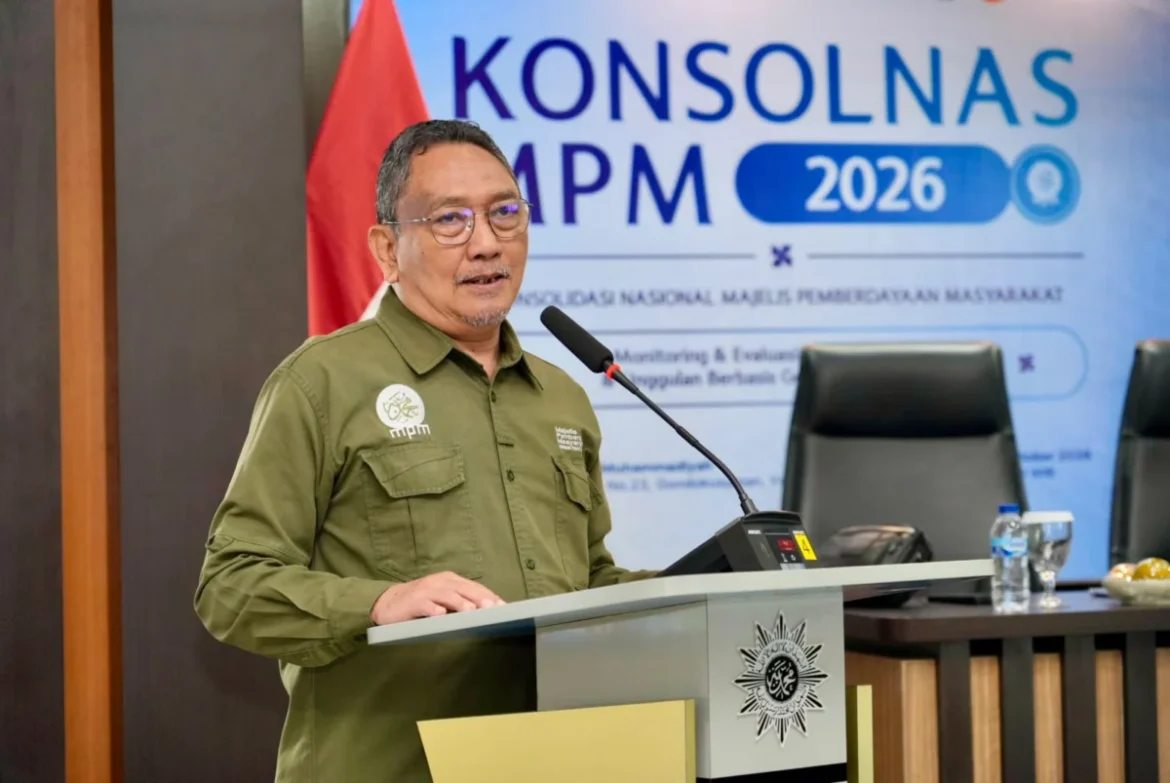
YOGYAKARTA — In an ambitious effort to recalibrate and accelerate its socio-economic upliftment initiatives, the Majelis Pemberdayaan Masyarakat (MPM) of the Central Leadership (PP) of Muhammadiyah convened its pivotal National Consolidation 2026 at the historic PP Muhammadiyah Office located on Jalan Cik Ditiro No. 23, Yogyakarta. Bringing together regional and municipal leadership boards—specifically the Majelis Pemberdayaan Masyarakat of the Provincial Leadership (PWM) and Regional Leadership (PDM) levels from across Indonesia—the gathering served as a dynamic platform to evaluate program execution, map out verifiable community empowerment achievements, and engineer forward-looking strategic roadmaps.
The high-level meeting, officially themed "Monitoring and Evaluation of Program Achievements and Activities of MPM PWM/PDM Across Indonesia," unfolded against the backdrop of an evolving socio-economic landscape. As civil society organizations face complex structural challenges ranging from agrarian shifts to labor vulnerabilities, Muhammadiyah’s specialized empowerment wing has taken proactive steps to ensure that its developmental interventions remain both structurally sound and deeply impactful at the grassroots level.
Strategic Vision and Leadership Directives
Addressing the assembly, the Chairman of MPM PP Muhammadiyah, Nurul Yamin, emphasized that the national consolidation transcended a routine administrative monitoring and evaluation exercise. Instead, Yamin framed the gathering as a crucial developmental milestone designed to formulate robust strategic actions capable of strengthening grassroots empowerment movements across all organizational tiers.
"From this organizational activity, we are simultaneously establishing concrete strategic steps for subsequent operational phases," Yamin stated during his keynote address to regional delegates.
To operationalize this vision, Yamin outlined a dual-track strategic framework consisting of National Programs and Flagship Programs. This structured approach ensures that overarching systemic challenges receive uniform institutional responses, while localized vulnerabilities are met with tailored, community-centric solutions.
The National Programs are meticulously engineered to systematically address societal issues vertically, cascading seamlessly from the central executive level down to local branches. This framework is anchored by four fundamental pillars:
- Institutional Organizational Strengthening: Enhancing the managerial, administrative, and operational capacities of MPM boards at the regional and local levels.
- Human Resource Development: Cultivating grassroots leadership and operational expertise through the specialized Sekolah Kader Pemberdayaan Masyarakat (Community Empowerment Cadre School).
- Agricultural Sector Revitalization: Bolstering the resilience and productivity of rural farmers through the Jemaah Tani Muhammadiyah (Jatam) initiative.
- Maritime and Coastal Empowerment: Supporting coastal communities, small-scale fishers, and marine workers through the Jamaah Nelayan Muhammadiyah (Jalamu) network.
Simultaneously, the Flagship Programs are deployed to target vulnerable demographics by optimizing hyper-local potentials. These targeted initiatives concentrate heavily on populations residing in Indonesia’s 3T regions (disadvantaged, frontier, and outermost territories), urban poor communities, informal sector laborers, and individuals with disabilities.
Extending the Reach: Safeguarding Migrant Workers
A standout dimension of MPM Muhammadiyah’s recent developmental outreach is its aggressive expansion into transnational labor advocacy. Recognizing the profound vulnerabilities faced by Indonesian laborers working abroad, MPM established Sahabat Migran Berkemajuan (Saranmu), a dedicated community-based companion network designed to protect and empower migrant workers.
According to institutional metrics presented during the consolidation, the Saranmu initiative has successfully extended its protective umbrella to 5,362 individuals, with the vast majority operating within Malaysia—a primary destination for Indonesian migrant labor.
Elaborating on the methodology behind this transnational intervention, Yamin underscored the necessity of a holistic support system. "The mentoring process is conducted comprehensively from upstream to downstream, touching not only legal issues but also spiritual and religious dimensions through the Jendela Migran forum," he explained. By combining legal aid, rights advocacy, and psychological-spiritual counseling, MPM aims to safeguard the dignity and welfare of migrant workers throughout their employment lifecycle.
Alignment with the 48th Muhammadiyah Muktamar Mandates
Reinforcing the institutional urgency of these initiatives, Budi Nugroho, Secretary of MPM PP Muhammadiyah, highlighted that the current consolidation acts as an accelerator for priority programs mandated by the historic 48th Muhammadiyah Muktamar (Congress) held in Surakarta. Nugroho stressed that the primary objective remains the systematic expansion of grassroots community empowerment through movement-based and congregational preaching (dakwah jamaah), operating effectively through both cultural paradigms and community-driven structures.
This strategic trajectory aligns directly with the core developmental vision outlined for the 2022–2027 organizational cycle within the official Tanfidz (Enactment Document) of the 48th Muktamar. The guiding vision explicitly states: "The Realization of a Progressive Community Empowerment Ecosystem to Realize the Welfare of Laborers, Farmers, Fishermen, and the Dhuafa-Mustadh’afin Groups as a Manifestation of Islam Rahmatan Lil Alamin."
This doctrinal and programmatic alignment ensures that every intervention undertaken by MPM is not merely a secular philanthropic gesture, but an intrinsic expression of Islamic theology translated into social justice, economic equity, and human dignity.
Launching the Countdown: The 2nd National Jamboree of Jatam
Amidst the rigorous evaluation panels and strategic planning sessions, the Yogyakarta consolidation also featured a major forward-looking organizational launch. MPM PP Muhammadiyah officially unveiled the official logo and theme song for the upcoming 2nd National Jamboree of the Jemaah Tani Muhammadiyah (Jambore Jatam II).
The large-scale national gathering of farmers is scheduled to take place in July 2027 in Lampung Province. Organizers anticipate that the event will draw thousands of agricultural practitioners, cooperative leaders, researchers, and policymakers from across the archipelago to share best practices, showcase technological innovations in sustainable farming, and advocate for pro-farmer agrarian policies.
Implications and Future Outlook
The convening of the National Consolidation 2026 arrives at a critical juncture for Indonesia’s civil society sector. As post-pandemic economic adjustments continue to impact vulnerable socio-economic strata, institutional bodies like Muhammadiyah play an indispensable role in filling social safety net gaps.
By systematically evaluating past performance and refining its four-pillar national framework alongside its specialized community interventions—such as Saranmu, Jatam, and Jalamu—MPM PP Muhammadiyah demonstrates a sophisticated, data-driven approach to faith-based social development. The emphasis on moving beyond temporary relief toward sustainable capacity building ensures that marginalized populations are not merely recipients of aid, but active agents of their own economic emancipation.
Ultimately, the Yogyakarta assembly reaffirmed the organization’s unwavering commitment to institutional synergy. By aligning regional implementation boards with national strategic visions, MPM PP Muhammadiyah has solidified a resilient operational foundation, ensuring that its mission to uplift laborers, farmers, fishermen, and the marginalized remains robust, measurable, and deeply transformative for years to come.
