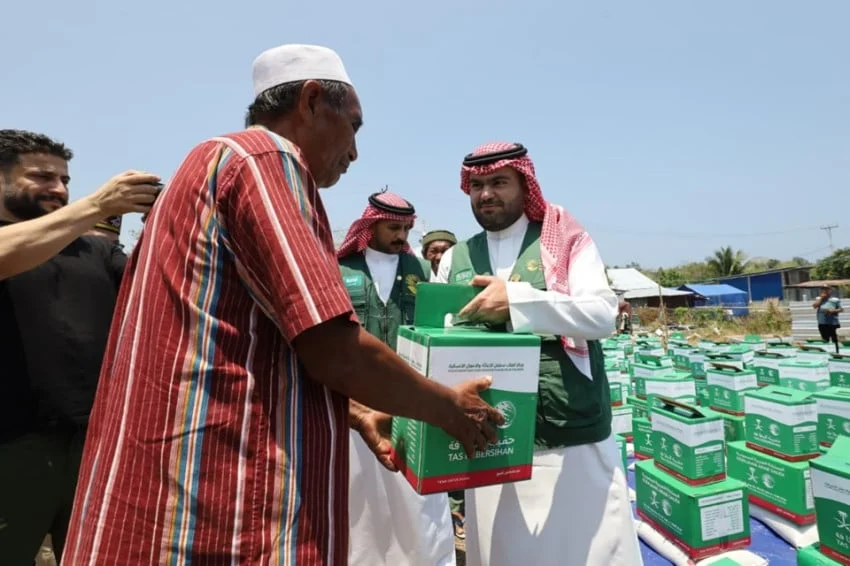
The King Salman Humanitarian Aid and Relief Centre (KSrelief) has successfully deployed a massive humanitarian relief operation to support victims of the devastating M7.7 earthquake that struck the Flores region of East Nusa Tenggara (NTT), Indonesia. Despite significant logistical challenges stemming from international flight disruptions and domestic administrative hurdles in Saudi Arabia, the organization delivered 15,000 food packages and 15,000 personal hygiene kits, representing a total aid valuation of approximately Rp18 billion.
The relief efforts were coordinated in partnership with the National Zakat Agency of Indonesia (Baznas RI). Idy Muzayyad, the leader of the distribution and empowerment division at Baznas RI, oversaw the arrival and dispersal of these critical supplies at the Waso refugee command post in Satar Kampas Village, East Manggarai, on Thursday, November 5, 2026. This intervention serves as a vital lifeline for thousands of displaced residents currently living in temporary shelters, where access to basic necessities has been critically compromised by the seismic activity and subsequent structural damage.
Chronology of the Disaster and Response
The M7.7 earthquake that struck the Flores region has been categorized as one of the most destructive natural disasters in the province’s recent history. The initial tremors triggered widespread panic and significant damage to infrastructure, residential homes, and public utilities. As of early November 2026, the official death toll has climbed to 142 individuals, with the majority of these fatalities—specifically 94 people—occurring within the precarious conditions of the refugee camps established in the immediate aftermath of the quake.
The disaster has not been a single, isolated event. Geological data indicates that the region has been subject to continuous aftershocks, which have hampered search and rescue operations and delayed the assessment of building safety. The constant threat of further seismic activity has kept the local population in a state of perpetual displacement, making the provision of consistent aid, such as that provided by KSrelief, essential for survival.
The logistics of this mission were fraught with complexity. KSrelief representatives faced severe operational constraints, including the temporary closure of Riyadh Airport and the necessity of securing alternative international flight routes to bypass restricted airspace. That these supplies reached the remote districts of East Manggarai is a testament to the high-level diplomatic and logistical coordination between the Saudi government and Indonesian relief agencies.
Analysis of the Aid Package and Humanitarian Impact
The Rp18 billion donation is structured to address the most immediate needs of the survivors. By focusing on both food security and personal hygiene, the aid package directly mitigates the risks of malnutrition and the spread of infectious diseases—a common secondary catastrophe in the wake of major earthquakes.
The impact of this aid goes beyond the tangible goods delivered. For the residents of Satar Kampas and surrounding villages, the presence of international humanitarian organizations provides a psychological boost, signaling that their plight is recognized globally. Idy Muzayyad emphasized that the partnership between Baznas and KSrelief is built on a foundation of long-term recovery, ensuring that the aid is not merely a stop-gap measure but a step toward sustainable relief.
The Second Phase: Infrastructure and Education
Recognizing that the needs of the NTT survivors will evolve as the initial crisis phase wanes, Baznas RI and KSrelief have already outlined a second phase of intervention. This phase shifts the focus from emergency supplies to infrastructure rehabilitation. Key components of this upcoming relief operation include:
- Healthcare Facilities: Establishing mobile clinics and temporary medical stations to provide treatment for earthquake-related injuries and chronic health conditions that have gone unmanaged since the quake.
- Transitional Shelters (Huntara): Designing and constructing semi-permanent housing solutions to provide safe, insulated, and secure living conditions for families who have lost their homes entirely.
- Sanitation and Hygiene (MCK): Prioritizing the construction of communal water, sanitation, and hygiene facilities to prevent environmental health crises in overcrowded refugee camps.
Furthermore, the recovery strategy incorporates an often-overlooked demographic: students. Baznas has announced a targeted scholarship program providing Rp3 million to each of 3,000 university students from NTT who are currently studying away from home. This initiative aims to ensure that the economic devastation caused by the earthquake does not force young scholars to abandon their education, thereby preserving the future human capital of the region.
Official Statements and Regional Coordination
During the distribution ceremony, Idy Muzayyad expressed profound gratitude on behalf of the Indonesian government and the survivors. "Baznas, alongside our colleagues at KSrelief, is committed to standing with the people of NTT. We understand the severity of the trauma experienced by these families, and we appreciate the solidarity shown by King Salman and the people of Saudi Arabia," he stated during the press briefing on Friday, November 6, 2026.
Muzayyad also addressed the survivors directly, urging patience and resilience. He underscored that while the path to normalcy is long, the presence of multiple aid organizations—both domestic and international—is a coordinated effort to ensure that no community is left behind. He acknowledged the challenges of operating in a disaster zone where aftershocks remain frequent, but assured the public that the monitoring of aid distribution is transparent and rigorous to ensure it reaches the most vulnerable demographics.
Broader Implications for Disaster Management
The M7.7 Flores earthquake serves as a stark reminder of the inherent vulnerability of the Indonesian archipelago to seismic activity. The high mortality rate in the refugee camps highlights a critical gap in Indonesia’s disaster preparedness: the ability to maintain health and safety standards in temporary, mass-shelter environments.
Experts in disaster management suggest that the influx of international aid, while necessary, must be integrated into a larger framework of "Build Back Better." This philosophy suggests that reconstruction efforts should not merely replace what was lost but improve the resilience of the community. For example, the focus on building semi-permanent shelters (Huntara) rather than long-term tents is a positive move toward ensuring that survivors have a dignified, safe space while their permanent homes are rebuilt to modern, seismic-resistant standards.
The cooperation between KSrelief and Baznas also highlights the increasing importance of international partnerships in humanitarian logistics. In an era where climate change and geological instability are increasing the frequency of large-scale disasters, the ability to mobilize resources across borders—even when flight paths are disrupted—is a capability that must be refined.
Future Outlook and Conclusion
As of the latest reports, the situation in NTT remains volatile. The continuous nature of the seismic activity in the Flores Sea necessitates a sustained, rather than episodic, relief effort. The integration of educational support, healthcare, and infrastructure development into the relief strategy represents a sophisticated approach to disaster recovery.
While the distribution of 30,000 total packages marks a significant milestone in the recovery process, the sheer scale of the destruction means that the recovery phase will likely last for years rather than months. The Indonesian government, in coordination with agencies like Baznas and international partners like KSrelief, continues to monitor the situation, prioritizing the safety of the survivors and the gradual restoration of local services.
The resilience of the NTT community, supported by the international solidarity demonstrated by this aid mission, remains the core of the recovery narrative. As the region navigates the ongoing seismic instability, the focus remains on ensuring that the basic needs of the victims are met while simultaneously planning for the reconstruction of a region that has been profoundly altered by the events of late 2026. The coming months will be crucial, as the success of the second phase of aid will determine the stability of thousands of households as they transition from emergency shelters to long-term recovery and eventual resettlement.