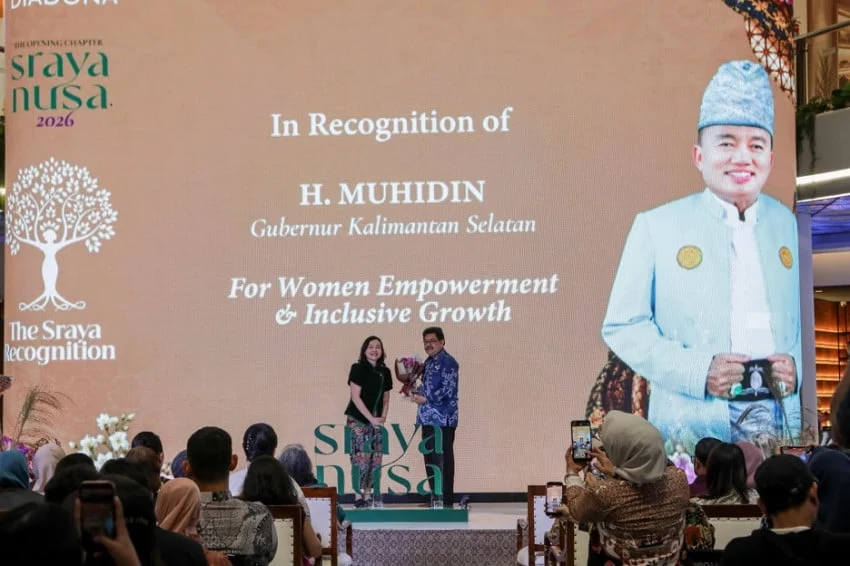
The Provincial Government of South Kalimantan has once again captured national attention for its steadfast commitment to fostering gender equality, empowering women, and driving inclusive regional development. In a landmark achievement that underscores years of strategic policy implementation, the Governor of South Kalimantan, H. Muhidin, was officially honored with The Sraya Recognition for Women Empowerment & Inclusive Growth. The prestigious accolade was presented during the grand celebration of the Apresiasi Perempuan Berpengaruh (APB) Sraya Nusantara 2026, held in Jakarta on Friday, September 11, 2026. This national recognition places a spotlight on regional leaders who have successfully translated gender-responsive policies into tangible, life-changing impacts for women, children, and vulnerable communities within their respective jurisdictions.
The award serves as a powerful testament to the overarching administrative philosophy of Governor Muhidin, whose governance framework consistently prioritizes the integration of marginalized groups into the mainstream economy and social structure. By weaving women empowerment, child protection, Micro, Small, and Medium Enterprises (MSMEs) reinforcement, and expanded access to foundational education and healthcare into the core of South Kalimantan’s regional development blueprint, the provincial administration has set a benchmark for inclusive governance across Indonesia.
Background Context and the Significance of APB Sraya Nusantara 2026
The Apresiasi Perempuan Berpengaruh (APB) Sraya Nusantara 2026 is one of Indonesia’s most anticipated annual national platforms, dedicated to acknowledging visionary leaders, changemakers, and institutions that champion gender equality and social inclusivity. In an era where regional autonomy demands proactive and empathetic leadership, the Sraya Recognition specifically targets male regional heads who have demonstrated extraordinary political will and administrative dedication to uplifting women and vulnerable segments of society.
For South Kalimantan, this recognition is not merely an isolated trophy, but rather a validation of a comprehensive, multi-sectoral strategy. Under Governor Muhidin’s leadership, the province has moved beyond conventional administrative compliance, adopting a holistic approach encapsulated by the regional motto: Working Together, Embracing All (Bekerja Bersama Merangkul Semua). This philosophy ensures that no demographic is left behind in the province’s rapid economic and infrastructural transformation.
Because Governor Muhidin was unable to attend the ceremony in person due to pressing regional duties, the award was formally accepted on his behalf by the Head of the Communication and Information Office of South Kalimantan, Muhamad Muslim. Speaking to the press following the ceremony, Muslim elaborated on the driving force behind the administration’s policy decisions.
"Many priority programs initiated by Governor H. Muhidin focus directly on women, particularly within the strategic pillars of education, health, and MSMEs. This prestigious recognition serves as concrete evidence of our unwavering commitment to driving a development agenda that genuinely empowers women, firmly rooted in our guiding spirit of working together and embracing all segments of society," Muslim stated during the post-award briefing in Jakarta.
Strategic Pillars: Economic Empowerment, Education, and Healthcare
The national jury panel evaluated candidates based on measurable indicators, including policy formulation, budgetary allocation, and the real-world effectiveness of programs targeting women and children. In South Kalimantan, these indicators are vividly manifested across multiple socioeconomic sectors.
Economic empowerment forms the bedrock of the provincial strategy. In recent years, South Kalimantan has experienced a surge in food security initiatives and creative economy enterprises. Crucially, the backbone of these vital sectors comprises MSMEs predominantly owned, managed, and operated by women. The provincial government has actively facilitated these enterprises through targeted financial literacy programs, digital transformation workshops, and streamlined market access. By positioning women as primary agents of economic resilience, South Kalimantan has successfully mitigated post-pandemic financial vulnerabilities at the grassroots level.
Simultaneously, the administration has implemented robust measures to enhance the quality of life for mothers and children. Improvements in healthcare infrastructure and social security guarantees have been systematically channeled to reduce maternal and infant mortality rates while expanding nutritional support for toddlers.
Education remains another critical battleground for inclusivity. Recognizing that geographical isolation can hinder human capital development, the South Kalimantan administration has heavily invested in alternative and equal opportunity learning programs. The promotion and expansion of the Paket A, B, and C equivalence education programs have opened doors for thousands of residents—particularly women living in remote and isolated areas—to secure formal educational credentials. This foundational knowledge equips them with the agency required to participate meaningfully in local governance and the modern workforce.
Infrastructural Connectivity as a Catalyst for Inclusive Growth
True inclusive growth requires physical connectivity to bridge economic disparities between urban centers and remote regions. A prime example of this infrastructural push is the ambitious development of the Pulau Laut Bridge, a mega-project designed to seamlessly connect mainland South Kalimantan with Pulau Laut (Kotabaru Regency).
While initially viewed as a transportation breakthrough, the socio-economic implications of the Pulau Laut Bridge extend far deeper into the realm of inclusive growth. For years, island communities faced logistical bottlenecks that inflated commodity prices and restricted market access for local producers. By bridging this geographical divide, the provincial administration is actively dismantling barriers to commerce. For women and MSME operators in the archipelago, the infrastructure project represents a gateway to broader markets, reduced operational costs, and accelerated business expansion. It exemplifies how macro-level engineering decisions can be directly aligned with micro-level economic empowerment.
Combating Cybercrime and Gender-Based Violence in the Digital Age
As modern society transitions deeper into the digital age, the parameters of vulnerability have shifted from physical spaces to virtual domains. Acknowledging that women and children face unprecedented threats in cyberspace, the South Kalimantan Provincial Government has taken pioneering steps to establish a comprehensive protective shield across educational institutions.
On July 27, 2026, a historic multi-stakeholder agreement was forged. The Provincial Government of South Kalimantan, alongside the Regional Police (Polda Kalsel), the Ministry of Religious Affairs regional office, various relevant state agencies, and an impressive coalition of 21 universities, officially signed a sweeping memorandum of understanding (MoU). This agreement established a dedicated collaborative forum aimed at preventing and handling violence, harassment, and cybercrimes targeting women and children across universities, formal schools, and Islamic boarding schools (pondok pesantren).
This proactive measure addresses a critical gap in regional protection mechanisms. In contemporary society, women and children are increasingly exposed to digital harassment, online scams, data privacy breaches, and cyberbullying. By establishing dedicated task forces operating under a coordinated institutional framework, South Kalimantan has created a safety net that bridges academic institutions and law enforcement agencies.
Governor H. Muhidin emphasized the urgency of this initiative, pointing out that safeguarding the younger generation requires education as much as enforcement.
"We want to provide comprehensive education to the younger generation regarding the profound dangers of violence as well as the misuse of digital technology. Protection today must be proactive, preventive, and adaptable to the realities of the digital era," Governor Muhidin asserted.
Chronology of Policy Milestones Leading to APB Sraya Nusantara 2026
To understand the comprehensive nature of South Kalimantan’s victory at the 2026 awards, it is essential to examine the chronological progression of policy milestones that shaped the administration’s inclusive governance agenda over recent years:
- Early Phase (Strategic Planning): The provincial administration under Governor Muhidin systematically integrated gender mainstreaming into the Regional Medium-Term Development Plan (RPJMD), ensuring that gender-responsive budgeting became a mandatory consideration across all regional apparatus organizations (SKPD).
- Economic Recovery and MSME Support: Following national economic shifts, the administration prioritized female-led MSMEs through specialized capital injection programs, packaging design assistance, and digital marketing training, resulting in a notable rise in female entrepreneurship metrics across rural districts.
- Educational Expansion: The provincial education office scaled up Paket A, B, and C equivalence programs, specifically targeting women in remote areas who dropped out of formal schooling due to early marriage or economic constraints.
- July 27, 2026 (Institutionalizing Protection): The landmark signing of the multi-sectoral MoU between the Pemprov Kalsel, Polda Kalsel, the Ministry of Religious Affairs, and 21 universities to combat physical and cyber violence against women and children in educational environments.
- September 11, 2026 (National Recognition): Governor H. Muhidin is officially awarded The Sraya Recognition for Women Empowerment & Inclusive Growth at the APB Sraya Nusantara 2026 ceremony in Jakarta, validating the province’s multi-year developmental trajectory.
Broader Implications and Future Outlook for Regional Development
The conferment of The Sraya Recognition upon Governor H. Muhidin carries significant implications not only for South Kalimantan but for the broader landscape of Indonesian regional autonomy. It demonstrates that regional leadership focused on human-centric development can yield quantifiable, nationally recognized results.
Experts in public policy note that awards of this caliber establish a healthy competitive dynamic among regional heads across the archipelago. By spotlighting successful models of gender mainstreaming and digital-era child protection, the APB Sraya Nusantara 2026 encourages other provinces to replicate and adapt South Kalimantan’s strategies.
Furthermore, the integration of physical infrastructure development—such as the Pulau Laut connectivity project—with social interventions like educational equity and MSME support offers a blueprint for holistic governance. It proves that economic growth and social justice are not mutually exclusive pursuits, but rather mutually reinforcing pillars of a sustainable society.
As South Kalimantan looks toward the future, the provincial administration faces the ongoing challenge of maintaining and expanding these initiatives. With robust legal frameworks now in place to combat cyber-based violence, alongside continuous investments in grassroots female entrepreneurship and alternative education, the province is well-positioned to sustain its trajectory of inclusive growth.
Ultimately, the accolade received in Jakarta serves as both a celebration of past achievements and a solemn reminder of the work that remains. For Governor H. Muhidin and the people of South Kalimantan, the recognition reinforces the validity of their foundational ethos: that true regional progress can only be measured by how effectively a society uplifts its most vulnerable members, ensuring that every citizen shares in the fruits of development.