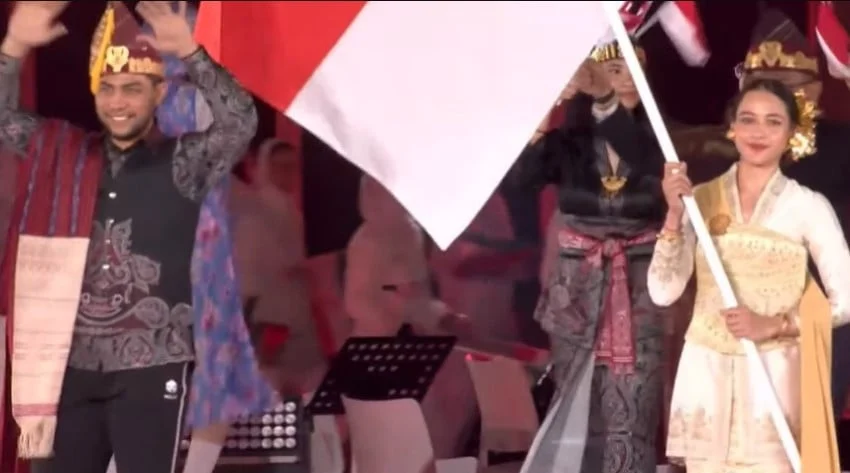
The Indonesian contingent made a striking impression at the opening ceremony of the Asian Games Aichi-Nagoya 2026, held at the Paloma Mizuho Stadium in Nagoya, Japan, on Saturday afternoon, September 19, 2026. Marching into the arena with an unmistakable sense of national pride, the delegation captured the attention of thousands of spectators and international television viewers by wearing meticulously crafted traditional attire that showcased the profound cultural diversity of the Indonesian archipelago. Entrusted with leading the parade as flag bearers were two of the nation’s rising athletic talents: basketball player Dewa Ayu Made Sriartha Kusuma Dewi and karateka Daniel Hutapea. Together, they hoisted the Red and White flag high, guiding the Indonesian contingent through the stadium amidst a vibrant display of global sportsmanship.
The official appearance of the Indonesian delegation reflected a thoughtful fusion of heritage and contemporary fashion, designed specifically to highlight the nation’s identity on a major multi-sport stage. The outfits worn by the flag bearers, alongside the apparel utilized by the marching athletes, were the result of a creative collaboration between Ghea Fashion Studio and state-owned enterprise Sarinah. This partnership sought to translate the multifaceted heritage of Indonesia into a unified visual identity for Team Indonesia under the overarching theme of Harmony in Diversity.
Grand Opening Ceremony and Contingent March Chronology
The opening ceremony at the Paloma Mizuho Stadium commenced in the late afternoon, following strict scheduling by the Aichi-Nagoya Asian Games Organizing Committee (AINAGOC). The pre-show festivities featured traditional Japanese performances, light installations, and musical acts celebrating the host region’s industrial and cultural prowess. As the parade of nations began in alphabetical order, the Indonesian contingent prepared in the staging area with high morale and visible enthusiasm.
Led by flag bearers Dewa Ayu and Daniel Hutapea, the Indonesian delegation entered the stadium field around late afternoon local time. The athletes walked in a disciplined yet energetic formation, waving to the crowd and acknowledging the international delegations and officials seated in the stands. The majority of the contingent members wore predominantly black ensembles that served as a sophisticated backdrop for the vibrant traditional patterns integrated into their garments.
Daniel Hutapea walked proudly in traditional attire representing his Batak Toba heritage, complete with structural elements characteristic of North Sumatran craftsmanship. Alongside him, Dewa Ayu wore a specially tailored outfit infused with traditional Balinese aesthetic touches, honoring her regional roots. Behind the flag bearers, approximately 50 athletes representing various sports codes marched in the defile, wearing official jerseys and apparel adorned with authentic Indonesian textile motifs.
Fashion Collaboration: Merging Tradition and Modernity
The visual presentation of the Indonesian contingent was not merely aesthetic; it served as a cultural diplomacy tool. The collection developed by Ghea Fashion Studio in partnership with Sarinah was conceptualized to resonate with international audiences while remaining deeply rooted in indigenous Indonesian textiles.
Central to the design of the official defile wear was the prominent use of the Gorga motif, a traditional decorative art form native to the Batak ethnic group of North Sumatra. Known for its distinct geometric patterns and symbolic protective meanings, the Gorga motif was meticulously woven into the fabric of the official jerseys worn by the athletes. Furthermore, this design element was integrated into the official apparel supplied to the National Olympic Committee (NOC) of Indonesia and the Chef de Mission (CdM) team.
To elevate the formal appearance of key delegation members, the collection also featured intricately crafted kebayas embedded with Gorga motifs, paired seamlessly with authentic Ulos fabric draped in traditional fashion. Traditional headwear completed the ensemble, striking a balance between ceremonial solemnity and modern athletic readiness. This deliberate choice of apparel aimed to project a unified national identity built upon a foundation of ethnic pluralism, directly supporting the mission of the Harmony in Diversity theme adopted for the 2026 delegation.
Background Context of the Aichi-Nagoya 2026 Asian Games
The 20th Asian Games, officially known as Aichi-Nagoya 2026, marks the third time Japan has hosted Asia’s premier multi-sport event, following Tokyo in 1958 and Hiroshima in 1994. The decision to award the games to the Aichi Prefecture and its capital city, Nagoya, was finalized by the Olympic Council of Asia (OCA) in 2016. The event runs from mid-September to early October 2026, adjusted from the traditional summer window to mitigate the peak heat of the Japanese climate.
The regional organizing committee has emphasized sustainability, technological innovation, and cost efficiency, utilizing a mix of pre-existing venues across the Aichi and Nagoya regions alongside newly constructed facilities. The Games feature a comprehensive sports program covering dozens of disciplines, encompassing both Olympic core sports and regional traditional sports such as teqball, wushu, and kabaddi.
For Indonesia, the Aichi-Nagoya Asian Games represent a critical milestone in the nation’s ongoing high-performance sports development cycle. Following successful hosting duties at the 2018 Jakarta-Palembang Asian Games and commendable performances at the 2022 Hangzhou Asian Games (held in 2023), the Indonesian contingent entered the 2026 edition with high expectations across multiple disciplines, including badminton, weightlifting, speed climbing, rowing, and martial arts.
Selection of Flag Bearers: Profile and Significance
The choice of Dewa Ayu Made Sriartha Kusuma Dewi and Daniel Hutapea as flag bearers was met with widespread acclaim within the Indonesian sports community. Selection as a flag bearer is considered one of the highest honors an athlete can receive during an international multi-sport event, symbolizing leadership, athletic excellence, and representation of national values.
Dewa Ayu Made Sriartha Kusuma Dewi is a prominent figure in Indonesian basketball, having represented the country in both traditional five-on-five basketball and the fast-growing discipline of 3×3 basketball. Her leadership on the court and dedication to her craft have made her a role model for aspiring female athletes across the nation. By carrying the flag, her inclusion underscored the growing recognition and parity of women’s sports within the Indonesian contingent.
Daniel Hutapea, representing the sport of karate, embodies discipline, resilience, and tactical focus. As a top-tier martial artist, Daniel has consistently demonstrated excellence in domestic and international competitions. His appointment as co-flag bearer highlighted the traditional strength of combat sports within Indonesia’s medal-contributing roster at major games.
Official Responses and Institutional Perspectives
Leadership figures within the Indonesian contingent and sports administration emphasized the broader significance of the opening ceremony presentation. Representatives from the NOC of Indonesia noted that participating in the defile with culturally distinct uniforms serves a dual purpose: projecting professionalism and educating the global audience about the vast heritage of the Indonesian archipelago.
The partnership with Sarinah and Ghea Fashion Studio was lauded as a successful model of public-private synergy in supporting national athletes. By leveraging national commercial and cultural enterprises to outfit the contingent, the presentation moved away from generic athletic wear toward a curated cultural showcase. Observers from the Indonesian delegation noted that the positive reception from international media and fellow delegations validates the strategy of integrating cultural storytelling into sports representation.
Furthermore, Chef de Mission officials reiterated that the enthusiasm displayed by the athletes during the march reflects high psychological readiness. The psychological uplift derived from walking together in culturally significant attire is viewed by sports psychologists as a vital component in fostering team cohesion before the commencement of grueling competition schedules.
Broader Impact and Implications for Indonesian Sports Diplomacy
The deployment of cultural narratives during high-profile international sporting events has become an essential pillar of modern sports diplomacy. For a diverse nation like Indonesia, comprising over 1,700 ethnic groups, international platforms such as the Asian Games offer a unique opportunity to project national unity while celebrating regional distinctiveness.
The inclusion of specific regional motifs—such as the Batak Toba Gorga and Balinese textile touches—demonstrates a conscious effort to ensure that various regions of Indonesia feel represented on the global stage. This inclusive approach helps bridge cultural divides at home while projecting a sophisticated, heritage-rich image abroad.
Economically and socially, such collaborations elevate the profile of Indonesian fashion designers and traditional textile artisans on the international stage. The utilization of authentic Ulos and indigenous design patterns reinforces the economic sustainability of local weaving communities by generating global visibility and appreciation for traditional craftsmanship.
Looking ahead at the competition schedule of the Aichi-Nagoya 2026 Asian Games, the strong start during the opening ceremony sets a confident tone for Indonesian athletes. As medal events unfold across various venues in Aichi and Nagoya, the visual legacy of the opening ceremony will remain a defining memory of Team Indonesia’s journey, blending athletic ambition with the timeless elegance of Nusantara culture.