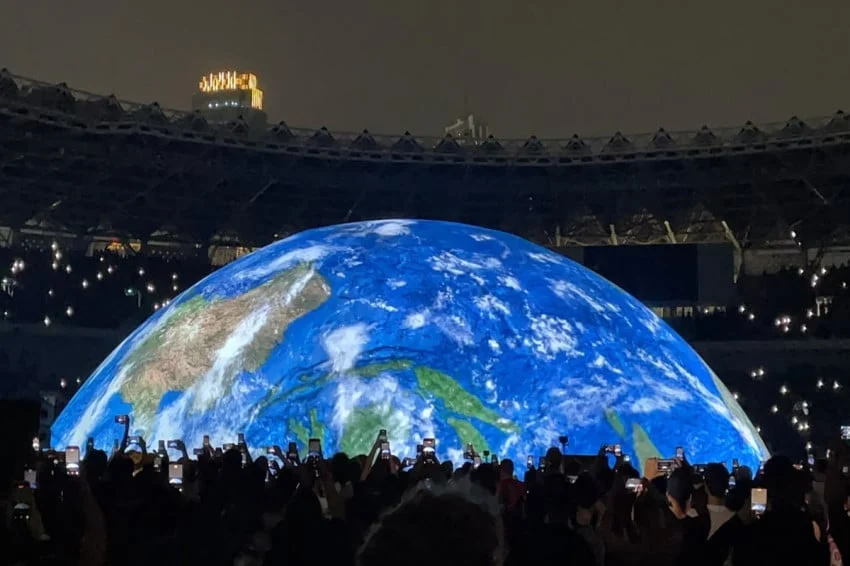
American rap icon Kanye West delivered a historic and visually arresting performance at the Gelora Bung Karno Main Stadium (SUGBK) in Senayan, Jakarta, captivating an audience of approximately 50,000 domestic and international music enthusiasts. The concert, held on Saturday, October 24, 2026, marked a significant milestone in Indonesia’s live entertainment sector, showcasing cutting-edge stage production and high-profile international touring logistics. Dominating the venue with an avant-garde architectural setup known as the "dome stage," the artist demonstrated his continued influence on global hip-hop culture while setting a new benchmark for stadium concerts in Southeast Asia.
Architectural Marvel: The Globe Dome Stage Design
The focal point of the Jakarta performance was an unprecedented half-globe dome structure that towered over the stadium field. From the apex of the massive hemispherical installation, which featured dynamic projections of the planet Earth, West stood in stark isolation. Piercing through thick artificial fog, a single, powerful white spotlight illuminated the rapper, creating a striking silhouette against the projected global map.
This minimalist yet grandiose entrance immediately galvanized the stadium, prompting thunderous applause and roars from the tens of thousands in attendance. Complementing the central structure was a sophisticated lighting design utilizing hundreds of synchronized, multi-colored lasers that crisscrossed the Jakarta night sky. The intersection of industrial-grade pyrotechnics, atmospheric fog, and futuristic projections positioned the concert not merely as a musical event, but as a multi-sensory immersive art installation.
Chronology of the Event and Audience Engagement
The preparation and execution of the concert followed a meticulously planned timeline designed to manage massive crowds and ensure seamless technical delivery.
Pre-Event Mobilization and Gates Opening
- 14:00 Western Indonesia Time (WIB): Security perimeters around the Gelora Bung Karno complex were established, with local law enforcement and private security managing traffic flow across Senayan.
- 16:30 WIB: Gates officially opened, allowing tens of thousands of ticket holders, ranging from festival-goers to VIP box attendees, to enter the venue smoothly.
- 19:00 WIB: The stadium reached near-capacity, with international travelers and domestic fans filling the stands and the pitch area surrounding the central dome.
The Performance Timeline
- 21:00 WIB: The stadium lights dimmed entirely, plunging SUGBK into darkness before the dome stage illuminated with the iconic Earth projection.
- 21:15 WIB: Kanye West emerged atop the dome structure, initiating a career-spanning setlist that blended foundational tracks with recent experimental compositions.
- 23:15 WIB: The concert concluded with an ambient audioscape and an extended light show, leaving the audience as the stadium lights gradually returned.
Economic and Logistical Scale of the Production
Beyond its artistic merit, the Kanye West concert in Jakarta carried substantial economic weight. Organizers confirmed that the event drew an estimated 50,000 attendees, generating significant revenue for the local hospitality, transportation, and tourism sectors. Hotel occupancy rates in central Jakarta experienced a notable surge during the concert weekend, driven by regional travelers from neighboring countries such as Malaysia, Singapore, and the Philippines.
Crucially, the production prioritized local labor integration. Industry reports indicated that thousands of Indonesian workers were directly and indirectly involved in the event’s lifecycle. From stage construction and rigging of the complex dome infrastructure to crowd management, catering, and technical support, local professionals played a pivotal role in executing the logistical demands of a Tier-1 global tour. This extensive collaboration highlighted the growing capability of Indonesia’s event production ecosystem to handle world-class entertainment operations.
Official Responses and Industry Stakeholder Perspectives
The scale of the production prompted statements from event promoters, municipal authorities, and tourism representatives regarding the broader implications of hosting such high-profile acts.
Event organizers emphasized that bringing an artist of West’s magnitude to Jakarta required months of rigorous safety compliance, structural engineering assessments, and coordination with stadium management. Ensuring the integrity of the SUGBK pitch while constructing a multi-ton dome stage demanded precise architectural oversight.
Meanwhile, municipal and tourism officials viewed the concert as a validation of Jakarta’s status as a premier entertainment hub in Southeast Asia. Representatives from the local creative economy sector noted that large-scale international concerts serve as vital catalysts for post-pandemic economic recovery, driving foreign exchange earnings and elevating the nation’s profile in the global tourism market.
Broader Implications and Future Outlook
The successful execution of Kanye West’s Jakarta concert underscores several key trends in the global music touring industry. As artists increasingly rely on immersive, conceptual stage designs rather than traditional concert formats, promoters in emerging markets must adapt to higher technical thresholds. The deployment of the globe dome stage in Jakarta demonstrates that Indonesian venues can support complex, high-spec international productions.
Furthermore, the involvement of thousands of local workers signals a maturation of the domestic workforce, fostering knowledge transfer and elevating operational standards within the local event production industry. As international promoters continue to view Indonesia as a viable and lucrative stop for global stadium tours, the success of the SUGBK concert establishes a high precedent for future events, balancing massive audience capacities with sophisticated artistic execution.