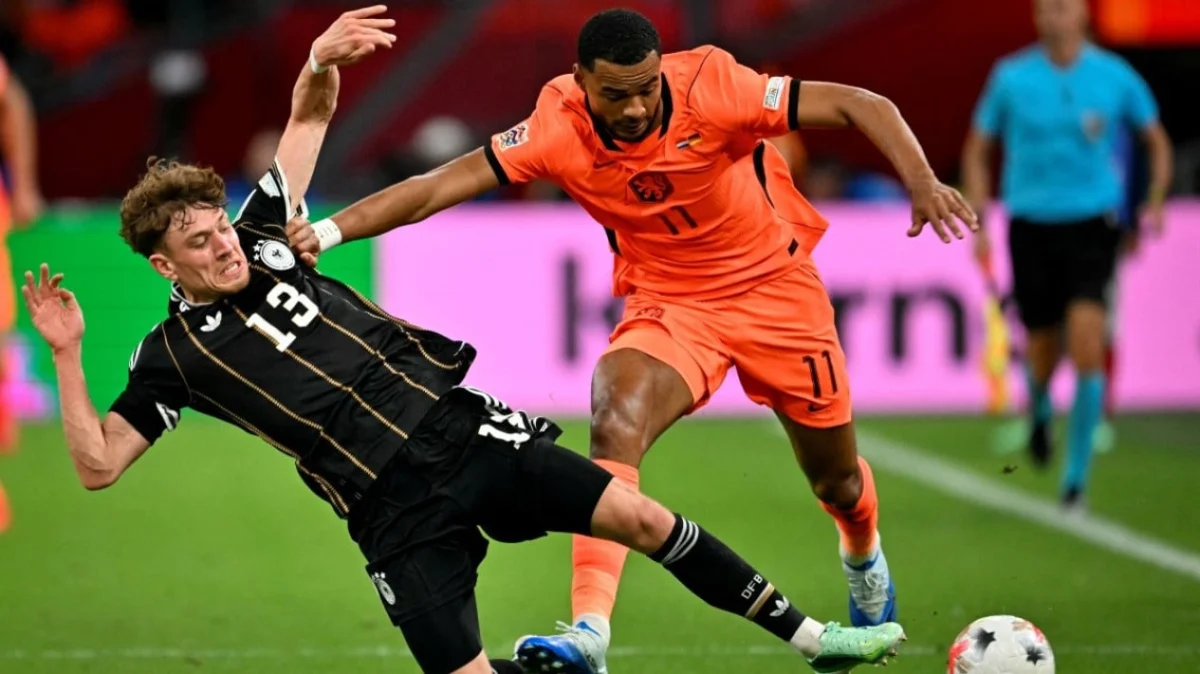
The Johan Cruijff Arena in Amsterdam played host to one of the most anticipated tactical showdowns of the European international calendar as the Netherlands and Germany locked horns in UEFA Nations League A Group 2. The match, played in the early hours of Friday, September 25, 2026, delivered high drama, tactical chess, and a late twist, culminating in a 1-1 stalemate. Beyond the traditional rivalry between the two European powerhouses, the fixture drew unprecedented global attention as it marked the managerial debuts of two modern tactical titans: Juergen Klopp taking charge of the German national team, and Xavi Hernandez stepping into the dugout for the Dutch Oranje.
With both nations transitioning into fresh managerial eras following underwhelming cycles, the opening match of the 2026–2027 UEFA Nations League campaign offered a fascinating glimpse into the future philosophies of two of football’s most influential minds. While Germany looked structurally disciplined and flashed moments of clinical counter-attacking brilliance under Klopp, the Netherlands demonstrated resilience and sustained attacking waves, ultimately rewarded by a moment of individual brilliance deep into stoppage time.
A High-Stakes Tactical Prelude and Background Context
The appointment of Juergen Klopp and Xavi Hernandez earlier in the year sent shockwaves through European football. For Germany, turning to Klopp—revered for his intense, high-pressing "Gegenpressing" philosophy—was seen as a decisive step to restore the Nationalelf to global dominance after years of international turbulence. Conversely, the Royal Dutch Football Association (KNVB) appointment of Xavi Hernandez signaled a radical philosophical shift toward positional play, patient build-up, and technical dominance, blending traditional Dutch Total Football with modern Catalan principles.
The setting could not have been more dramatic. The Johan Cruijff Arena was packed to capacity, a sea of orange contrasting with pockets of traveling German supporters. Group 2 of League A is historically regarded as a "Group of Death" equivalent in the UEFA Nations League, featuring formidable opponents including Greece and Serbia. Consequently, dropping points early in the campaign carried significant implications for qualification to the tournament’s latter stages.
Chronology of the Match: First-Half Drama and Disallowed Goals
The match began at a blistering pace, living up to the pre-match tactical hype. Xavi’s Netherlands looked to establish dominance in possession, circulating the ball with intricate triangular movements, while Klopp’s Germany deployed a compact, aggressive mid-block designed to choke central passing lanes and strike quickly on the transition.
The tension on the pitch boiled over as early as the 12th minute. The Netherlands thought they had drawn first blood when captain and defensive stalwart Virgil van Dijk rose majestically to meet a pinpoint set-piece delivery, powering a header past German goalkeeper Marc-André ter Stegen. The home crowd erupted in celebration, but the ecstasy was short-lived. Following a VAR review, the referee disallowed the goal, ruling that striker Bryan Brobbey had impeded Ter Stegen in the goalmouth during the build-up. Replays showed Brobbey’s physical engagement with the German shot-stopper constituted an illegal intervention, offering an early sigh of relief for Klopp’s side.

As the half progressed, the physical intensity of the fixture began to take a toll. Around the 30-minute mark, Germany suffered a major blow when key playmaker Kai Havertz pulled up with an apparent muscular injury. The versatile attacker was forced off the pitch, prompting Klopp to hand an unexpected debut to young prospect Younes Ebnoutalib. Ebnoutalib slotted into the frontline and immediately tested the Dutch defense with his pace, notably stinging the hands of goalkeeper Bart Verbruggen with a sharp effort from a tight angle.
Just as the momentum seemed evenly balanced, Germany capitalized on a defensive lapse to break the deadlock in the 32nd minute. A routine clearance attempt by the Dutch backline went awry, leaving a loose ball bouncing on the edge of the penalty area. Felix Nmecha reacted quickest to the loose ball, keeping his composure to guide a precise, first-time right-footed shot past a helpless Bart Verbruggen. The goal stunned the Amsterdam crowd and handed Germany a crucial 1-0 advantage heading into the halftime interval, validating Klopp’s pragmatic first-half strategy.
The Second-Half Siege: Dutch Pressure and Ter Stegen’s Heroics
Trailing by a goal, the Netherlands emerged from the dressing room with renewed urgency and an elevated tempo. Xavi’s tactical adjustments at halftime injected greater width into the Dutch attack, forcing Germany onto the defensive.
Wing-back Denzel Dumfries began to exert his influence down the right flank, repeatedly bypassing the German defensive line. On the hour mark, Dumfries carved out a golden opportunity, cutting the ball back into the danger zone, but substitute Meerdink failed to convert from close range. Two minutes later, Meerdink found himself in space again, only to be denied by the formidable presence of Marc-André ter Stegen.
As the clock wound down, the match transformed into a one-sided siege. The Dutch wave after wave of attacks collided against a resolute German defensive wall, anchored brilliantly by Antonio Rüdiger and marshaled from the back by Ter Stegen. The Barcelona goalkeeper put on a masterclass in modern goalkeeping, frustrating the Dutch forwards time and time again. In the 72nd minute, Ter Stegen produced a sprawling reflex save to deny Meerdink once more.
With regulation time expiring, the pressure mounted further. In the 88th minute, substitute Ruben van Bommel unleashed a ferocious long-range strike that seemed destined for the top corner, only for Ter Stegen to produce a fingertip save, tipping the ball over the crossbar. It appeared that Germany’s defensive discipline under Klopp would secure a hard-fought clean sheet and all three points in Amsterdam.
Dramatic Stoppage-Time Equalizer
Football, however, is a game defined by late twists. As the match entered stoppage time, the Netherlands threw every available outfield player into the attacking third.

In the 92nd minute (90+2′), the breakthrough finally arrived. Ruben van Bommel received possession on the left side of the pitch and spotted an intelligent run from Cody Gakpo. Demonstrating exceptional vision and technique, Van Bommel delivered a sublime, curling trivela pass over the German defensive line. Gakpo timed his run to perfection, meeting the flight of the ball with an instinctive, acrobatic right-footed volley. The connection was flawless, and the ball rocketed past Ter Stegen before the German defense could react, sending the Johan Cruijff Arena into absolute delirium.
The goal served as fitting reward for the Netherlands’ sustained second-half pressure and rescued a vital point for Xavi Hernandez in his managerial bow. Shortly after the restart, the referee blew the final whistle, sealing a 1-1 draw that felt entirely justified by the run of play.
Standings, Implications, and Immediate Group Outlook
The shared points in Amsterdam leave the Group 2 standings finely poised after the opening round of fixtures. Germany sits in second place in the temporary group table, reflecting their tactical discipline and flashes of brilliance under Klopp, while the Netherlands occupies the third spot, buoyed by their relentless character and late equalizer.
Surprise leaders of Group 2 at this early stage are Greece, who captured a statement 2-1 victory over Serbia in their opening fixture, demonstrating that the traditional heavyweights cannot afford any complacency in this fiercely competitive group.
Looking ahead, the road does not get any easier for either side as the UEFA Nations League schedule intensifies. The Netherlands will face a daunting away trip to Belgrade to square off against Serbia, where Xavi Hernandez’s side will be expected to translate their late-game momentum into a full ninety-minute performance. Meanwhile, Germany will return to home soil to host group leaders Greece in what promises to be another high-stakes tactical test for Juergen Klopp’s evolving squad.
As the dust settles on an eventful night in Amsterdam, the early impressions of the Klopp and Xavi eras suggest that both teams are undergoing compelling evolutions—balancing defensive resilience with tactical innovation—setting the stage for a thrilling remainder of the international campaign.