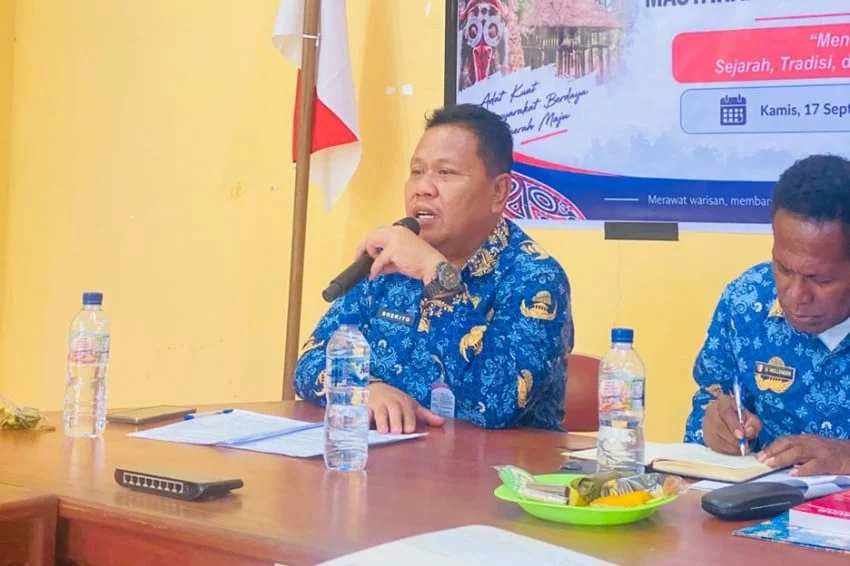
The National Unity and Politics Agency (Kesbangpol) of Merauke Regency, located in the province of Papua, Indonesia, is actively pursuing a comprehensive framework to elevate the status of indigenous institutions and traditional leaders. Rather than restricting their involvement to reactive crisis management when social disputes arise, the local government aims to integrate customary authorities into the core architecture of regional governance. This strategic shift was underscored during a high-level focused group discussion held on Thursday, September 17, 2026, at the Kesbangpol Meeting Room in Merauke.
The event, which served as a focal point for institutional reform discussions, was organized by the Merah Pusaka Stratejik Indonesia (MPSI) Foundation. It brought together local government officials, community leaders, and indigenous stakeholders under the overarching theme of Strengthening, Protection, and Participation of Indigenous Legal Communities in Regional Development. The dialogue illuminated a shared consensus among regional stakeholders: sustainable development in Papua’s southernmost territory requires deep-rooted collaboration with the customary guardians of the land, whose social influence often supersedes formal administrative channels.
Shifting Paradigms: From Crisis Intervention to Strategic Partnership
For decades, the standard administrative approach across many regions in Indonesia often relegated customary institutions (lembaga adat) to informal mediators summoned only when land disputes, social friction, or horizontal conflicts escalated into public disturbances. Government officials would frequently rely on tribal chiefs (kepala suku) and traditional elders to restore calm retroactively. However, the administration in Merauke Regency is pioneering a forward-looking paradigm that positions indigenous leaders as proactive architects of peace and developmental catalysts.
Head of the Merauke Regency Kesbangpol, Sukito, articulated this policy pivot during the forum, emphasizing that the intrinsic social capital possessed by indigenous figures makes them indispensable to the region’s stability. Traditional leaders command deep-seated authority, cultural reverence, and moral legitimacy within their communities. When aligned with government objectives, this influence facilitates smoother policy implementation, enhances public trust in local institutions, and ensures that regional development projects respect cultural sensitivities and local ecological wisdom.
"Indigenous institutions and traditional leaders possess profound social influence in the midst of our society," Sukito stated during the discussion. "This position grants them a crucial role, not merely in maintaining public order, but actively in building communication and preventing social issues from escalating into full-scale conflicts."
This institutional strengthening initiative directly addresses the complex socio-cultural landscape of Merauke. As a rapidly developing regency that serves as a major agricultural and economic hub in southern Papua, Merauke experiences demographic shifts, infrastructure expansion, and economic investments that occasionally generate friction regarding land rights, resource allocation, and cultural preservation. By integrating customary leaders into regular consultative frameworks, the local government hopes to preemptively address these structural vulnerabilities.
Chronology and Background of the MPSI Initiative
The dialogue on September 17, 2026, was not an isolated event but the culmination of months of coordinated policy engagement between local civil society organizations and regional bureaucratic bodies. The Yayasan Merah Pusaka Stratejik Indonesia (MPSI) initiated the collaborative platform following a series of preliminary assessments conducted throughout the first half of 2026. These assessments highlighted a growing disconnect between top-down regional development policies and grassroots indigenous aspirations.
Timeline of the Policy Engagement
- January – March 2026: MPSI conducts regional research across several districts in Merauke to evaluate the participation levels of indigenous communities in local development planning (Musrenbang). The findings indicate that while formal mechanisms exist, customary legal communities often feel alienated from high-level decision-making processes.
- April – May 2026: Preliminary consultations are held between MPSI researchers, district heads, and select customary leaders to design a comprehensive framework for indigenous institutional empowerment.
- June – July 2026: Draft proposals for strengthening customary roles are shared with the Merauke Regency Kesbangpol, laying the groundwork for a formal partnership between the local government and civil society advocates.
- August 2026: Preparations for the multi-stakeholder forum are finalized, focusing on legal protections, cultural preservation, and economic participation for indigenous populations.
- September 17, 2026: The formal focused group discussion, titled “Strengthening, Protection, and Participation of Indigenous Legal Communities in Regional Development,” convenes at the Kesbangpol Office in Merauke, culminating in policy recommendations embraced by local authorities.
The involvement of MPSI as an independent intermediary underscores the critical role played by non-governmental organizations in facilitating constructive dialogues between state apparatuses and traditional societies. By bridging bureaucratic terminology and customary frameworks, foundations like MPSI help translate complex regional regulations into actionable, culturally resonant practices.
Security, Stability, and the Economics of Development
A central thesis emerging from the Merauke discussions is that long-term economic prosperity and infrastructural progress are inextricably linked to social stability and preventive diplomacy. Sukito elaborated on this principle, noting that peace is not merely the absence of open conflict, but the active presence of robust communicative channels among the government, civil society, and traditional authorities.
"Security and public comfort are foundational prerequisites for development to proceed effectively," Sukito explained. "Although the general condition of Merauke remains relatively conducive and stable, potential social issues must still be detected early through continuous communication between the government, the public, and traditional figures."
This philosophy challenges the conventional state-centric view of security, which often relies heavily on law enforcement agencies and physical deterrence. Instead, the Kesbangpol approach prioritizes early detection, cultural mediation, and empathetic dialogue. In practice, preventing conflict does not always require massive physical investments or punitive measures; rather, it relies on the subtle, continuous labor of maintaining open dialogue spaces where grievances can be aired and resolved before they crystallize into social unrest.
This holistic approach complements broader economic initiatives currently underway in the region. For instance, recent regional assessments in Merauke’s agricultural sector—highlighted by local officials overseeing food estate optimization and corporate social responsibility (CSR) programs—have successfully stabilized rice production and regional food prices. However, agricultural expansion and land optimization projects frequently intersect with customary land ownership claims (hak ulayat). Without the active mediation and partnership of indigenous institutions, such economic interventions run the risk of inadvertently triggering agrarian disputes. By fortifying the status of traditional leaders, the Merauke government ensures that economic optimization goes hand in hand with social equity and cultural respect.
Institutional Synergy: A Multi-Forum Framework for Social Resilience
The Merauke Regency Kesbangpol does not rely solely on ad-hoc meetings to maintain social cohesion. The agency has systematically constructed an intricate network of consultative bodies designed to encompass every facet of society. These institutional pillars work in tandem to monitor social dynamics, promote religious tolerance, and foster national integration at the local level.
Key Forums Operative in Merauke Regency
- Lembaga Adat (Customary Institutions): Representing the indigenous clans and traditional governance structures that hold historical stewardship over the land and natural resources of Merauke.
- FKUB (Forum Kerukunan Umat Beragama / Religious Harmony Forum): Dedicated to bridging inter-faith dialogues, mitigating religious sensitivities, and ensuring harmonious coexistence among diverse spiritual communities.
- FKDM (Forum Kewaspadaan Dini Masyarakat / Community Early Warning Forum): Tasked with gathering grassroots intelligence and identifying potential social anomalies, localized disputes, or security threats before they materialize into public disturbances.
- FPK (Forum Pembauran Kebangsaan / National Integration Forum): Focused on fostering unity and cultural assimilation among the multi-ethnic demographic tapestry inhabiting Merauke, ensuring that migrant communities and indigenous populations coexist harmoniously.
- Organisasi Kemasyarakatan (Civil Society and Mass Organizations): Encompassing youth groups, professional associations, and advocacy networks that contribute to the active functioning of local democracy.
By embedding indigenous leadership within this broader ecosystem of civic and cultural forums, the Merauke administration has created a multi-layered defense against social friction. When an emerging dispute touches upon territorial boundaries, cultural heritage, or resource distribution, the Kesbangpol can mobilize the appropriate network—deploying customary elders alongside early-warning specialists and religious figures to de-escalate tensions organically.
Broader Implications for Papua’s Regional Governance
The proactive stance adopted by the Merauke Regency government offers a valuable blueprint for regional governance across the broader Papua region and Indonesia at large. Papua’s unique sociopolitical landscape, governed by special autonomy provisions, necessitates administrative models that respect local customary laws (hukum adat) while advancing modern public administration standards.
For years, critics have argued that regional development in Papua has occasionally prioritized physical infrastructure at the expense of indigenous rights and cultural preservation. The initiative in Merauke signals a conscious effort to correct this imbalance. By formally recognizing customary institutions as strategic partners rather than peripheral entities, the local government validates the dignity and autonomy of indigenous legal communities.
Furthermore, this collaborative model has significant implications for investment security. Investors seeking to engage in Merauke’s vast agricultural, logistical, and infrastructural sectors increasingly recognize that legal permits issued by central or regional governments must be complemented by social licenses granted by traditional land-owning clans. By establishing transparent, institutionalized channels through Kesbangpol, the Merauke government provides investors with a more predictable operating environment, minimizing the risk of prolonged land disputes and operational stoppages.
As the initiatives discussed on September 17, 2026, transition from policy discourse into operational reality, the success of Merauke’s approach will depend heavily on sustained political will, adequate resource allocation for customary institutions, and genuine grassroots participation. If executed effectively, Merauke can serve as a shining example of how regional governments can harmonize modern developmental ambitions with the timeless wisdom and stewardship of indigenous peoples, fostering a future defined by enduring peace, cultural preservation, and shared prosperity.