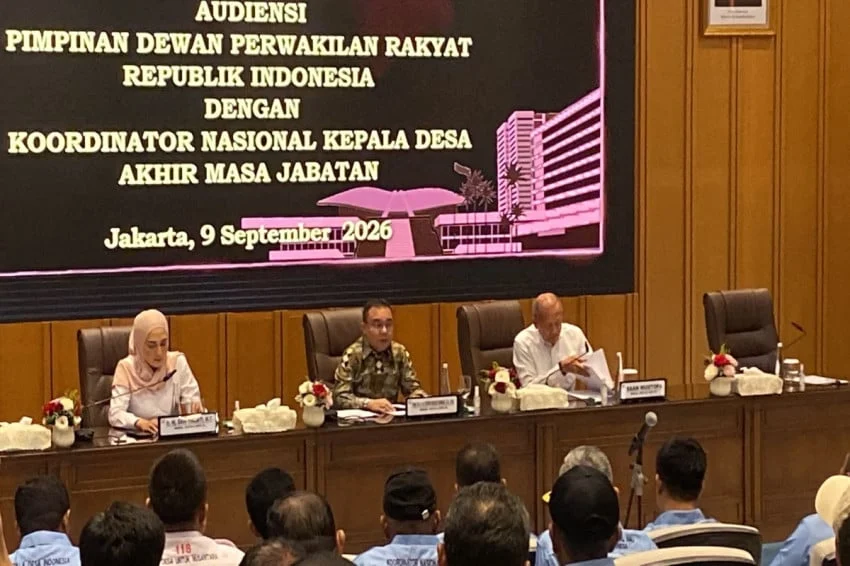
The legislative halls of the Indonesian House of Representatives (DPR RI) in Senayan, Jakarta, became the focal point of a high-stakes dialogue on Wednesday, September 9, 2026, as parliamentary leadership convened with the National Coordinator for Village Heads whose terms are reaching their conclusion (Kades AMJ). The meeting, held in the Abdul Muis Room of the Nusantara Building, centered on the precarious administrative landscape facing village heads nearing the end of their tenure in 2027. Amidst rising economic pressures and concerns over rural governance stability, the meeting sought to bridge the gap between village-level administration and central policy-making regarding the critical transition of leadership through the Village Head Elections (Pilkades).
The Core Issues and Legislative Intervention
Representing the DPR RI, Deputy Speaker Sufmi Dasco Ahmad, accompanied by fellow parliamentary leaders Sari Yuliati and Saan Mustopa, presided over the session. The discussion was multifaceted, addressing not only the technical timeline for upcoming elections but also the broader rights of village officials, the necessity for recognition of their long-term service, and the maintenance of continuity in public service delivery during the transition period.
The primary point of contention revolves around the 2027 expiration of numerous village head mandates. With the current economic environment characterized by global inflation and volatile local financial conditions, many village heads have expressed that the immediate staging of Pilkades could place an undue burden on village coffers. The delegation of Kades AMJ emphasized that the financial and social costs associated with these elections require a more synchronized approach with national fiscal policy to ensure that democratic processes do not compromise the delivery of essential services to rural communities.
Economic Context and Administrative Challenges
The urgency of this meeting is underscored by the current macroeconomic climate. As noted by Deputy Speaker Dasco, the interplay between global economic shifts and local inflation has created a delicate situation in rural regions. Indonesia’s village governance system relies heavily on the stability of local leadership to manage the Village Fund (Dana Desa), which has been a pillar of rural development since the enactment of the 2014 Village Law.
The potential for a "leadership vacuum" or, conversely, a premature transition during an inflationary period, risks disrupting ongoing development projects. In many districts, the administrative cost of conducting a village election is substantial. When combined with the broader inflationary pressure on the cost of living and logistical expenses, the financial strain on village budgets becomes a matter of national concern. The Kades AMJ representatives argued that the government must provide clear guidance on whether terms should be extended or whether election schedules can be adjusted to align with more favorable economic windows.
Chronology of the Advocacy Process
The formal request for this audience was the culmination of months of grassroots organizing by village heads across the archipelago. The trajectory leading to the September 9, 2026, meeting includes:
- Early 2026: Informal consultations begin among village heads regarding the expiration of terms in 2027 and the lack of clarity on the scheduling of the next round of Pilkades.
- June 2026: Regional workshops held by village head associations highlight the need for federal intervention to prevent localized political unrest during the transition.
- August 2026: A formal letter of request for an audience is submitted to the DPR RI leadership, citing the need for legislative clarity on the interpretation of the Village Law regarding term limits and election cycles.
- September 9, 2026: The formal hearing takes place at the Parliament Complex, where the specific grievances regarding the 2027 transition are presented to the House leadership.
Official Responses and the Commitment to Coordination
Following the hearing, the DPR leadership expressed a commitment to act as a mediator between the village officials and the relevant government bodies, most notably the Ministry of Home Affairs and the Ministry of Villages, Development of Disadvantaged Regions, and Transmigration.
"We have received the aspirations of the village heads, which highlight a significant concern regarding the intersection of global economic trends and local governance sustainability," said Sufmi Dasco Ahmad. He further noted that the DPR’s role is to ensure that the transition does not negatively impact the rural population. "We will conduct a comprehensive coordination with the relevant ministries and agencies to ensure that the stages of the Pilkades are executed at an optimal time, with calculations that reflect the current economic realities of our villages."

This commitment to "coordinated timing" is significant. It implies that the government may consider a phased approach to the 2027 elections or explore administrative measures to extend terms where necessary, provided such actions remain within the constitutional framework of the Village Law.
Broader Implications for Indonesian Rural Governance
The situation facing the Kades AMJ is a microcosm of the larger challenges facing Indonesian decentralization. Since the implementation of the Village Law, the village has become a primary unit of development. However, the professionalization of the village head position has brought about complex issues concerning term limits, career paths, and political stability.
Analysts point out that the push for "certainty" in the Pilkades timeline is not merely about job security for incumbents; it is about the "continuity of governance." If a village head election is held amidst a period of economic instability, the risk of social fragmentation within the village increases. Furthermore, the administrative transition requires a seamless handover to ensure that multi-year infrastructure projects funded by the Village Fund are not abandoned or mismanaged during the interregnum.
The advocacy by the Kades AMJ reflects a shift in the political agency of village heads. No longer just local figures, they are increasingly functioning as a cohesive national interest group capable of negotiating with the central government. This dynamic forces the DPR to balance the democratic necessity of regular elections with the practical need for administrative stability.
Expert Perspectives on Policy Adjustments
Legal and governance experts observing the process note that the government has a few options to address these concerns. These include:
- Regulatory Alignment: Issuing a Ministerial Regulation (Permendagri) that provides flexibility in the scheduling of Pilkades based on local economic indicators.
- Budgetary Support: Providing central government subsidies for election logistics to alleviate the burden on local village budgets.
- Legislative Review: Potential amendments or clarifications to existing regulations that define the "end of term" to allow for minor extensions in the interest of public service continuity.
However, any move to extend terms faces scrutiny regarding the democratic process. Critics of term extensions argue that such moves could be perceived as a drift away from democratic accountability. Therefore, the DPR’s challenge is to find a solution that satisfies the requirement for stability without undermining the electoral mandate of the villagers.
Looking Ahead
The dialogue in Senayan is expected to continue in the coming weeks. The DPR is tasked with consolidating the data and requests submitted by the Kades AMJ into a policy recommendation that will be presented to the executive branch. For the millions of citizens residing in rural Indonesia, the outcome of this coordination will be critical. The stability of their local governance, the continuity of their development programs, and the legitimacy of their future leaders all hang in the balance.
As the 2027 deadline approaches, the pressure on the government to provide a definitive roadmap for the Pilkades will only intensify. The September 9 meeting serves as a crucial starting point for a dialogue that must now translate into concrete, actionable policy. The collaborative spirit demonstrated by the DPR leadership and the village representatives suggests a recognition that in times of economic uncertainty, the strength of the village is the strength of the nation. The upcoming months will likely see intensive negotiations as stakeholders work to balance the competing needs of fiscal prudence, administrative efficiency, and democratic participation.
In conclusion, the meeting between the DPR RI and the Kades AMJ represents a pivotal moment in the governance of Indonesia’s rural areas. By bringing the concerns of the village heads to the highest level of the legislature, the representatives have ensured that the challenges of the 2027 transition are now firmly on the national agenda, necessitating a thoughtful and coordinated response from the central government.