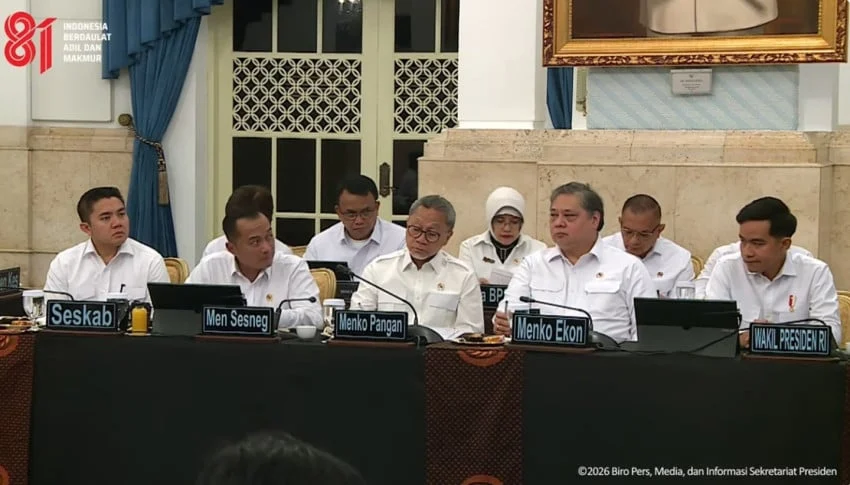
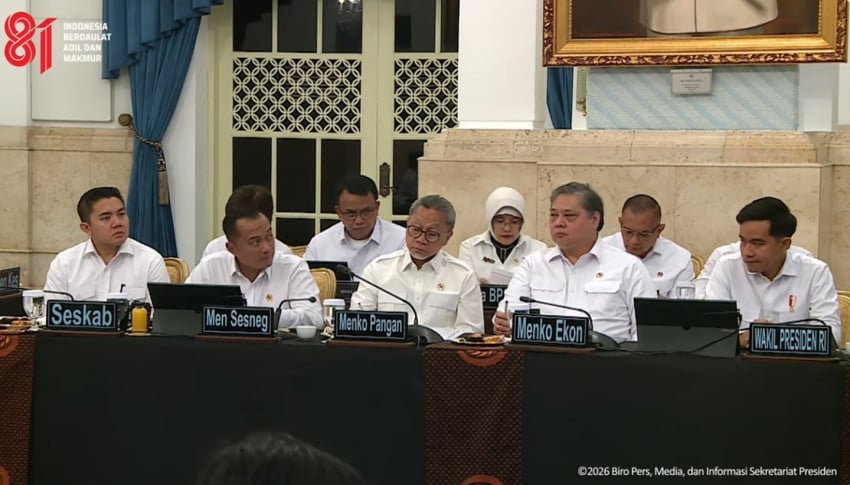
The Indonesian State Palace has issued a formal clarification regarding a noticeable change in the seating configuration during the Plenary Cabinet Meeting held on Monday, July 20, 2026. Observers and members of the press noted that Vice President Gibran Rakabuming Raka was no longer seated directly adjacent to President Prabowo Subianto, a departure from the traditional protocol observed in previous high-level government gatherings. During the session at the State Palace in Jakarta, Vice President Gibran was positioned in the front row on the right-hand side of the President, placing him in a line traditionally reserved for senior cabinet members and coordinating ministers.
This specific arrangement saw the Vice President seated alongside the Coordinating Minister for Economic Affairs Airlangga Hartarto, the Coordinating Minister for Food Affairs Zulkifli Hasan, Minister of the State Secretariat Prasetyo Hadi, and Cabinet Secretary Teddy Indra Wijaya. The visual shift sparked immediate public discourse and speculation regarding the internal dynamics of the executive branch, as the Vice President typically occupies a seat of honor directly to the left or right of the Head of State during such formal proceedings.
A Departure from Established Visual Protocol
The contrast in seating was highlighted by comparing Monday’s session to a previous Plenary Cabinet Meeting held on Friday, March 13. In that earlier session, which also took place at the State Palace, Vice President Gibran was seated in the conventional manner, directly beside President Prabowo. During that March meeting, the President was seen in his signature brown safari shirt while the Vice President wore a formal white shirt, both positioned at the head of the assembly table to signify the unified leadership of the executive.
In the July 20 meeting, however, President Prabowo sat at the center of the head table, flanked by a different configuration of officials or, in some segments of the meeting, presiding with a more singular focus at the head of the "U-shaped" or rectangular arrangement. The placement of Gibran Rakabuming Raka among the coordinating ministers has been interpreted by some as a move toward a more functional, "working-style" cabinet meeting, where the Vice President is positioned closer to the ministers who manage specific sectoral clusters.
Official Justification from the State Secretariat
Addressing the inquiries from the media, Minister of the State Secretariat (Mensesneg) Prasetyo Hadi provided a detailed explanation for the adjustment. According to the Minister, the seating arrangement is not a fixed or rigid structure but is instead adapted based on the specific agenda, the technical requirements of the discussion, and the need for effective communication between the President, the Vice President, and the relevant coordinating ministers.
"There is no political significance or shift in authority behind this seating arrangement," Prasetyo Hadi stated in his briefing. "The layout of a Plenary Cabinet Meeting is designed to facilitate the most efficient flow of information. In this particular session, the focus was on cross-sectoral coordination between the Vice President and the Coordinating Ministers. By placing the Vice President in that specific row, it allowed for more direct interaction and synchronization on the implementation of priority programs."
The Minister further emphasized that the President and Vice President remain a singular unit of executive leadership. He noted that the Cabinet Secretariat, headed by Teddy Indra Wijaya, is responsible for the technicalities of these meetings and that changes are often made to ensure that the ministers most relevant to the day’s agenda have the necessary proximity to the executive leadership.
The Legal Framework: Law No. 9 of 2010 on Protocol
To understand the significance of this shift, it is necessary to examine the legal basis for state ceremonies and meetings in Indonesia. Law Number 9 of 2010 concerning Protocol (Undang-Undang Nomor 9 Tahun 2010 tentang Keprotokolan) dictates the "Order of Precedence" (Tata Tempat) for state officials.
Under Article 4 of the Protocol Law, the President and Vice President are classified as the highest-ranking state officials. In formal state ceremonies, the Vice President is required to be positioned immediately following the President. However, for "Working Meetings" or "Cabinet Meetings," the rules allow for more flexibility. Article 22 of the same law suggests that the seating for government meetings can be arranged to suit the nature of the event, provided that the dignity and status of the officials are maintained.
In the context of the July 2026 meeting, the Palace maintains that Gibran’s placement in the front row, alongside the most senior coordinating ministers, still upholds his status as the second-highest official in the land. By being at the "head" of the ministerial line, he acts as a bridge between the President’s directives and the ministers’ execution.
Chronology of Cabinet Meeting Configurations (2024-2026)
Since the inauguration of President Prabowo Subianto and Vice President Gibran Rakabuming Raka in October 2024, the administration has experimented with several meeting formats.
- October 2024 – January 2025: The "Unity Phase." Almost all meetings featured the President and Vice President sitting side-by-side at a long head table, emphasizing the transition and the "Continuity" (Keberlanjutan) narrative from the previous administration.
- February 2025 – Early 2026: The "Sectoral Phase." As the administration began rolling out its "Free Nutritious Meals" program and food sovereignty initiatives, the Vice President began taking a more active role in supervising specific ministries. Seating began to vary slightly depending on whether the meeting was held in Jakarta or at the new capital, Ibu Kota Nusantara (IKN).
- March 13, 2026: A return to the classic side-by-side arrangement during a plenary session focused on national security and foreign policy.
- July 20, 2026: The "Functional Realignment." The most recent shift where the Vice President moved into the ministerial row to oversee technical deliberations on food security and economic stability.
Analytical Perspective: Functionalism vs. Symbolism
Political analysts suggest that this shift reflects a broader trend in the Prabowo-Gibran administration toward a more "technocratic" approach to governance. In traditional Indonesian political symbolism, the proximity of the Vice President to the President is often scrutinized as a measure of their "chemistry" or the level of trust between the two leaders.
However, an alternative view suggests that Gibran Rakabuming Raka is being positioned as a "Chief Operating Officer" of sorts. By sitting with the Coordinating Ministers, the Vice President is visually and physically integrated into the "engine room" of the government. This allows him to lead discussions within the ministerial clusters more effectively before the final decisions are elevated to the President.
"The Vice President is being given a very specific mandate by President Prabowo to oversee the implementation of ground-level programs," says a policy analyst from a Jakarta-based think tank. "Sitting him with Airlangga Hartarto and Zulkifli Hasan sends a signal that the Vice President is not just a ceremonial figurehead but is deeply embedded in the economic and food security coordination which are the pillars of this administration."
The Role of the Coordinating Ministers
The presence of Airlangga Hartarto (Economy) and Zulkifli Hasan (Food) in the same row as the Vice President is significant. These two portfolios represent the most critical challenges facing the administration in 2026. With global supply chain fluctuations and the domestic push for food self-sufficiency, the "Food Affairs" coordinating ministry—a relatively new addition to the cabinet structure—requires constant synchronization with the Vice President’s office.
By placing Gibran in this row, the administration may be attempting to streamline the decision-making process. Rather than the Vice President observing from the head table, he is actively part of the "frontline" of the cabinet during the debate. This setup also includes Prasetyo Hadi and Teddy Indra Wijaya, the two men responsible for the administration’s logistics and secretarial flow, ensuring that any decision made during the meeting is immediately recorded and processed into official state documents.
Public and Political Reaction
Despite the Palace’s clarification, the change has not gone unnoticed by the opposition and political observers. Some members of the House of Representatives (DPR) have called for consistency in state protocol to avoid public confusion.
"Protocol is a symbol of the state’s stability," said one legislator from the Commission II, which oversees home affairs and the state secretariat. "While we understand the need for efficiency, the visual of the President and Vice President sitting together is a powerful symbol of national unity. We hope this change is indeed purely technical and not a sign of a shift in the constitutional role of the Vice President."
Conversely, supporters of the administration argue that the public should focus on the outcomes of the meetings rather than the seating chart. They point to the successful rollout of the national food program and the stabilization of inflation as evidence that the administration’s "working" format is yielding results.
Implications for Future Governance
As the Prabowo-Gibran administration approaches its second anniversary in late 2026, the evolution of cabinet dynamics will likely continue. The State Palace has indicated that seating arrangements will remain flexible, determined by the "needs of the state" and the "nature of the agenda."
This flexibility may become the new standard for Indonesian governance, breaking away from the more rigid, formalistic traditions of the past. If this "functional seating" leads to more productive cabinet sessions and faster policy implementation, it could redefine the role of the Vice President in the Indonesian presidential system—moving the office from a "spare tire" or purely symbolic role to a more integrated, executive oversight position.
In conclusion, the seating of Vice President Gibran Rakabuming Raka among the ministers during the July 2026 Plenary Cabinet Meeting appears to be a calculated move toward operational efficiency. While it deviates from traditional visual protocols, the explanation provided by the State Secretariat emphasizes a focus on synergy and technical coordination. As the administration continues to navigate complex national issues, the physical layout of the State Palace’s meeting rooms may continue to serve as a barometer for its evolving style of leadership and management.