The conclusion of the FIFA World Cup 2026 was intended to be a global celebration of footballing excellence, yet for Argentina, the tournament’s end has signaled the beginning of a complex legal and disciplinary battle. Following a narrow 1-0 defeat to Spain in the final held at MetLife Stadium in East Rutherford, New Jersey, on Sunday, July 20, 2026, the Argentine national team, known as La Albiceleste, now finds itself under the microscope of FIFA’s Disciplinary Committee. The investigation centers on a series of volatile incidents that occurred during the final match and the preceding semifinal, potentially leading to heavy fines, player suspensions, and reputational damage for the outgoing champions.
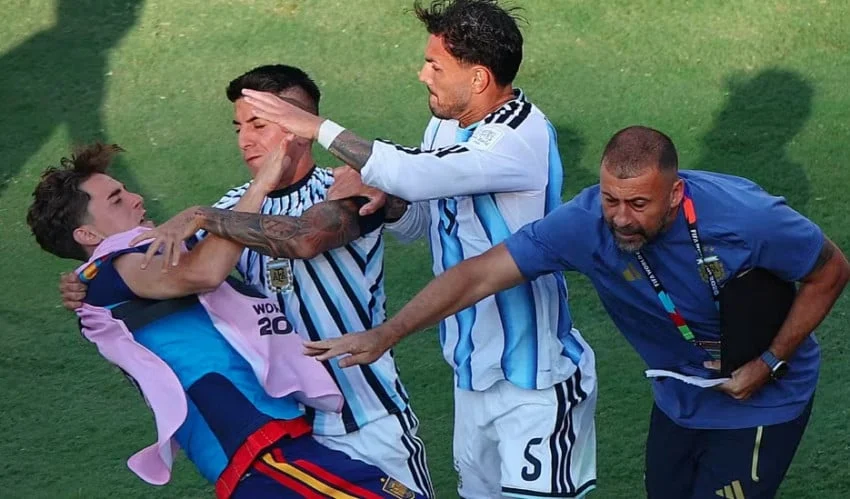
The tension reached a breaking point during the final’s extra time when Ferran Torres found the back of the net, securing Spain’s fourth world title. However, the sporting achievement was quickly overshadowed by scenes of aggression and unsporting conduct. As the final whistle blew, the atmosphere shifted from competitive intensity to physical confrontation. FIFA officials have confirmed that they are reviewing multiple reports from the officiating team and match delegates regarding the conduct of several key Argentine players who were involved in a post-match brawl that spilled across the pitch.
The MetLife Stadium Incident: A Chronology of Chaos
The disciplinary issues for Lionel Scaloni’s side began late in the match. In the 93rd minute, with Argentina desperately searching for an equalizer, midfielder Enzo Fernandez was dismissed after receiving a second yellow card for a reckless challenge. This initial dismissal set a frantic tone for the remaining minutes of extra time. Following the conclusion of the match, the situation escalated into a full-scale melee.
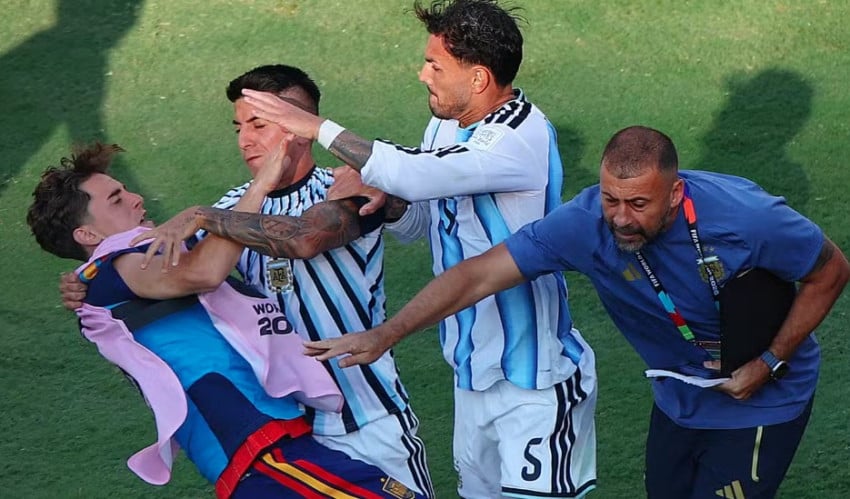
Leandro Paredes, known for his combative style of play, was at the center of the post-match controversy. Reports indicate that Paredes engaged in a heated verbal exchange with Spanish defenders Eric Garcia and Gavi, which quickly turned physical. Despite the match being over, the referee issued a straight red card to Paredes for his role in the confrontation. Simultaneously, video footage emerged appearing to show Nahuel Molina striking Spanish captain Rodri during the confusion. While the officiating crew did not initially catch every movement in the crowded technical area, FIFA’s use of high-definition broadcast feeds and VAR surveillance is expected to provide the necessary evidence for further sanctions.
The chaos lasted for several minutes, with security personnel and coaching staff from both sides attempting to separate the players. The incident was a jarring contrast to the celebratory scenes usually associated with a World Cup final and has prompted FIFA to take immediate action to preserve the "integrity and image of the game."
The Semifinal Controversy: Political Messaging and FIFA Statutes
The investigation into Argentina’s conduct is not limited to the physical altercations in New Jersey. FIFA is also scrutinizing an incident that took place following Argentina’s semifinal victory over England. During the post-match celebrations, several members of the Argentine squad were seen displaying a banner that read "Las Malvinas son Argentinas" (The Falkland Islands are Argentine).
This act has put Argentina in direct conflict with Article 11 of the FIFA Disciplinary Code and the general principles of the FIFA Statutes, which strictly prohibit the display of political, religious, or personal slogans or messages during international matches. FIFA has historically maintained a zero-tolerance policy regarding the use of football as a platform for territorial or political disputes. The "Malvinas" issue is a deeply sensitive diplomatic topic between Argentina and the United Kingdom, and its appearance on the world’s biggest sporting stage is viewed by the governing body as a significant breach of neutrality.
A FIFA spokesperson noted that the Independent Disciplinary Committee is currently "studying the match reports and all circumstances surrounding the semifinal and final." The inclusion of the political banner in the investigation suggests that Argentina could face a cumulative penalty for multiple infractions throughout the knockout stages.
Technical Breakdown of Potential FIFA Sanctions
The severity of the punishment facing the Argentine Football Association (AFA) and its players depends on how FIFA classifies the various incidents. Under the current FIFA Disciplinary Code, the penalties are categorized by the nature of the offense:
- Automatic Suspensions: The red cards shown to Enzo Fernandez and Leandro Paredes carry an automatic one-match ban for the next competitive FIFA-sanctioned fixture. This would typically apply to the upcoming 2030 World Cup qualifying matches under the CONMEBOL jurisdiction.
- Violent Conduct Enhancements: If the Disciplinary Committee determines that the actions of Paredes or Molina constitute "assault" (striking, kicking, or elbowing an opponent), the minimum sanction is a three-match suspension. In extreme cases of "serious unsporting behavior," these bans can be extended to six matches or a specific timeframe, such as several months.
- Team Misconduct: Under Article 12, if a team receives more than five bookings in a single match or if its players engage in a mass confrontation, the national association is subject to a mandatory fine. Given the scale of the brawl at MetLife Stadium, the AFA is expected to face a substantial financial penalty.
- Political Violations: For the "Malvinas" banner, the sanctions usually involve a heavy fine and a formal warning. However, if FIFA deems the act as "bringing the game into disrepute," they could impose stadium bans or force Argentina to play upcoming home matches behind closed doors.
Historical Precedents and Comparative Analysis
This is not the first time the Argentine national team has faced scrutiny for its disciplinary record. During the 2022 World Cup in Qatar, the quarterfinal match between Argentina and the Netherlands—famously dubbed the "Battle of Lusail"—saw a record-breaking 18 yellow cards and one red card. FIFA launched an investigation into that match as well, resulting in fines for the AFA.
However, the 2026 incidents are viewed as more severe because they involve physical altercations after the match had concluded and a clear violation of political neutrality rules. In comparison, when Swiss players Granit Xhaka and Xherdan Shaqiri made political gestures during the 2018 World Cup, they were fined but not suspended. Argentina’s situation is more complex due to the combination of physical violence and political messaging in back-to-back high-profile matches.
Experts suggest that FIFA may use this case to set a precedent for the 2026-2030 cycle. As the first 48-team World Cup, the tournament was meant to showcase a more inclusive and professional image of the sport. The scenes at the final are perceived as a setback for those efforts, increasing the likelihood that FIFA will impose "exemplary" punishments to deter future occurrences.
Broader Implications for the Future of La Albiceleste
The potential loss of key players like Enzo Fernandez, Leandro Paredes, and Nahuel Molina for the start of the next international cycle poses a significant challenge for manager Lionel Scaloni. Argentina is currently in a period of transition, with several veteran players expected to retire following the 2026 tournament. Losing the core of the midfield and defense to long-term suspensions could hinder the team’s ability to stabilize during the 2027 Copa America and the subsequent qualifying rounds.
Furthermore, the AFA’s relationship with FIFA could be strained. While the Argentine fans remain fiercely loyal, the international perception of the team has been affected by these recurring disciplinary issues. The "Malvinas" banner, in particular, has sparked debate in international diplomatic circles, reminding the world that football and politics often remain inextricably linked despite FIFA’s best efforts to separate them.
From a strategic standpoint, the AFA is expected to file a comprehensive defense, likely arguing that the emotions of a World Cup final led to isolated incidents of poor judgment. They may also point to alleged provocations from the opposition to mitigate the severity of the sentences. However, with clear video evidence of the brawls and the presence of the banner, a total exoneration appears highly unlikely.
As the football world moves on from the 2026 World Cup, the shadow of the New Jersey final will linger over Argentina until the FIFA Disciplinary Committee delivers its final verdict. The rulings, expected within the next few weeks, will determine whether the 2026 runners-up will start their next journey on the pitch or in the stands. For now, the glory of their 2022 triumph feels more distant than ever, replaced by the stark reality of impending sanctions and the need for a profound internal review of team discipline.