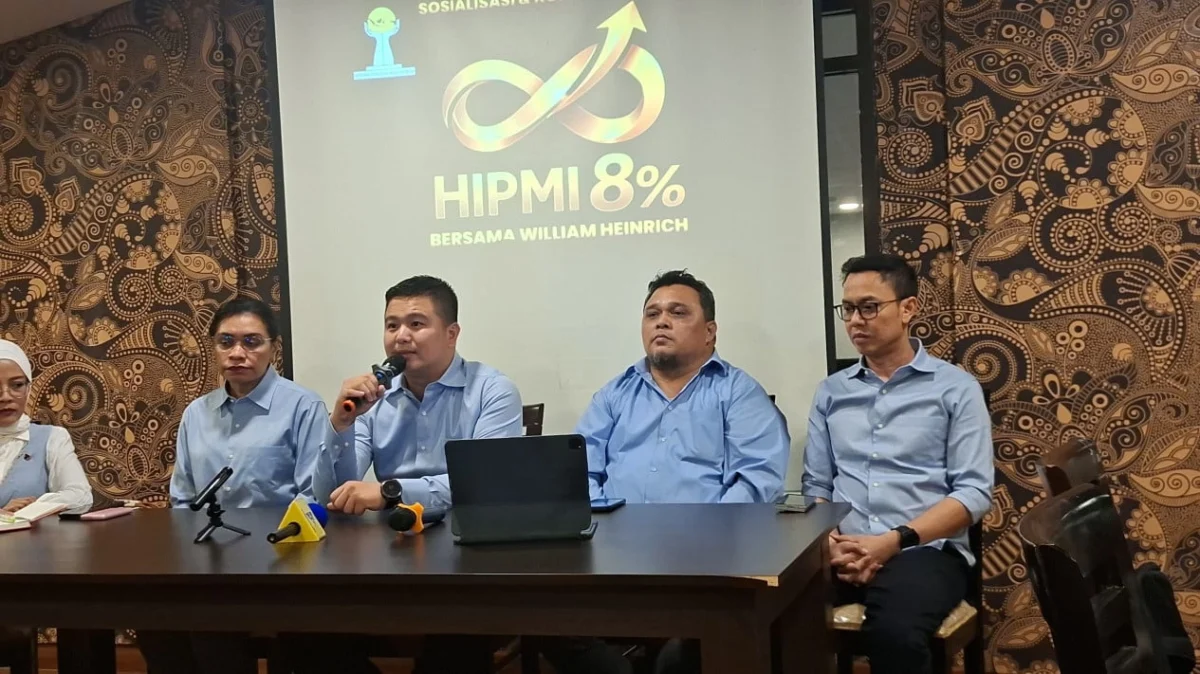
Jakarta, VIVA – On Wednesday, April 15, 2026, at 21:46 WIB, William Heinrich, a prominent candidate for the chairman of the Central Executive Board (BPP) of the Indonesian Young Entrepreneurs Association (HIPMI), unveiled a comprehensive and ambitious strategic concept dubbed ‘HIPMI 8%’. Presented during a press conference held in the heart of Jakarta’s bustling SCBD district, Heinrich’s proposal outlined a concrete framework designed to significantly contribute to accelerating Indonesia’s national economic growth, aligning with and actively supporting the economic policy directions set by President Prabowo Subianto’s administration.
Heinrich emphasized that the target of 8% economic growth is not merely an aspirational figure but a fundamental necessity for Indonesia to successfully navigate and ultimately escape the pervasive ‘middle-income trap’. This economic phenomenon describes a situation where a country’s growth stagnates after reaching middle-income levels, failing to transition into high-income status. For Indonesia, which has enjoyed steady, albeit often moderate, growth averaging around 5% in recent decades, achieving a sustained 8% would represent a transformative leap, positioning the nation among the fastest-growing major economies globally. The current economic trajectory, while stable, requires a significant push to capitalize on its vast potential and avoid the pitfalls that have ensnared many developing nations.
The Urgency of 8% Growth: Escaping the Middle-Income Trap
Indonesia, with its vast natural resources, large domestic market, and burgeoning middle class, is at a critical juncture. The World Bank classifies Indonesia as an upper-middle-income country, a status it achieved in 2020 before temporarily dipping during the pandemic and then regaining it. Historically, many countries have struggled to transition beyond this income bracket, often due to structural impediments such as insufficient human capital development, low productivity, reliance on commodity exports, and inadequate infrastructure. Heinrich’s proposition directly addresses these challenges, asserting that a robust 8% growth rate is the engine required to generate the necessary capital, innovation, and job creation to break free.
The concept hinges on the timely and strategic utilization of Indonesia’s demographic bonus, a period characterized by a significantly larger working-age population relative to dependents. This window of opportunity, projected to peak around 2030-2035, presents an unparalleled chance to boost productivity and economic output. However, Heinrich warned that without proactive and strategic measures involving all stakeholders, particularly young entrepreneurs who are the driving force of the real sector, this demographic dividend could easily turn into a demographic disaster, leading to widespread unemployment and social unrest. Historical data from countries like South Korea and Taiwan demonstrates how effectively leveraging a demographic bonus through targeted industrial policies and entrepreneurship development can lead to rapid economic advancement.
HIPMI’s Role in a Constrained Fiscal Landscape
A central tenet of Heinrich’s vision is the recognition of the government’s fiscal limitations. He argued that the state cannot single-handedly shoulder the immense burden of stimulating such ambitious economic growth. Indonesia’s fiscal space, while managed prudently, remains constrained by factors such as a relatively low tax-to-GDP ratio (around 10-11% in recent years, significantly lower than many regional peers and OECD averages) and competing demands for public spending on infrastructure, social welfare, and defense. In this context, HIPMI, as the preeminent organization for young entrepreneurs, must assume a more proactive and central role as a motor for economic growth.
Heinrich articulated a shift in HIPMI’s operational philosophy. He stressed the need for the organization to transform into a productive force capable of creating substantial added value within the economy, rather than merely acting as a conduit for government projects or focusing predominantly on ceremonial activities. This transformation would involve empowering its members to innovate, scale their businesses, and contribute directly to economic output, thereby alleviating some of the pressure on government resources and fostering a more self-reliant, dynamic private sector. This echoes the sentiment often expressed by economic policymakers who advocate for greater private sector participation in national development.
Enhancing Economic Efficiency: Tackling ICOR and Boosting TFP
A significant challenge identified by Heinrich is the issue of national economic efficiency, particularly Indonesia’s relatively high Incremental Capital Output Ratio (ICOR). ICOR measures the additional capital required to produce an additional unit of output. A high ICOR indicates inefficient use of capital, meaning more investment is needed to achieve a certain level of economic growth compared to countries with lower ICORs. Indonesia’s ICOR has historically hovered around 6-7, which is higher than some of its more efficient regional competitors. This suggests that investments are not consistently yielding optimal returns, potentially due to bureaucratic inefficiencies, infrastructure bottlenecks, or suboptimal resource allocation.
To address this, Heinrich proposed that HIPMI position itself as a key agent in reducing the national ICOR through a concerted focus on increasing Total Factor Productivity (TFP). TFP measures the efficiency with which capital and labor inputs are used, essentially reflecting technological progress, innovation, and improvements in management and organization. HIPMI’s strategy would involve actively promoting business digitalization, encouraging the adoption and application of advanced technologies across various sectors, and implementing strategies to enhance supply chain efficiency. By embracing these measures, Heinrich believes that investments within the HIPMI ecosystem and, by extension, the broader economy, will generate greater and more sustainable output. This emphasis on TFP is crucial for long-term, sustainable growth, as it moves beyond simply adding more inputs (labor and capital) to growing through smarter, more efficient use of existing resources.
Strengthening State Revenue through a Broader Tax Base
In parallel with boosting economic efficiency, Heinrich also offered solutions for strengthening state revenue. He acknowledged the government’s commitment to maintaining public purchasing power, exemplified by the decision to keep the Value Added Tax (PPN/VAT) at 11 percent, rather than raising it further, to avoid unduly burdening consumers and businesses. While this approach supports demand, it also underscores the need for alternative revenue-generating mechanisms.
Heinrich posited that the most sustainable and equitable way to increase state revenue is through the expansion of the tax base, primarily by fostering the creation of formal employment opportunities. He envisioned HIPMI as a pivotal platform for developing young entrepreneurs who are not only capable of achieving sustainable growth and profitability but also of contributing tangibly to the national treasury through income taxes, corporate taxes, and further expanding the VAT base as their businesses thrive. This approach aligns with modern economic principles that prioritize broadening the tax base through economic growth and formalization over simply raising tax rates, which can sometimes stifle economic activity. The informal sector in Indonesia remains significant, and formalizing businesses through entrepreneurial growth can unlock substantial tax revenue potential.
Commitment to Entrepreneurial Development and Tangible Economic Impact
To underscore his commitment, William Heinrich outlined specific, measurable targets. He aims for the birth of 10,000 new productive entrepreneurs under HIPMI’s guidance. These entrepreneurs would be nurtured not just to start businesses, but to build enterprises that are resilient, profitable, and capable of creating sustainable local employment. This focus on "productive" entrepreneurs implies a move beyond mere subsistence businesses to those that contribute to value chains, innovate, and expand.
Furthermore, Heinrich plans a significant reform of HIPMI’s organizational performance indicators. He proposes shifting the focus from purely ceremonial events and membership numbers to quantifiable economic impact. This would include metrics such as the number of jobs created by HIPMI members, the total investment facilitated, and the aggregate economic output generated. If this strategic approach is implemented optimally, Heinrich projects that the collective contributions of HIPMI members could generate an additional economic output of up to Rp20 trillion in the domestic market. This ambitious figure, if realized, would represent a substantial injection into the national economy, demonstrating the real-world impact of a revitalized and strategically focused young entrepreneurial movement.
Financing the Future: Leveraging New Economic Architecture
The latter part of Heinrich’s vision, as indicated by the subsequent page of the original article, delves into the crucial aspect of financing. He believes that the evolving national economic architecture in Indonesia presents significant opportunities for young entrepreneurs, particularly concerning access to funding. The emergence of new investment institutions, such as Danantara, is highlighted as a critical development that can strengthen the funding landscape for aspiring and growing businesses.
Danantara, likely a state-backed or state-affiliated investment vehicle, would play a vital role in bridging the financing gap often faced by SMEs and startups in Indonesia. Traditional banking institutions sometimes shy away from funding nascent businesses due to perceived high risks or lack of collateral. Institutions like Danantara, potentially offering venture capital, private equity, or specialized loans, can provide the necessary capital injection for innovative young entrepreneurs to scale their operations, invest in technology, and expand their market reach. This enhanced access to financing is indispensable for realizing the ambitious targets of 10,000 new productive entrepreneurs and the projected Rp20 trillion in economic output.
Broader Implications and Expert Considerations
Heinrich’s "HIPMI 8%" concept, while ambitious, reflects a growing understanding among Indonesia’s business community of the urgent need for structural economic reforms and increased private sector engagement. Achieving a sustained 8% growth rate would require not only entrepreneurial dynamism but also consistent and supportive government policies across various sectors.
Economists observing Indonesia’s trajectory generally agree on the importance of addressing the middle-income trap. However, the path to 8% growth is fraught with challenges. Sustained high growth would necessitate significant improvements in infrastructure, a highly skilled workforce, a stable regulatory environment, and continued political stability. Furthermore, global economic headwinds, such as fluctuating commodity prices, geopolitical tensions, and potential trade wars, could impact Indonesia’s ability to maintain such high growth.
From a policy perspective, Heinrich’s emphasis on reducing ICOR and increasing TFP is particularly pertinent. Government efforts in deregulation, ease of doing business reforms, and investment in digital infrastructure would complement HIPMI’s initiatives. The focus on formal job creation and tax base expansion also resonates with the Ministry of Finance’s long-term goals to improve fiscal sustainability without resorting to punitive tax rate hikes.
The proposed transformation of HIPMI’s performance indicators from ceremonial to economically tangible is a crucial step towards making the organization a more effective and accountable partner in national development. It signals a maturation of the entrepreneurial ecosystem, moving beyond networking events to actual wealth and job creation.
In conclusion, William Heinrich’s ‘HIPMI 8%’ concept represents a bold and well-articulated vision for Indonesia’s economic future. By strategically leveraging the demographic bonus, enhancing economic efficiency, expanding the tax base through entrepreneurship, and securing robust financing mechanisms, the proposal offers a concrete pathway for HIPMI to play a transformative role in propelling Indonesia beyond the middle-income trap and achieving sustained, high economic growth under President Prabowo Subianto’s administration. The success of this initiative would not only solidify Heinrich’s leadership but also significantly contribute to shaping a more prosperous and resilient Indonesian economy for decades to come.