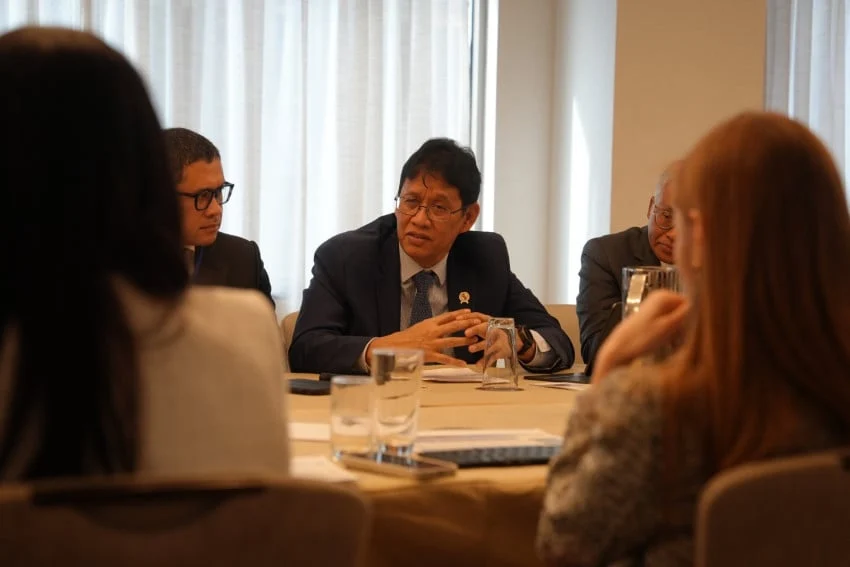
In a series of high-level diplomatic and investor outreach meetings culminating on Wednesday, April 15, 2026, in Washington D.C., Indonesian Finance Minister Purbaya Yudhi Sadewa successfully garnered overwhelmingly positive responses from leading international financial institutions, including the International Monetary Fund (IMF) and the World Bank, as well as a significant cohort of global investors. The engagements underscored a growing confidence in Indonesia’s economic resilience and its prudently managed fiscal strategy amidst a complex and uncertain global economic landscape. Minister Sadewa’s comprehensive presentations detailed Indonesia’s approach to balancing robust economic growth with stringent budgetary discipline, a strategy that resonated strongly with international partners keen on identifying stable and promising investment destinations.
Minister Sadewa’s delegation embarked on an intensive schedule designed to convey the depth and credibility of Indonesia’s economic policies to a global audience. These strategic interactions encompassed a wide array of stakeholders, from pivotal multilateral organizations to influential private sector financial entities. The Minister held bilateral meetings and courtesy calls with key figures, including the Managing Director of the IMF, senior officials from the World Bank, and representatives from prominent international credit rating agencies such as S&P Global Ratings. A critical component of the agenda involved direct engagement with eighteen major institutional investors, featuring financial titans like Goldman Sachs and Fidelity Investments, all eager to gain a deeper understanding of Indonesia’s economic trajectory.
The core objective of these meetings was to articulate Indonesia’s long-term economic vision, its growth policies, and the sophisticated mechanisms employed for budget management. "We met with 18 large investors, including Goldman Sachs and Fidelity Investments. They wanted to understand the direction of Indonesia’s growth policies and budget management, and to assess whether these strategies are credible and sustainable," Minister Sadewa stated in a written press release on the aforementioned date. This direct dialogue aimed to dispel any lingering uncertainties and to firmly establish Indonesia’s position as a fiscally responsible and economically dynamic nation.
Chronology of Strategic Engagements in Washington D.C.
The multi-day itinerary of Minister Sadewa in the United States capital was meticulously planned to cover all critical facets of international financial diplomacy and investor relations. The engagements commenced with preparatory briefings and internal strategy sessions, setting the stage for the high-stakes discussions.
Early in the schedule, the Indonesian delegation engaged in pivotal bilateral meetings with the leadership of the International Monetary Fund. These discussions typically revolve around global economic outlooks, country-specific economic assessments, and policy recommendations. For Indonesia, the focus was on demonstrating adherence to sound macroeconomic principles and outlining plans for structural reforms that align with IMF’s objectives of global financial stability and sustainable growth. The positive feedback from the IMF underscored their recognition of Indonesia’s commitment to fiscal prudence and its effective navigation of global economic headwinds.
Following the IMF engagements, Minister Sadewa transitioned to meetings with World Bank officials. These sessions often delve into development financing, infrastructure projects, poverty reduction strategies, and human capital development. The World Bank’s endorsement of Indonesia’s fiscal strategy is particularly significant, as it reflects confidence in the government’s capacity to allocate resources effectively for long-term development without compromising fiscal sustainability. The discussions likely highlighted Indonesia’s ambitious infrastructure agenda, its commitment to green financing, and efforts to enhance social safety nets.
A crucial component of the visit involved interactions with international credit rating agencies, prominently S&P Global Ratings, as mentioned by the Minister. These meetings are vital for reaffirming Indonesia’s sovereign credit rating, which directly impacts the cost of borrowing for the government and state-owned enterprises in international capital markets. Presenting a clear and credible fiscal roadmap, including debt management strategies and revenue generation plans, is paramount to maintaining or improving credit ratings. The positive reception from these agencies suggests a robust understanding and acceptance of Indonesia’s fiscal narrative.
The latter part of the mission was dedicated to investor outreach, involving direct consultations with a substantial group of institutional investors. These engagements are not merely ceremonial but are critical for attracting foreign capital necessary for economic growth and development. The presence of major players like Goldman Sachs and Fidelity Investments signifies a high level of interest in Indonesia’s market opportunities. These meetings provided a platform for Minister Sadewa to directly address investor concerns, clarify policy directions, and present the compelling investment case for Indonesia, spanning both fixed income and equity markets. The discussions covered macroeconomic stability, regulatory environment, sector-specific opportunities, and the long-term growth prospects of the Indonesian economy.
Indonesia’s Fiscal Strategy: Balancing Growth and Discipline
At the heart of the positive international reception lies Indonesia’s meticulously crafted fiscal strategy, designed to foster robust economic growth while strictly adhering to budgetary discipline. The government has consistently emphasized a prudent approach to public finance, particularly in the aftermath of global economic shocks. This strategy revolves around several key pillars:
- Revenue Mobilization and Diversification: Efforts to broaden the tax base, improve tax compliance through digitalization, and explore new non-tax revenue streams have been central. This includes ongoing tax reforms aimed at creating a more equitable and efficient tax system. For instance, the implementation of the Harmonized Tax Law (UU HPP) has been instrumental in optimizing state revenue.
- Prudent Expenditure Management: The government is committed to prioritizing productive spending, particularly on infrastructure development, human capital formation (education and health), and targeted social safety nets, while curbing inefficient expenditures. This involves a continuous review of spending programs to ensure maximum impact and value for money. Indonesia’s annual budget (APBN) typically allocates a significant portion to these strategic areas.
- Sustainable Debt Management: Despite global pressures, Indonesia has maintained a conservative debt-to-GDP ratio, well below the statutory limit of 60%. The strategy focuses on diversifying funding sources, lengthening debt maturities, and managing foreign exchange exposure to minimize fiscal risks. As of recent periods, Indonesia’s government debt-to-GDP ratio has hovered around 38-40%, a figure deemed manageable and sustainable by international standards.
- Structural Reforms: Beyond immediate fiscal measures, the government has embarked on comprehensive structural reforms aimed at improving the investment climate, enhancing competitiveness, and fostering long-term growth. The Omnibus Law on Job Creation, for example, sought to streamline regulations, simplify business licensing, and attract greater foreign direct investment (FDI).
- Digital Transformation: Leveraging digital technologies across government services, including tax administration, public procurement, and social assistance distribution, enhances efficiency, transparency, and accountability, further strengthening fiscal credibility.
Minister Sadewa’s presentations explicitly outlined how these policies collectively contribute to maintaining economic growth without unduly burdening the State Budget (APBN). This explanation was crucial in alleviating concerns previously raised by some international parties regarding Indonesia’s ability to achieve faster economic growth while upholding fiscal discipline. The Minister highlighted robust economic fundamentals, including strong domestic consumption, a burgeoning middle class, and a relatively diversified economic base, as key drivers of resilience.
Global Economic Backdrop and Indonesia’s Resilience
The positive international assessment of Indonesia’s fiscal strategy is particularly noteworthy given the prevailing global economic climate. The period leading up to and including 2026 has been characterized by a confluence of challenging factors: persistent inflationary pressures in major economies, leading to tighter monetary policies and higher global interest rates; geopolitical tensions in various regions, impacting supply chains and commodity markets; and lingering uncertainties from post-pandemic recovery efforts. These factors have amplified risks for many emerging markets, making fiscal stability a premium commodity.
In this context, the IMF and World Bank, whose mandates include fostering global financial stability and sustainable development, closely scrutinize countries’ macroeconomic policies. Their positive response to Indonesia’s strategy reflects a recognition of the nation’s efforts to safeguard its economy against these external shocks. Indonesia’s economic performance has demonstrated a remarkable degree of resilience, with GDP growth consistently above 5% in recent periods, driven largely by robust domestic demand and strategic investments. For instance, Indonesia’s GDP growth in 2025 was projected to remain strong, solidifying its position among the fastest-growing G20 economies. Inflation, while monitored closely, has largely remained within the central bank’s target range, indicating effective monetary and fiscal policy coordination.
The nation’s current account balance has also generally remained stable or in surplus, supported by strong commodity exports and increasing foreign direct investment. FDI inflows have shown a consistent upward trend, reflecting investor confidence in Indonesia’s long-term growth prospects and stable policy environment. This resilience contrasts sharply with the vulnerabilities experienced by some other emerging economies facing higher debt burdens and volatile capital flows.
Investor Confidence and Market Appetite
The enthusiastic interest from global investors, particularly from the United States, in Indonesia’s financial sector instruments — both fixed income (bonds) and equity (stocks) — underscores the effectiveness of Minister Sadewa’s outreach. For institutional investors like Goldman Sachs and Fidelity Investments, the primary concerns revolve around risk-adjusted returns, policy predictability, and the long-term sustainability of an economy.
The detailed presentations by Minister Sadewa evidently addressed these concerns effectively. Investors were reassured by the government’s credible and sustainable approach to fiscal management, which minimizes sovereign risk. The attractiveness of Indonesian bonds stems from relatively higher yields compared to developed markets, coupled with improving macroeconomic stability and a strengthening currency. The equity market, meanwhile, offers exposure to Indonesia’s large domestic market, growing consumer base, and dynamic corporate sector, particularly in areas like digital economy, resource processing, and infrastructure.
The high level of interest indicates that these investors perceive Indonesia as offering a compelling combination of growth potential and relative stability. This translates into increased demand for Indonesian government bonds (SBNs), potentially lowering borrowing costs for the government, and greater foreign portfolio investment in the Jakarta Composite Index (JCI). Such inflows are crucial for providing liquidity to the capital markets, funding corporate expansion, and ultimately supporting job creation and economic development.
Addressing Prior Skepticism and Reinforcing Credibility
Minister Sadewa acknowledged that some international parties had previously harbored reservations regarding Indonesia’s capacity to simultaneously accelerate economic growth and maintain stringent fiscal discipline. This skepticism often arises from historical precedents in other emerging economies where ambitious growth targets led to fiscal imbalances or unsustainable debt accumulation.
However, the comprehensive explanations provided by the Indonesian government team, backed by solid economic data and a clear policy roadmap, successfully assuaged these concerns. The Minister’s detailed exposition on how Indonesia plans to fund its growth initiatives – through enhanced domestic revenue mobilization, strategic public-private partnerships, and efficient allocation of resources – without resorting to excessive borrowing or printing money, proved convincing. The commitment to a responsible fiscal deficit target, consistently below 3% of GDP since the end of the pandemic emergency measures, served as a tangible demonstration of this discipline.
Furthermore, the emphasis on productivity-enhancing reforms, such as improving the ease of doing business, investing in digital infrastructure, and developing human capital, demonstrated a forward-looking approach that aligns growth with long-term sustainability. These reforms are critical in boosting the economy’s inherent capacity to grow without relying solely on fiscal stimulus. The reduction in international skepticism is a testament to the transparency and coherence of Indonesia’s economic policymaking.
Broader Implications for Indonesia’s Economic Future
The successful engagements in Washington D.C. carry significant broader implications for Indonesia’s economic future and its standing in the global financial community.
Firstly, the robust international endorsement enhances Indonesia’s reputation as a reliable and attractive investment destination. This improved perception is likely to translate into increased foreign direct investment (FDI) inflows across various sectors, from manufacturing and infrastructure to technology and renewable energy. FDI is crucial for technology transfer, job creation, and fostering industrial growth, aligning with Indonesia’s aspiration to move up the global value chain.
Secondly, sustained confidence from credit rating agencies and institutional investors can lead to more favorable borrowing terms for the Indonesian government and corporations. Lower interest rates on international loans and bond issuances reduce the cost of capital, freeing up resources for public services and private sector expansion, thus stimulating further economic activity.
Thirdly, the positive feedback reinforces the validity of the government’s current economic policy direction. This provides a strong mandate for continued fiscal prudence and structural reforms, ensuring consistency and predictability in policymaking – qualities highly valued by international investors. It also strengthens Indonesia’s voice and influence in multilateral forums such as the G20, where it can advocate for policies that support stable global economic growth.
Finally, at a time of heightened global uncertainty, Indonesia’s demonstrated resilience and fiscal responsibility position it as a beacon of stability in Southeast Asia and among emerging markets. This can attract businesses looking to diversify their operations away from more volatile regions, further integrating Indonesia into global supply chains and boosting its export competitiveness.
However, challenges remain. Indonesia must continue to navigate potential global economic slowdowns, manage commodity price volatility, and address long-term structural issues such as climate change financing and income inequality. The successful Washington D.C. mission provides a strong foundation, but sustained effort and adaptive policies will be essential to capitalize on this renewed international confidence and ensure Indonesia’s continued trajectory towards sustainable and inclusive prosperity. The positive engagements serve as a powerful affirmation of Indonesia’s commitment to sound economic management and its promising future on the global stage.