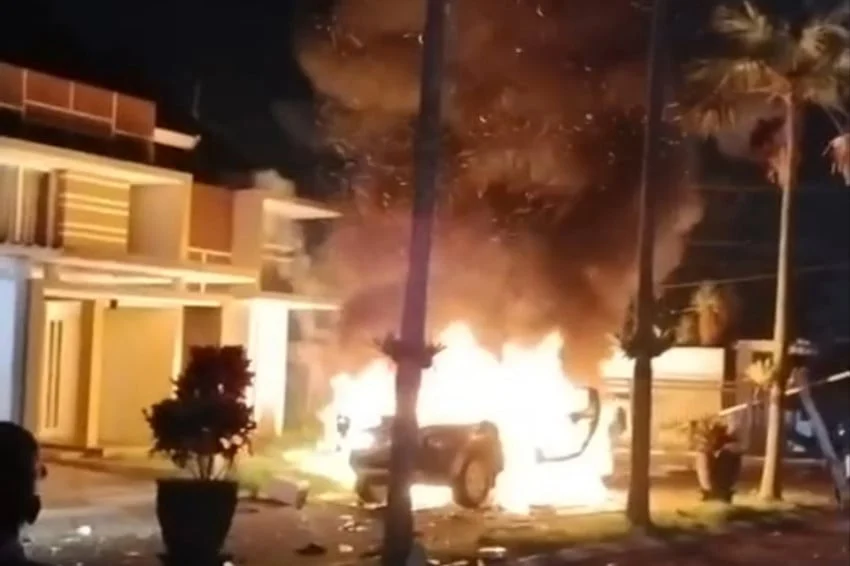
The quiet residential enclave of Emerald Garden, located in the Saptorenggo Village of the Pakis District in Malang Regency, transformed into a theater of civil unrest late Friday night, November 27, 2026. What began as a localized expression of public outrage over a tragic case of student bullying escalated into a violent confrontation between hundreds of protesters and law enforcement officers. The incident resulted in significant property damage, including the burning of police patrol vehicles, and left several officers injured, including a high-ranking official.
The Catalyst: A Case of Fatal Bullying
The unrest is fundamentally linked to a preceding incident that has gripped the Malang community: the death of a high school student following a brutal bullying episode. Reports indicate that the bullying was motivated by romantic jealousy, a motive that has sparked widespread indignation across the region. As news of the victim’s death circulated, public sentiment shifted from grief to anger, specifically targeting the perpetrators identified in the investigation.
Among the individuals implicated in the case is a minor identified by the initials CAN. Investigations revealed that CAN’s parents reside in the Emerald Garden housing complex in Saptorenggo. The realization that a suspect’s family, particularly one with ties to law enforcement, was residing in the community served as a flashpoint for the protest that culminated in the destruction witnessed on Friday night.
Chronology of the Incident
The tension began to manifest around 9:00 PM local time on Friday. Recognizing the potential for civil disobedience, the Malang Police Department (Polres Malang) had proactively deployed personnel to the Emerald Garden residential area. The intent was to maintain order and ensure the safety of the residence, which was perceived as a target for vigilante justice.
However, the situation quickly became untenable as the crowd swelled. By late evening, hundreds of individuals—many of whom were not residents of the immediate area—converged on the location. Protesters arrived equipped with signage, banners, and, in some instances, wooden clubs, indicating a degree of premeditation or an intent to escalate the confrontation.
As the night deepened toward midnight, the demeanor of the crowd grew increasingly hostile. Law enforcement efforts to disperse the gathering proved ineffective, as the sheer volume of protesters overwhelmed the initial police perimeter. The situation deteriorated into open conflict, characterized by the sounds of pyrotechnics and the rhythmic thud of stones being hurled at police lines. Despite the presence of reinforcements from the Brimob (Mobile Brigade) unit of the East Java Regional Police, the authorities found themselves outnumbered and struggling to regain control.
The climax of the violence occurred when a segment of the crowd breached the residential perimeter. In the ensuing chaos, two patrol vehicles belonging to the Pakis Police Sector were set ablaze. The destruction of these state assets underscored the severity of the public’s anger and the breakdown of public order.
Injuries and Law Enforcement Response
The physical toll of the riot was significant. Several police officers sustained injuries during the clashes, primarily due to projectile attacks. Among the most serious casualties was the Chief of the Pakis Police, AKP Bambang Subinanjar. Reports confirm that the officer was struck by a paving stone, resulting in severe injuries that necessitated immediate medical attention.
The police response was characterized by a delicate balance between attempting to restore order and avoiding a further escalation that could lead to more casualties. The use of force by protesters against officers highlights a dangerous trend in how local grievances are currently being addressed in the region. By the early hours of Saturday morning, authorities were finally able to secure the area, though the damage had already been done.
Broader Context and Sociological Implications
The violence in Saptorenggo is not an isolated event but rather a reflection of the rising tension surrounding juvenile delinquency and systemic bullying in Indonesia. Recent data from the Indonesian Child Protection Commission (KPAI) suggests a concerning uptick in reports of violence within school settings, often exacerbated by the speed at which information—and misinformation—spreads on social media platforms.
The involvement of a police officer’s child in the initial bullying case adds a layer of complexity to the public’s reaction. There is an inherent perception among the public that children of law enforcement or high-profile figures may receive preferential treatment during legal proceedings. When a community feels that justice is being delayed or skewed by nepotism, the impulse toward vigilante action often overrides institutional trust.
Sociologists note that when public trust in the judicial system erodes, the propensity for mob violence increases. The incident in Malang serves as a stark reminder of the "justice gap"—the distance between what the public expects from the legal system and what they perceive is actually being delivered.
Official Statements and Future Outlook
As of Saturday, local authorities have initiated an investigation into the riot itself. Police spokespeople have emphasized that the legal process regarding the bullying case is proceeding independently of the protests. The Malang Police have urged the public to remain calm and allow the judicial process to run its course, warning that those who engaged in the burning of property and the assault on officers will be held criminally liable.
"We understand the grief and anger of the community," a regional official stated during a preliminary press briefing. "However, resorting to violence, attacking officers, and destroying public property is a criminal act that we cannot tolerate. We will conduct a thorough investigation to identify the provocateurs and the individuals responsible for the destruction."
The incident has also prompted a call for a review of how law enforcement handles sensitive cases involving minors, particularly when those cases draw significant public attention. There is a pressing need for clearer communication from the authorities to the public to prevent the vacuum of information that often leads to rumors and subsequent unrest.
Analyzing the Impact of Mob Violence
The burning of police vehicles is an extreme indicator of social instability. In a democratic society, the police are the primary instrument for maintaining order. When citizens target police infrastructure, it signifies a total breakdown of the social contract in that specific area. The economic impact, while secondary to the human cost, includes the cost of replacing specialized patrol vehicles and the temporary diversion of resources away from crime prevention to riot control.
Furthermore, the involvement of individuals from outside the immediate area suggests that the event was fueled by a broader, possibly organized, sentiment that transcended local village concerns. This suggests that the authorities must now look beyond the local neighborhood to understand how the narrative of the bullying case was disseminated and potentially weaponized to incite a riot.
Conclusion: A Path Forward
The events in Saptorenggo represent a failure of both conflict resolution and community policing. Moving forward, the focus must be twofold: ensuring that the original bullying case is handled with transparency and integrity to satisfy the public’s demand for justice, and holding the rioters accountable for the violence that transpired on Friday.
As the community of Malang recovers from the shock of the incident, the challenge for the regional government and the police force will be to rebuild the trust that was shattered in the early hours of Saturday. Without a concerted effort to address the root causes of both the initial bullying and the subsequent mob violence, the risk of recurring civil unrest remains a tangible threat to the stability of the region. The tragedy of a student’s death has been compounded by a night of lawlessness, leaving a community searching for answers, accountability, and, ultimately, peace.